In the early 1990s, a traveling sound system and music collective known as Spiral Tribe coalesced a new kind of subculture in the U.K. As opposed to the urban acid house scenes or the nascent rumblings of a hugely profitable global electronic music industry, the Spiral Tribe were squatters, nomads, and anti-authoritarian ravers in crust punk regalia that roved the countryside in retrofitted military trucks, throwing free parties for thousands. Their ethos was radical: a wholesale rejection of British social life and the capitalist systems that structured it.
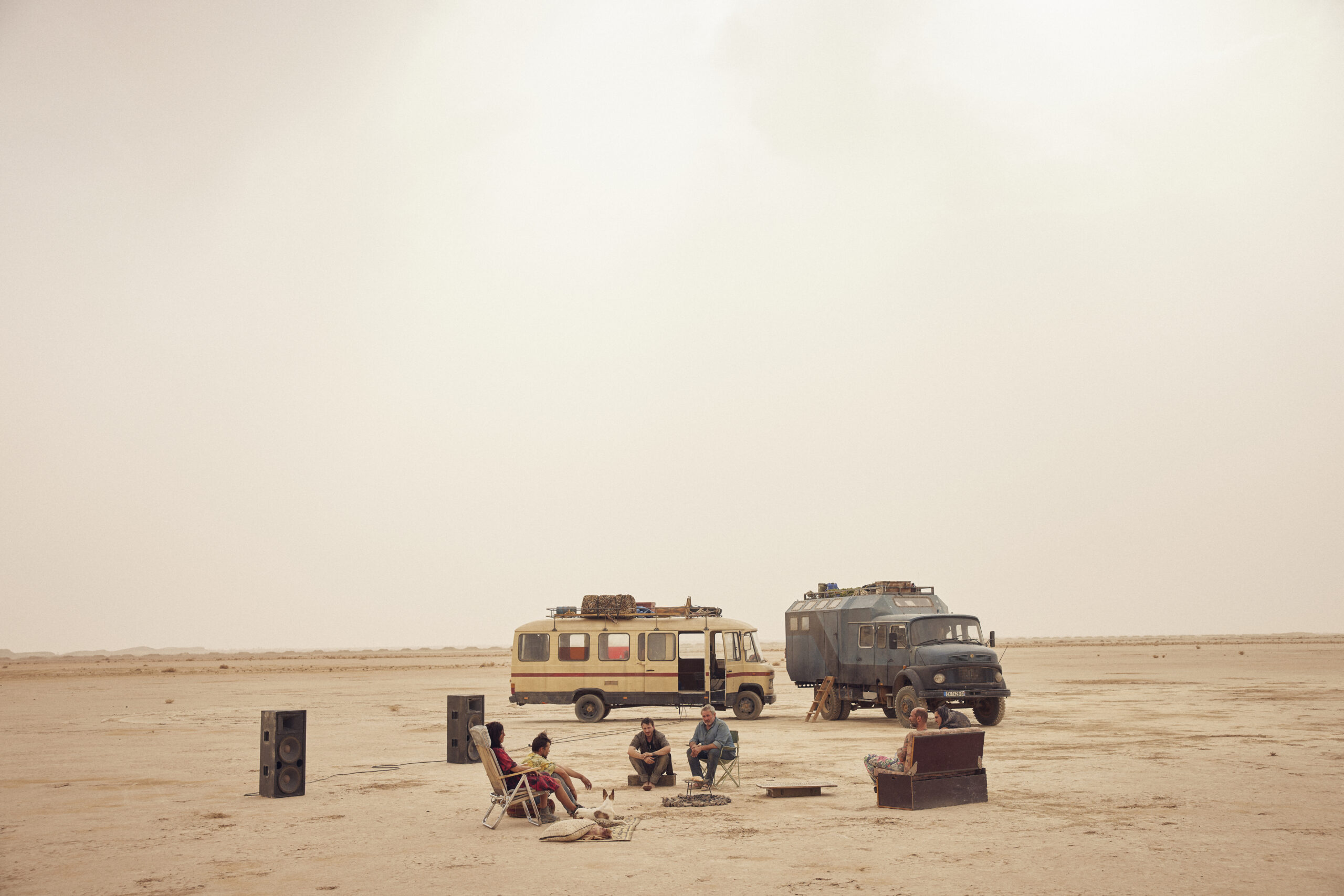
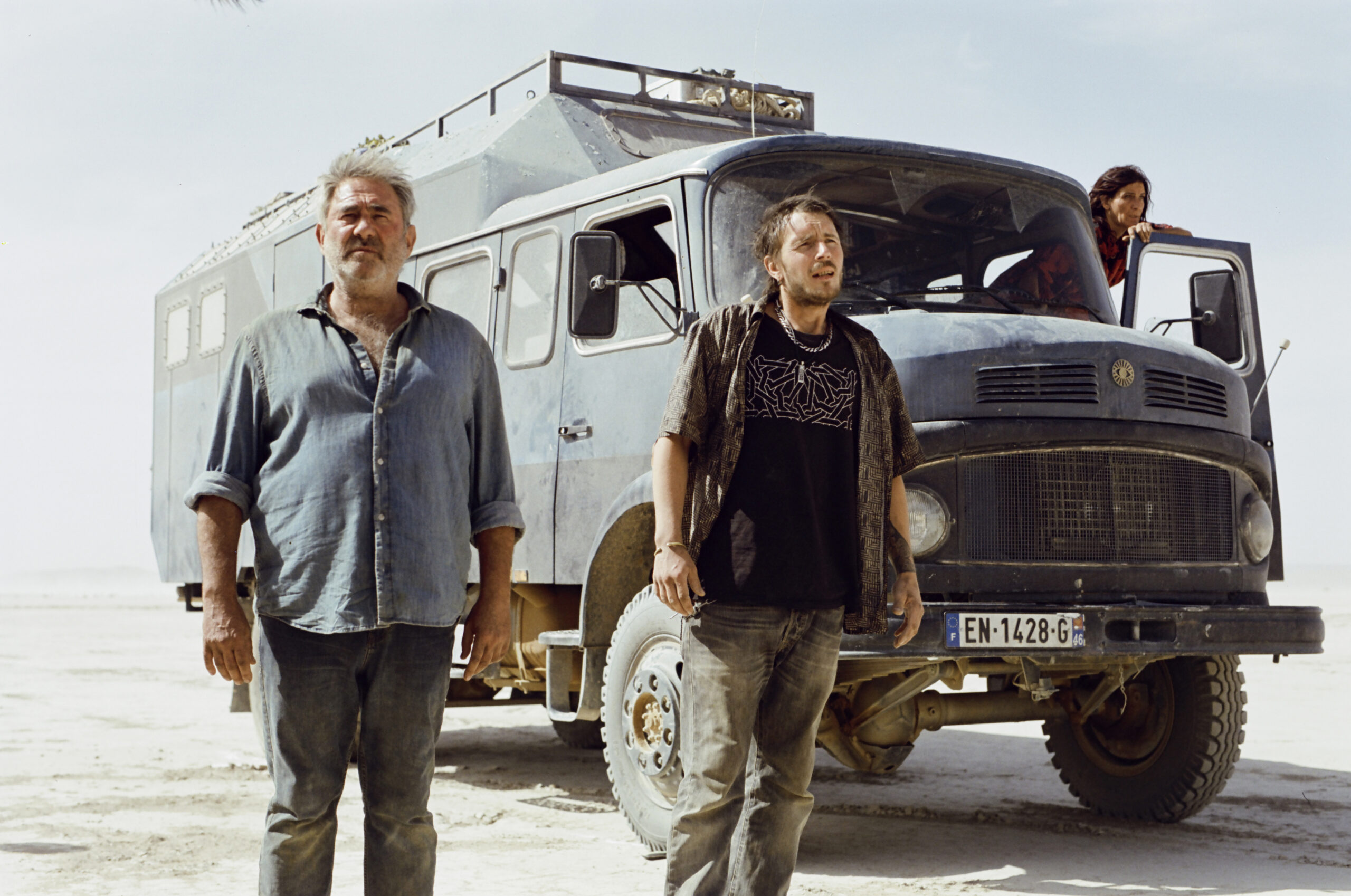
Three decades later, the Spiral Tribe’s descendants stacked enormous speakers in the northern Moroccan desert, preparing for another free party in the opening scene of Sirât, Oliver Laxe’s Cannes Jury Prize-winning and Academy Award-nominated film. The camera pans pensively over the vibrating cabinets, echoed by the striated sediment in the surrounding mountains. A crew of weathered European ravers trickle in, dreadlocked, draped in pashminas. Among them, a buttoned-down father searches for his missing daughter, his young son in tow. She’s not there, but a ragtag group of partiers suggest she might be at another event, deeper in the desert.
Over the next 90 minutes, Laxe pushes his characters to extremes—physical, emotional—in an increasingly combustive journey. As the motley crew of travelers plunge deeper into their wounded psyches, they also drive deeper into the desert—and Western Sahara, one of the most hotly contested regions on the planet.
Often described as “Africa’s last colony,” the region has been under Moroccan control since the mid-’70s, an occupation that has quite literally fractured the landscape. This atmosphere of conflict and political violence suffuses every frame of Sirât, whether or not the characters are equipped to deal with its presence. The question of a colonial gaze in the film also arises: is it an indictment of the ignorance that impels the characters to seek transcendence in an embattled landscape they know little about? Or is the film mired in deeper, more troubling narratives about encountering violence and the unknown on the African continent?
Laxe, a Paris-born, Spanish filmmaker, lived in Morocco for much of his 20s. Several of his films are set there, including You Are All Captains and Mimosas, which both make use of non-professional local actors. Although he currently resides in Galicia, the cultural and religious textures of the country still inform the foundations of his work. But with Sirât, Laxe is more interested in the psychological or the spiritual (the film’s title comes from the Arabic word for “path,” in the Qu’ran, a narrow bridge stretched between heaven and hell.) As the feature heads to theaters across the United States, we spoke with the director about his influences—from Sufism to Sorcerer—and what he’d really say to his critics.
Do you like explaining your art, or do you prefer to let the work speak for itself?
I’m narcissistic, so I like to speak about myself. But I try not to explain too much. I can talk about my intentions, but I do prefer ambiguity. I have to trust the audience.
Sirât is quite ambiguous when it comes to the characters’ backstories or some of the images that you present.
It’s about maintaining a balance between saying something explicitly and evoking something implicitly. If you say too much, you can’t evoke anything. But if you evoke too much, you can be too abstract. It’s always a cocktail.
I would love to hear about your own history or relationship to raving and techno. It’s an incredibly varied community globally, but I think that very few films or pieces of art have been able to capture the specificity of the subculture that you’re dealing with.
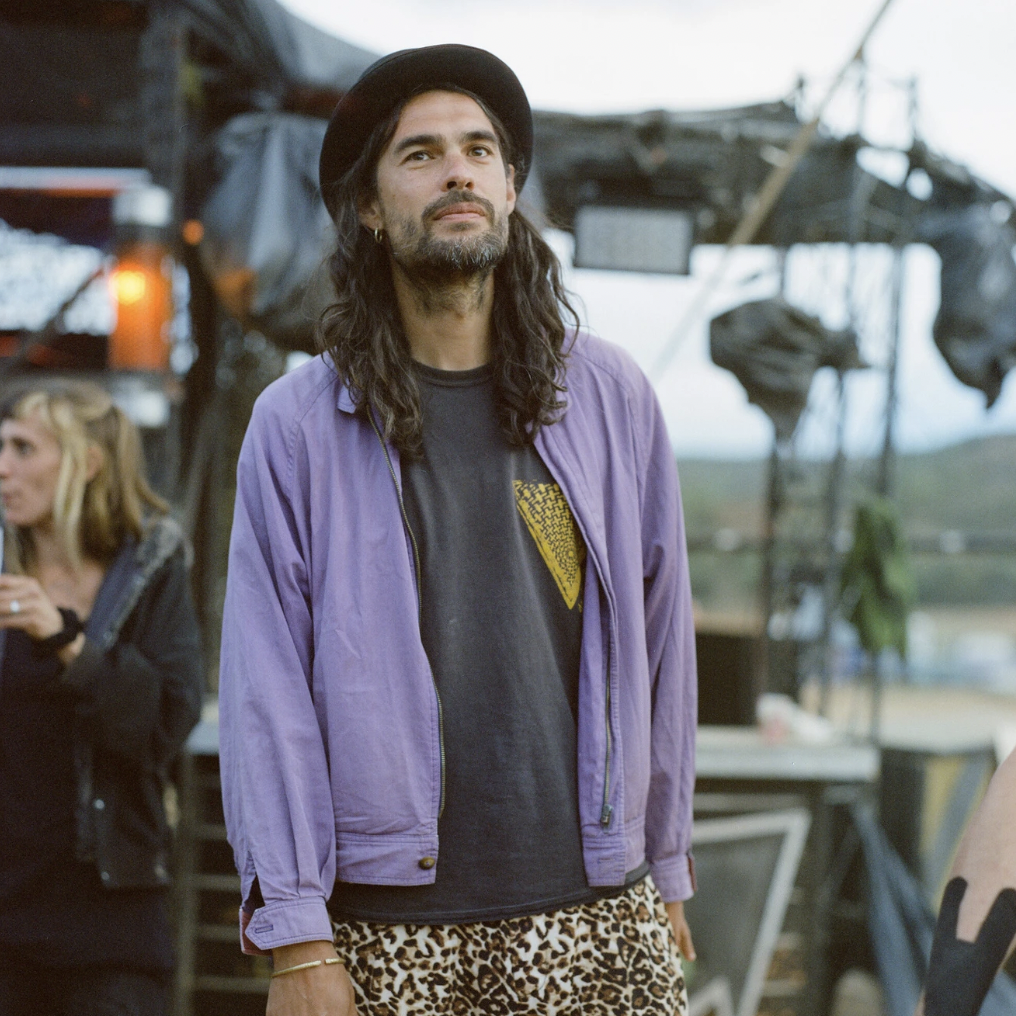
I created the party, the rave in the film with some of the sons of Spiral Tribe. They were mixing during the rave we were shooting. I knew them because I went to a lot of raves. We were looking for the essence of this subculture.
I’m not really into clubbing. I go to Berghain, but I identify most strongly with the free party scene. It provides a less neurotic dance floor. There is a lot of ego on the other dance floors. At a free party, I like that there often isn’t a DJ—rather you are in front of the sound system. This is therapeutic for me because you are more connected with your wound. I’m actually studying psychotherapy right now, and I’m discovering that dancing is good for you because it helps release the trauma that is etched into your body.
Do you think of your film as therapeutic in that way? What do you want it to do to the viewer’s body?
It’s shock therapy. The aim is to make the spectator [symbolically] die after watching the film. You die when you watch Sirât, and it’s a good, healthy thing. Because you have to die before actually dying. I was also really inspired by the idea of psychotherapy and Sufism. So yes, I think the film is certified as a good medicine. Sometimes the medicine is bitter.
You deal with your shadows. Looking inside is painful, oftentimes it isn’t easy. So, ceremony music helps you to cross these shadows. That’s the heart of how ceremony music operates. It gives us strength in the moments where we need help to cross our shadows.
You lived in Morocco for many years, and several of your films have been set there. How has your experience living in the country informed the film?
When I made my first two films [You All Are Captains and Mimosas], I didn’t feel like Morocco was my country. So, it felt like I was trying to be creatively legitimized in a place that wasn’t mine. However, making Sirât was different. In fact, the film was released in Morocco and Turkey—places where I didn’t have to explain the film too much because they already understand it. Techno and the Qur’an. The film deals with these two subjects that I like, that are inside myself.
Do you think of the film as more personal or more external, more political?
Art is always about looking inside. My cinema also belongs to a kind of spiritual practice or a self-discovery. So I’m connecting with my wound when I make my films with my fragility.
When I was raving, I was crying a lot on the dance floor. Sometimes, you are connected with your tribal strength. Sometimes, you are connecting to your vulnerability, your transpersonal or transgenerational wound. But obviously there are political dimensions in the film too.
Let’s talk about the political landscape of this film. The European characters are, unknowingly, driving deeper into one of the most contested regions on the planet—Western Sahara—between Morocco and Mauritania, which leads to them walking into a literal minefield. That very real political conflict is contrasted with another, more vague, fictional crisis happening elsewhere that reaches the characters only through radio transmissions. Can you speak a little bit about those choices?
Political issues, for me, are never the driving force of why I make films. Though, in my last film [Fire Will Come], there was a political dimension: We had real fires. My team and I were like firefighters shooting in the middle of flames. In Spain, fires are political because they are often caused, purposefully, for business gains. Not always, but I do believe there is a business.
The way we filmed Sirât was not inherently political, but, I actually think that there’s nothing more political than a poetic approach—to elevate the spectator’s level of consciousness. [Explicitly] political films are important, but most of the time, they are not actually deep enough. They don’t transform you. They’re not creating catharsis inside of you. So the key with Sirât was to evoke real feelings. Because I think that cinema and art can deeply heal the collective imaginary.
You know, this all relates to Gaza too. A lot of people told me that by the end of Sirât. So, I think the film is connected to our time, to our fears, to our dreams.
In recent years, in light of what’s happening in Gaza, there’s been a lot of discussion about the politics of raving. In general, big questions have emerged about the global electronic music industry. Is raving inherently a political communal act, or is it a drive towards oblivion?
During Covid, I was doing interviews where they asked me, “How do you feel?” And I said, “I was never so happy till now.” I didn’t feel solitary, but the opposite [because I was dancing]. I think that our responsibility to avoid fear is to celebrate. Nowadays, everyone seems to have a lot of fear consuming them.
So we must dance, celebrate, and pray with our bodies. These are things that we’ve been doing for thousands of years—they really are spiritual practices. After all, the dance floor is a ritual space. It is a place where you connect—as I told you—with your wounds, with your fragility. You know, raving can be likened to art and spirituality. It’s all about pushing your limits.
Besides, you protect yourself from society by going to the dance floor. It depends on the kind of dance, but I think this is true in the film. I’m also someone who, ever since I was a child, understood that the world is not sustainable. So I’m also preparing myself for this era of change [by dancing more].
I’m curious about the central quest of the film. The father in search of his missing daughter. He obviously doesn’t get very far.
You think not?
At least not literally.
I don’t want to interpret the film for you, but I will tell you what a lot of spectators think: Thanks to what happened in the film, he feels her. He dances with her and he finds her in a subtle and spiritual way.
What does it mean then to find family?
We have so many things to learn from our biological family. We are tested by them. But I understand that, for some people, this test can get too difficult, so they need to build another family to survive. As I did, in a way.
As I get older, I like this concept [of building found family] more and more. It fuels a sense of hope. It’s been increasingly hard to live in this world, but a new family pushes us to take better care of others. This is one of the things I respect about the rave culture and techno travelers.
When I talk about raves and travelers, I’m not only referring to partying—the weekend is coming so I will dress as a punk and go dance. No, I’m talking about this new sense of community that is created. Raves open up an alternate way of life, and I think we were able to evoke that feeling in Sirât.
I’m curious if you’ve had any negative responses to the film in terms of it being too violent, too nihilistic, too cruel to its characters. How might you respond to that?
Yes, there are a lot of those responses. This film pushes you to die. So I totally understand that for some people this is too painful. But when I listen to them, even the more critical people, I know we did a good job. We know how images can heal, so we don’t care what the spectator says about the therapy. We know it works.
Also, given the success of Sirât, I am inclined to believe that many people feel lighter after watching it. They feel that there is a reason for and a way out of their pain.
More of our favorite stories from CULTURED
Julie Delpy Knows She Might Be More Famous If She Were Willing to Compromise. She’s Not.
Our Critics Have Your February Guide to Art on the Upper East Side
Move Over, Hysterical Realism: Debut Novelist Madeline Cash Is Inventing a New Microgenre
Sign up for our newsletter here to get these stories direct to your inbox.







 in your life?