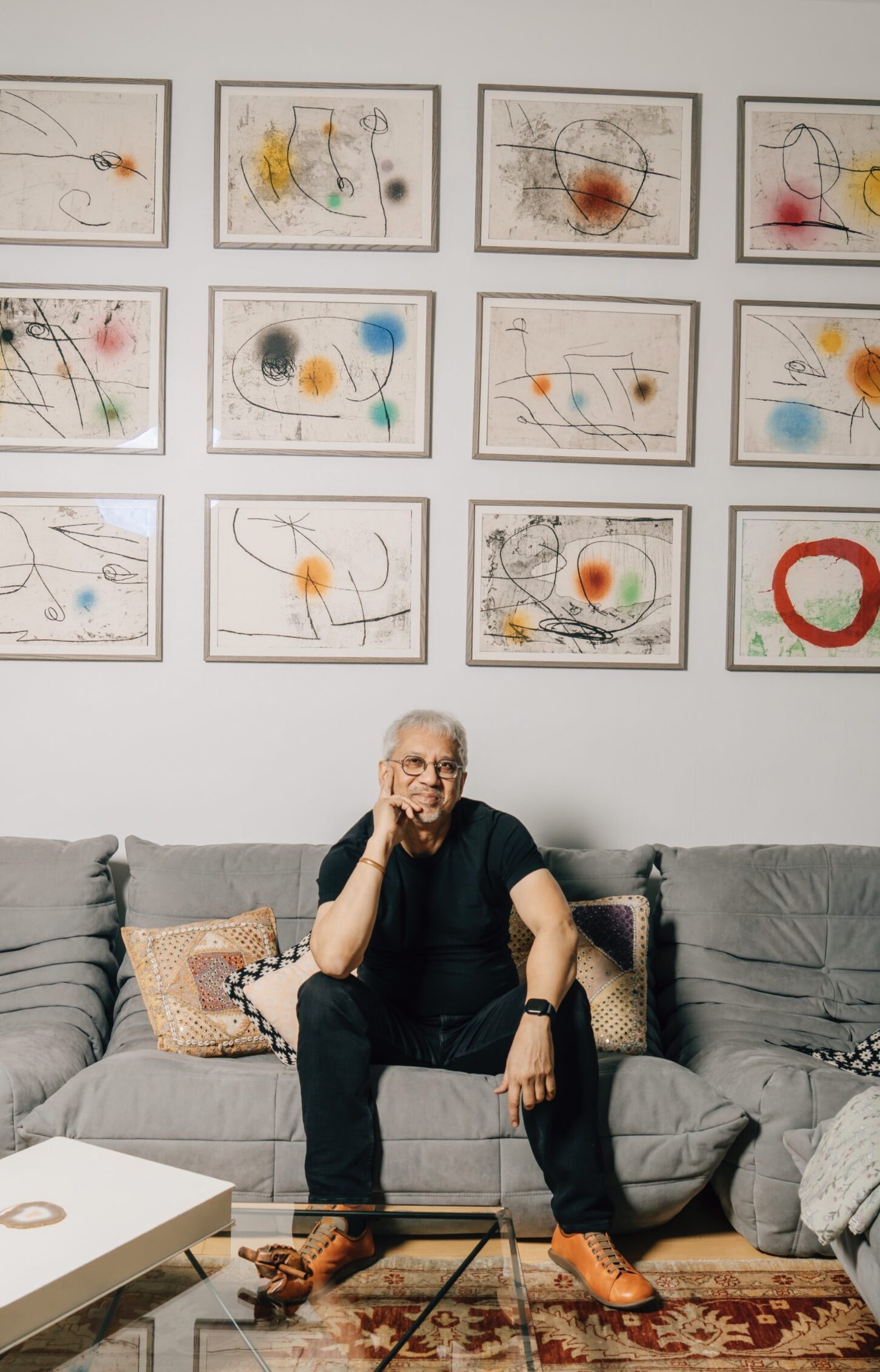
For economic theorist and NYU economics professor Debraj Ray, any acquisition should be weighed between one’s faith and decisive calculations. When the two align, it can appear almost cinematic—like when a Picasso etching he had long admired appeared at auction. (He won it on a lark.) Joan Miró’s “Lapidario” sheets arrived as a series of loose, separate prints, but Ray grouped them, constructing a dynamic centerpiece for his home. His collection—anchored in pieces by early- and mid-20th-century masters, from Picasso’s rare harlequin etchings to Egon Schiele’s intimate portraits—reflects both the analytical mind and passions of its owner. Here, he shares his best advice for contending with the two (with an assist from his daughter, the photographer who brought his New York home to our pages).
Where does the story of your collection begin?
It began with Zayira, my daughter. She’s a wonderful artist, beyond being a photographer. When she was a kid, we used to draw together. We’d look up images online to copy, just scrolling through Google, and one day she came across this beautiful Picasso image. As it turned out, it was for sale. I contacted the owner—he was an art gallerist in Berkeley, California—and I took the plunge and bought it. There’s also a tradition on my mother’s side of the family. There are artists, people who painted and collected. Once I bought that first piece, the [collecting] bug really came alive. I never looked back.
Tell us about more about that Picasso—the first work you acquired.
It was a Picasso etching from 1954. It’s an interesting piece. Early Picassos often explored these acrobatic themes—figures balancing on balls, performers, that whole world—and then those motifs more or less disappeared. The harlequin theme vanishes after about 1905 or 1907. What’s fascinating is that in 1954, the harlequin makes a rare reappearance. I’m not an expert on this, but that’s part of what makes the piece so compelling.
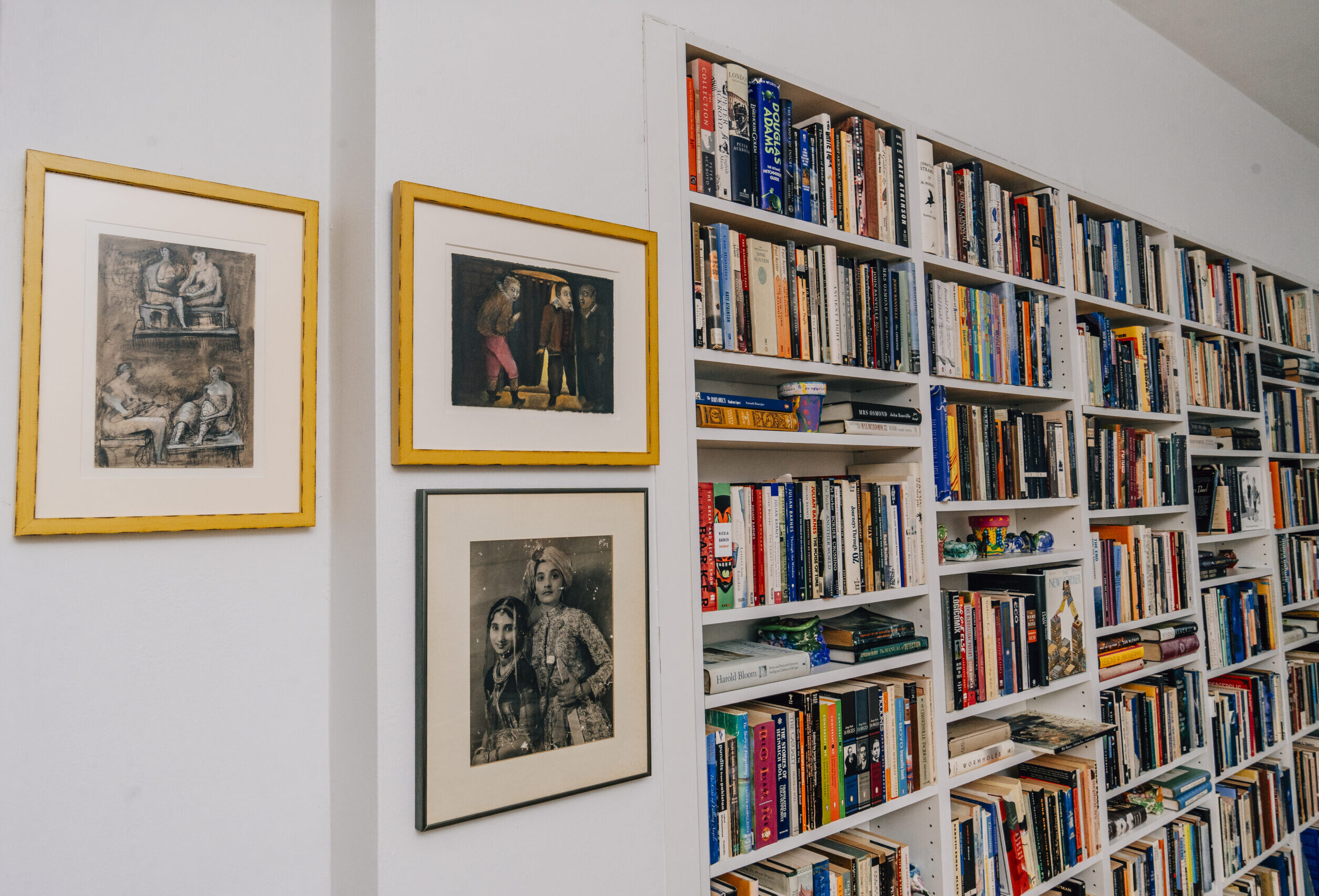
How would you characterize your collection, and which throughlines have you found?
What really unites the collection are two things: a chronological thread and an aesthetic one. Chronologically, I’m generally drawn to early and mid-20th-century art. There are several Picasso lithographs here, for instance, but also a Joan Miró and an Egon Schiele. I did also have a Salvador Dalí, which I’ve just sold.
Then there’s the aesthetic side, which is a bit more idiosyncratic. Aside from the occasional splash of color, I’m really drawn to monochrome work. I like etchings and lithographs, and I tend to prefer them without color. An example is Annemarie Petri. There’s something about monochrome that allows me to really concentrate on the image itself. For a long time, color felt more like a distraction to me. Only very recently have I started to return to color in a more serious way.
Your professional background is rooted in theory, structure, and deep mathematical analysis. How does that mindset show up in the way you look at and acquire art?
I’m what you’d call an economic theorist. I’m interested in the connections between economics and mathematics, other social sciences, economics, and even biology. There’s a strong analytical component to this work. The connection to art or music is almost immediate for me. I don’t have to take an extra step—it’s the same mode of thinking. It’s like that old Douglas Hofstadter book, Gödel, Escher, Bach: an Eternal Golden Braid, where everything is interconnected. I respond to aesthetically beautiful things—whether it’s good music, good mathematics, or good art—in exactly the same way.
What is the strangest negotiation you’ve ever had with an artist or dealer?
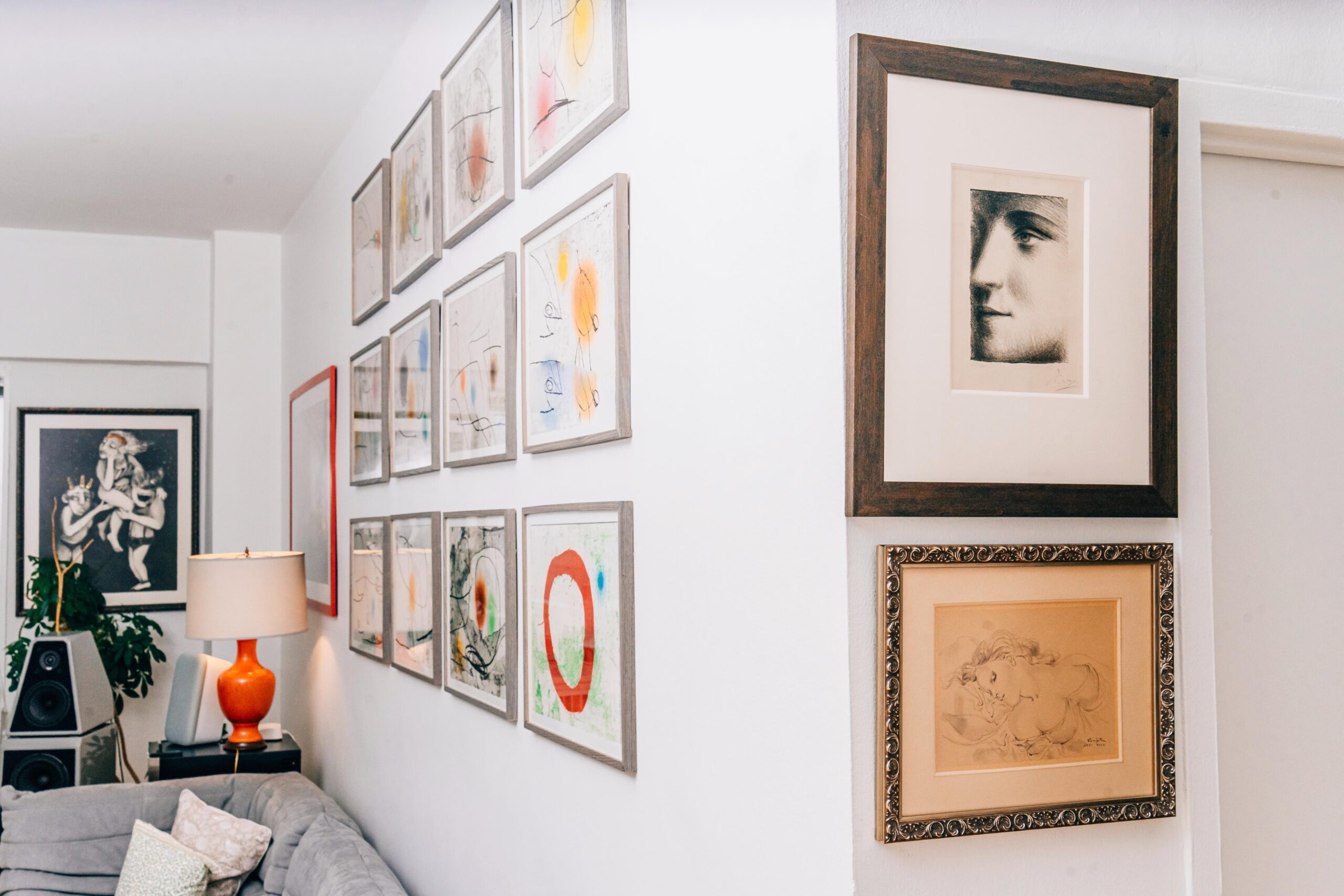
There’s a Picasso etching here that was a “click” moment for me. It’s called Portrait of Marie-Thérèse. I’ll tell you why. At one point in my life, I acquired an impression—it exists in multiples, all etchings. Then, a few years later, when another impression came up at auction, I had it playing in the background out of idle curiosity—like how people look up what their house might be worth.
At the moment the bidding passed the price I had originally paid, I suddenly became very interested. I thought, Let me see what’s happening here. I switched to the auction window and, without really realizing it, I clicked the bid button.
Oh my gosh, by accident?
Completely by accident. Suddenly, the auctioneer says, “We have a new live online bid from New York.” Everything was happening very fast. It’s not like there’s a big confirmation screen—you just click. Boom, boom, boom. I’d been lusting after Portrait of Marie-Thérèse for decades, and now I was about to have two of them. The auctioneer looked around the room and said, “Well, I have X [dollars]—does anyone want to bid?” No one does. And then she says, “Sold.”
The story gets funnier afterward, though it wasn’t funny at the time. I called Sotheby’s and asked to speak to whoever was in charge of the auction. I said, “I accidentally bid. I already own another impression—I was just comparing prices.” They wouldn’t let me off the hook. I called an old friend who’s probably the biggest Picasso and [Edvard] Munch dealer in the world, when it comes to etchings. I told him what had happened. Because he’s such a big figure, he called Sotheby’s himself and was able to get me off the hook.
How do you discover new artists and work?
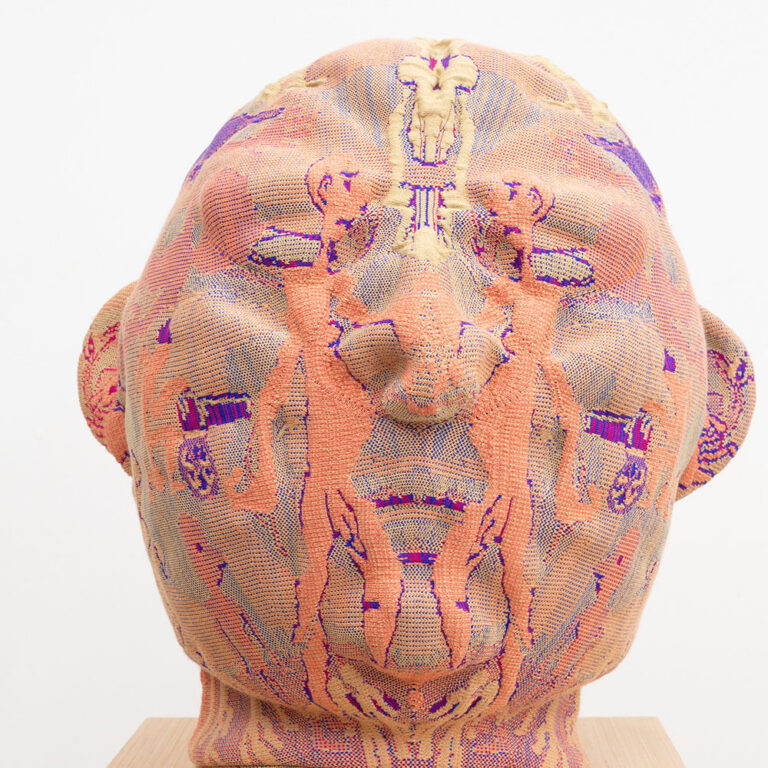
I’d say—especially for any aspiring collector—going to the New York fairs is a wonderful place to start. I’m not particularly drawn to very contemporary work, but I still go. You never know what you’ll find. For instance, that’s where I discovered an astonishing artist named Teodora Axente. She’s Romanian. She’s been exhibiting recently in Siena, and she’s also been selected for a very special honor there for the Palio. It’s one of Italy’s highest cultural distinctions, to be chosen to paint the banner that’s awarded to the winning team.
Which work of yours provokes the most conversation from visitors?
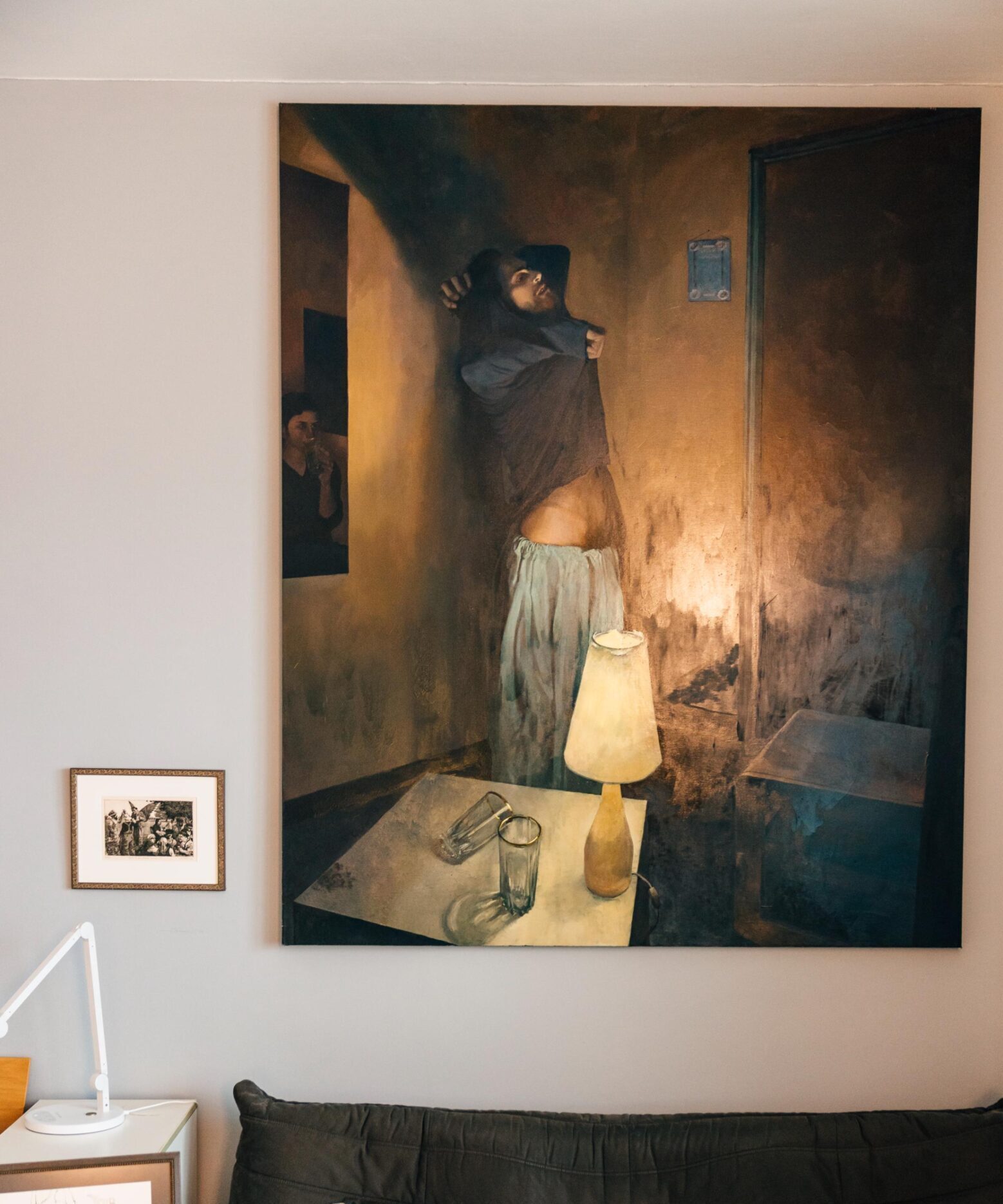
I’d say it’s the Salman Toor oil painting I have, from long before the Whitney show. That painting provokes an incredible amount of conversation. The other work that really draws people in is Joan Miró’s last piece, called “Lapidario.” The word refers to stones, and each of the forms corresponds to a particular stone. I just love them, especially as a group. They originally came as loose sheets, and together they generate a lot of conversation as well.
Has there been a work that got away—or one you still find yourself thinking about?
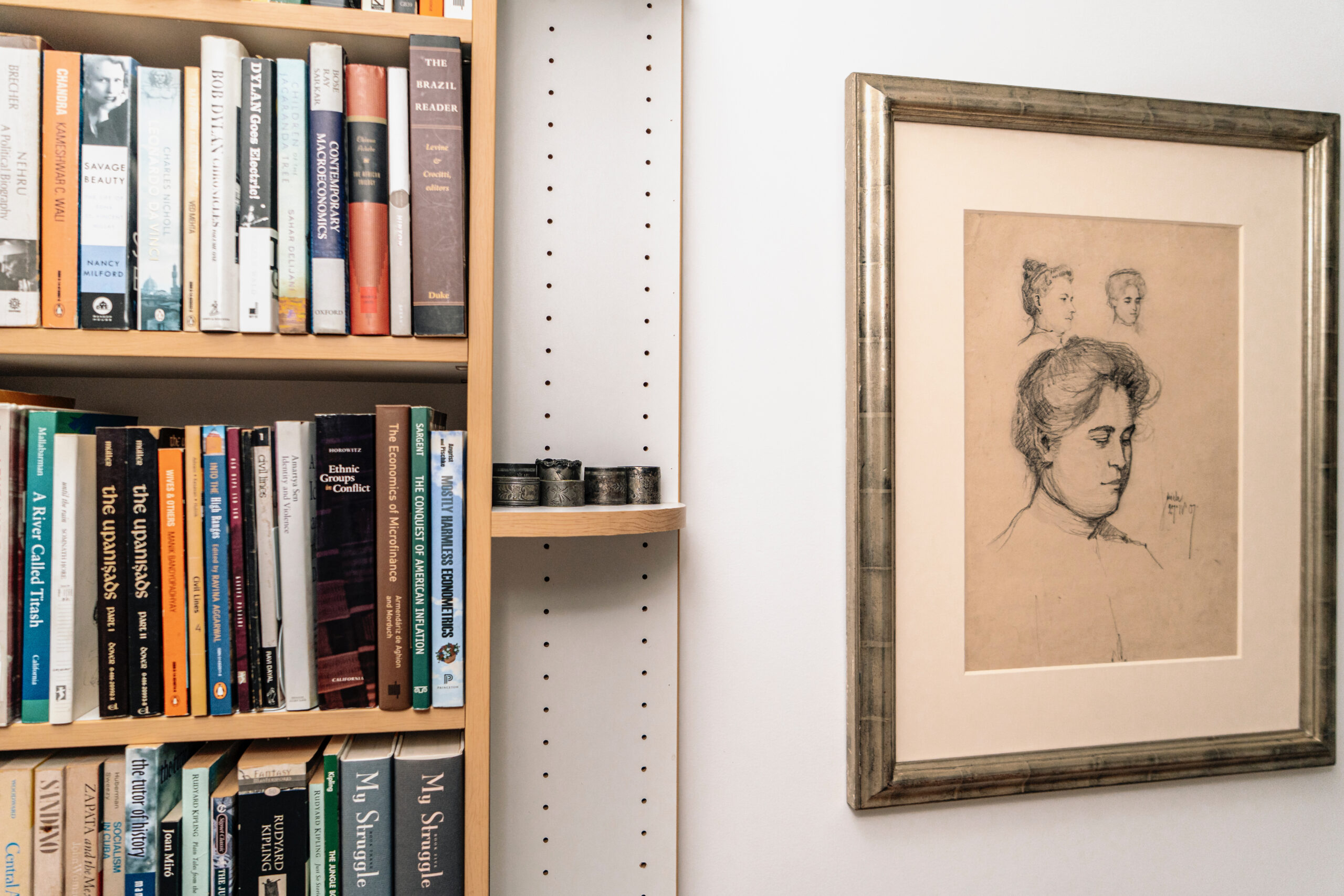
Oh yes. The one I miss most is a drawing by Abanindranath Tagore. I bid on it quite ferociously in London, but it got away. It was a beautiful piece. [The work] was a woman in profile—just incredibly beautiful. It reminded me of where I grew up: India, Calcutta, Bengal. Tagore was a Bengali artist, and something about that connection made it feel like home. The girl’s face was very wistful, very tender. It stayed with me. I can still see it perfectly in my mind, so in that sense it truly got away.
Another was by Remedios Varo, an extraordinary Surrealist artist. She was Spanish, but lived in Mexico. I saw it at Mary-Anne Martin’s gallery uptown. It was a preparatory sketch for an oil painting, and honestly, I found the sketch more beautiful than the finished work. That’s another one I wish I’d held on to.
More of our favorite stories from CULTURED
13 Books Our Editors Can’t Wait to Read This SeasonWith Art Basel Qatar, Wael Shawky Is Betting on Artists Over Sales LogicJay Duplass Breaks Down the New Rules For Making Indie Movies in 2026How Growing Up Inside Her Father’s Living Sculpture Trained This Collector’s EyeIt’s Officially Freezing Outside. Samah Dada Has a Few Recipes Guaranteed to Soothe the Cold.
Sign up for our newsletter here to get these stories direct to your inbox.





 in your life?