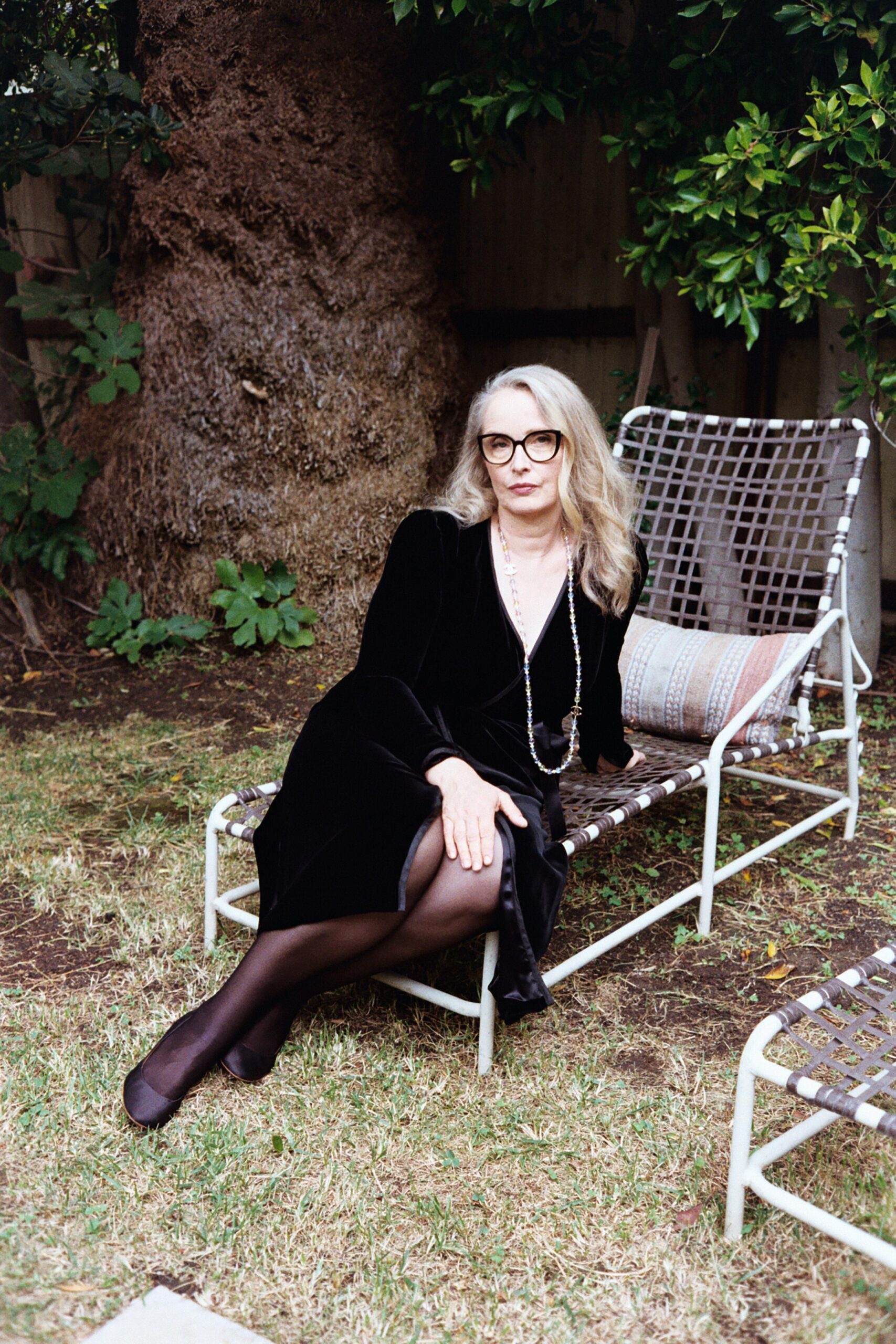
Julie Delpy isn’t the least bit sentimental. “It’s far in the past,” she says of Before Sunrise, the 1995 film that made her a Gen X staple, with a shrug. “It doesn’t exist in my life anymore.” The 55-year-old actor is voluble, and a little mischievous—not unlike Céline, the sharp-tongued romantic she made famous, or like a person who has been underestimated for decades. On a late morning last fall, she spoke freely about fame, freedom, and the uneasy business of being remembered, but only glancingly and reluctantly about the film trilogy—which marked its 30th anniversary in 2025—that reshaped how the world saw her, even if she never changed that much herself.
A decade before Richard Linklater came calling, Delpy was already steeped in European art-house cinema. After Jean-Luc Godard discovered her as a teen, she starred in Mauvais Sang by Leos Carax, earning a César nomination (France’s equivalent of the Oscars), and in Polish director Krzysztof Kieślowski’s Three Colors trilogy, building a career marked by a restless curiosity for complex cinema. Then came Before Sunrise, a modest American indie that became an unlikely cultural touchstone, and its follow-ups Before Sunset (2004) and Before Midnight (2013).
Delpy hasn’t watched the movies in years, though her teenage son recently did. His verdict? They’re cute, but Stalker, the 1979 slow-cinema classic by Andrei Tarkovsky, is much better. “I have to say, Stalker is fucking genius,” she concedes with a laugh. Whatever the Before films meant to Delpy and the rest of us then, she, at least, is well beyond them now.
When the first installment of the Richard Linklater trilogy premiered at the Sundance Film Festival in 1995, its quiet, lived-in mood moved through theaters like a secret. The film features one of cinema’s most enduring meet-cutes: Céline (Delpy) follows Jesse (Ethan Hawke) on a whim, stepping off the train in Vienna. They amble through the city, transforming a cheap date into something life-altering. In an era of romances like Materialists and Palm Springs, where self-awareness and irony buffer emotion, the premise of Before Sunrise—two strangers talking their way through an unbroken day off the grid—feels radical in its simplicity, and achingly difficult to conjure now.
What’s often forgotten, especially today, is how much of the trilogy’s voice—its humor and its female realism—came from Delpy herself. “I picked my name, I picked the book I was reading, and I picked my family,” she says about recalibrating Kim Krizan’s script. In the process, she rendered Céline “an active romantic, not a passive one.” Her writing lent the films the grounding sting of feminine self-awareness that kept them from drifting into fantasy, and kept audiences coming back.
“I’m not the pretty girl anymore—and, personally, I don’t give a shit.” — Julie Delpy
Though Delpy and Hawke were officially credited as co-writers on the sequels, Before Sunset and Before Midnight, she treads carefully when discussing her contributions to the first film, which was the subject of a years-long public dispute. “It was like treason,” she says of the bitter situation. “I went away from the business for a while because of that.”
But Delpy has never been one to lick her wounds for long. She pivoted to directing, making a string of smart, prickly films, like the darkly comic Lolo and the historical thriller The Countess. Most didn’t have international distribution beyond 2 Days in Paris and 2 Days in New York, a pair of neurotic, self-lacerating romantic comedies. “There’s a huge difference between how my work as a director has been received in the U.S., where it barely exists, and in Europe, where some are cult movies,” she notes, half-amused, half-exasperated, and thoroughly over Hollywood’s nonsense.
Delpy, who splits her time between Los Angeles and Paris, insists her choices have nothing to do with ambition—sometimes to her disadvantage. “I’m not driven by ego,” she says. “I go with what feels right for me.” She wrote her latest feature, Meet the Barbarians, because she felt it was an important story to tell, “not because I thought it was a hit.” In it, a small French town prepares to welcome a Ukrainian refugee family—only to be surprised when a Syrian family arrives instead. It premiered at the Toronto International Film Festival in 2024 to warm reviews and has been a conversation starter in Europe, though, like most of her work, it hasn’t found U.S. distribution. “Apparently, refugees are not very in, especially when they’re Arabs,” she deadpans. (The film will have its New York premiere at the New York Comedy Film Festival on Feb. 19.)
Still, creative freedom matters more to Delpy than reach. “I never want to be anyone’s creation,” she says. People think of her less now than they did in her starlet years, which suits her fine. “I’m not the pretty girl anymore—and, personally, I don’t give a shit,” says Delpy, who makes a point of wearing the same dress to every public event. “With what’s going on in the world, I am uncomfortable showing up with thousands and thousands of dollars on me.”
That fierce sense of autonomy has become her signature. In Hostage, one of Netflix’s most popular miniseries last year, Delpy plays the president of France, navigating a crisis with icy authority and flashes of weary humanity. The show’s success revealed a new facet of Delpy to a wider audience; many who first met her as a romantic lead discovered her as a commanding, middle-aged woman in power. “She’s someone who made every compromise to rise to the top,” Delpy says of her character. “Fortunately—or unfortunately—I’m the opposite. I’ve made very few compromises in my life and career. Maybe I’d be further along if I had.”
Delpy is already turning her attention to the next challenge: Ruben Östlund’s The Entertainment System Is Down, a jet-black ensemble comedy co-starring Keanu Reeves—“that one is pure fun”—and more projects she’s not ready to announce just yet. For now, she prefers to stay in motion. “I’m looking at the future,” she says resolutely. “Nothing else matters.”
Makeup by Kathy Jeung
Hair by Christian Marc
Production by Adam Bodenstein
Production Management by Auriana Ehsani
Photography Assistance by Tristan Hirsch
More of our favorite stories from CULTURED
13 Books Our Editors Can’t Wait to Read This Season
With Art Basel Qatar, Wael Shawky Is Betting on Artists Over Sales Logic
Jay Duplass Breaks Down the New Rules For Making Indie Movies in 2026
How Growing Up Inside Her Father’s Living Sculpture Trained This Collector’s Eye
It’s Officially Freezing Outside. Samah Dada Has a Few Recipes Guaranteed to Soothe the Cold.


 in your life?