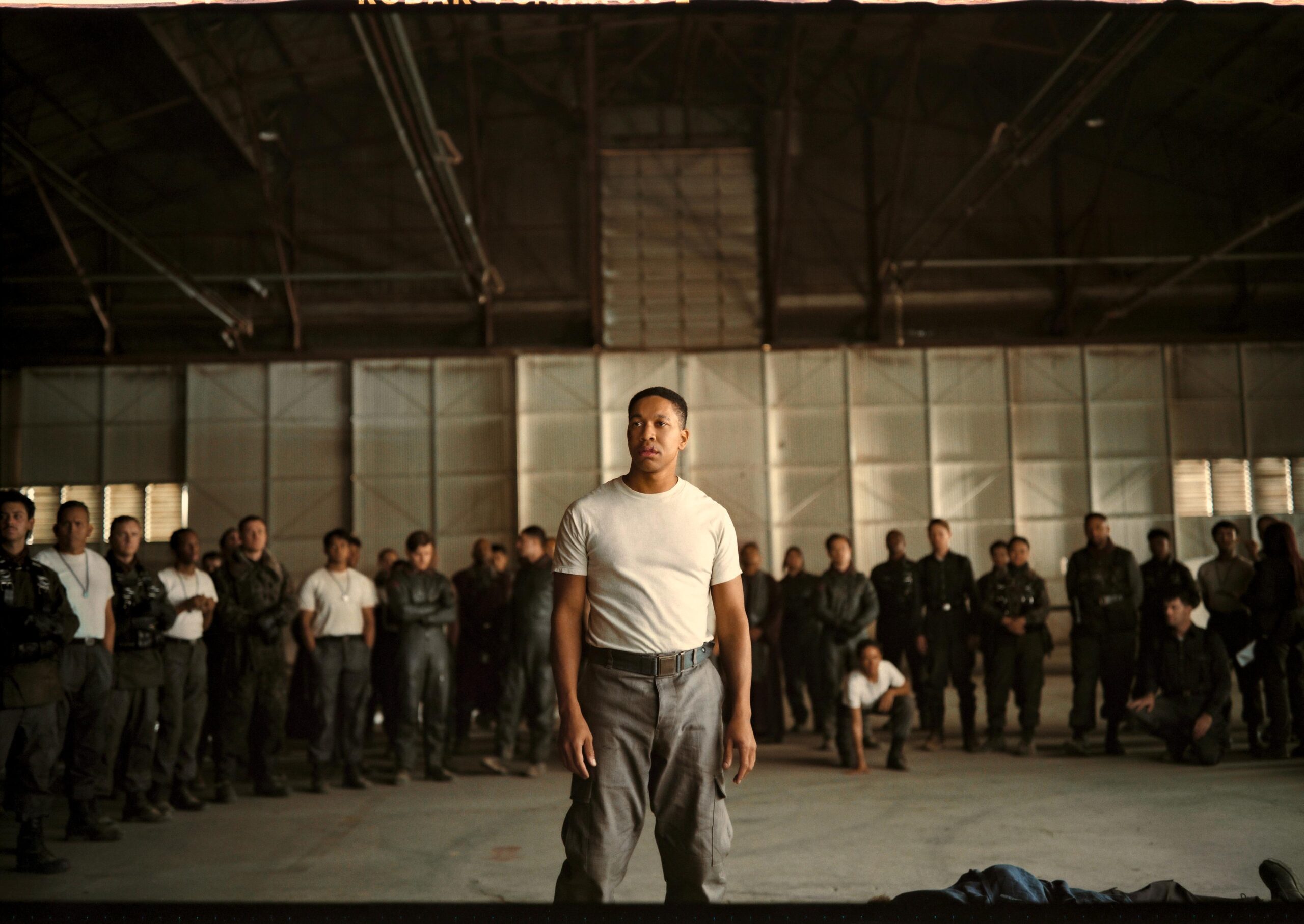
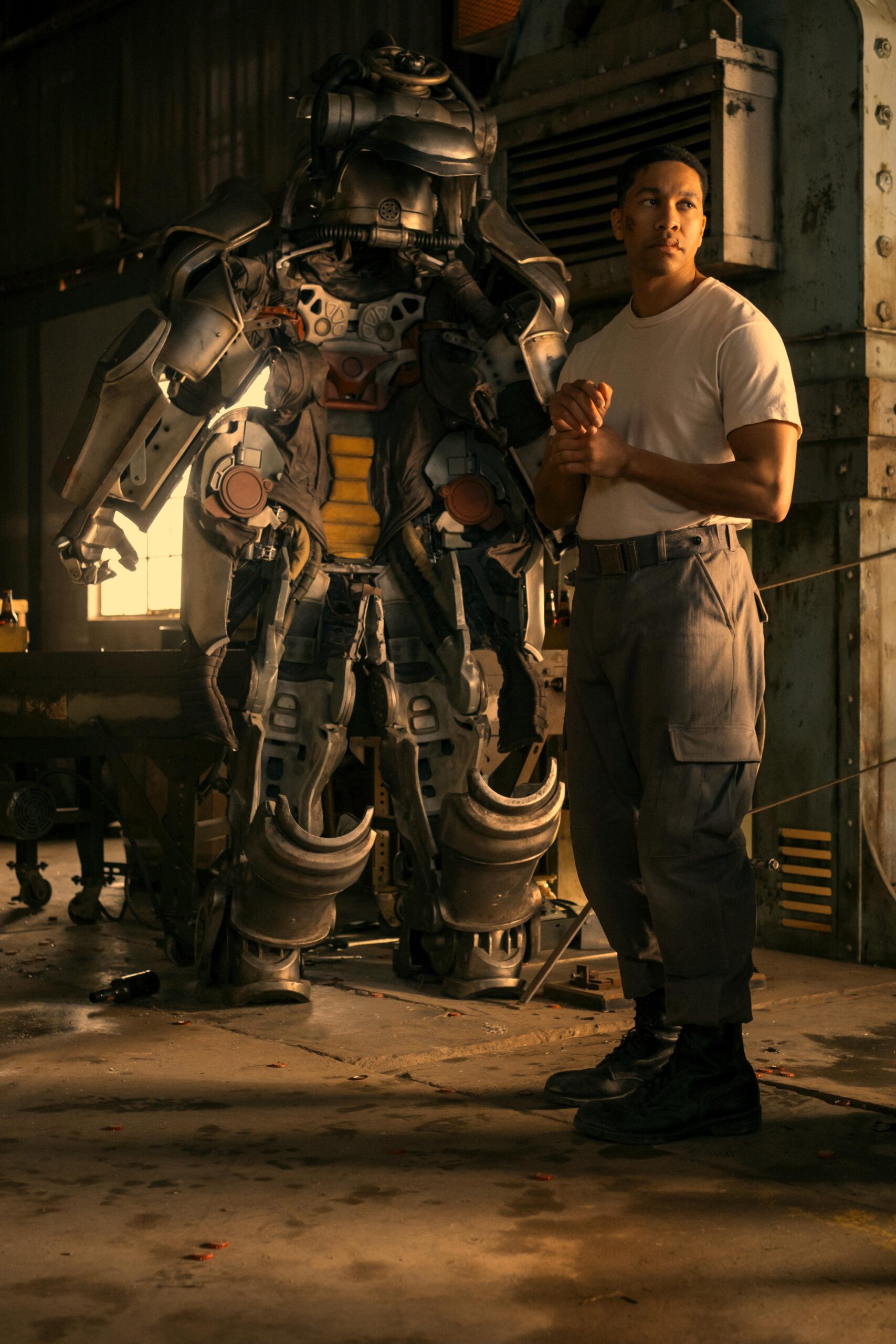
“It’s like if The Jetsons got a bomb dropped on them,” says Aaron Moten of the relentlessly chaotic Fallout universe. The second season of the hit show—adapted from a video game series of the same name—is set to debut next week, with Moten returning as Maximus, a squire in the militaristic Brotherhood of Steel. The warped and scorched setting he describes was captured on location in the Namibian desert, the salt flats of Utah, and abandoned subway tunnels in the Bronx.
It’s a uniquely retro-apocolyptic aesthetic that his former co-star, Kathy Bates (the pair worked together on the Netflix series Disjointed), zeroes in on when the two speak. There are the hulking power suits donned by both Moten and co-star Kyle MacLachlan, the spaghetti Western getup of Walton Goggins‘s ghoulish character, and the production team’s knack for conjuring mid-century TV cheer in underground bunkers. Fallout oscillates with uncanny smoothness between the surreal scale of its namesake videogame series and the intimate, human dread Moten sees as the story’s core: “I wanted it to feel a bit panicked at times—like any of us would if we were experiencing the end of times.” Here, he tells Bates exactly how they captured both tones in one 8-episode season.
Kathy Bates: I want to start by getting into the nuts and bolts. What was your first meeting with Jonathan Nolan like?
Aaron Moten: My first meeting was with the writers and showrunners—Jonathan, Graham Wagner, and Geneva [Robertson-Dworet]. They had this great idea, and I thought, This is a hero’s journey, but where we start him is going to be different.
I got really excited—and I didn’t know the game at all, Kathy. But it was this great concept of how to take this guy who’s hyperrealistic, and send him into this whacked, ultra-futuristic world. For this particular story, I didn’t want to be so stoic. I wanted strength to mean something in this show. When you’re running from monsters or whatever’s coming after you, I wanted it to feel a little bit more panicked at times—like it would be for any of us experiencing the end of times.
Bates: How were you introduced into the world of the show? Did they put it on a computer so you could see it?
Moten: I went to YouTube. The library of people posting their gameplay on YouTube is so vast, and you can see this world. Our production designer Howard Cummings built it out.
I’m sure you see this on your sets, too—sometimes things are unfinished when you arrive. We might rehearse while they’re still putting things together. I’ve looked at painters who will take a car, and by the time we get back to set, it’s pristine. The stuff they can do so quickly is just phenomenal.
Bates: Where did you shoot? Did you have to travel for certain scenes?
Moten: All of the desert exterior is in southwest Namibia. Before that we shot in New York, and also in the salt flats of Utah. [The fictional city] Shady Sands was in New York. I mean, the most bizarre locations. Abandoned subway tunnels in the Bronx, that kind of thing.
Bates: What was your rehearsal process? How many days was each episode?
Moten: With some of the travel we had to do, every episode was around three-and-a-half weeks. It was a slow process.
Bates: Tell me about the suit that you had to wear—how did you get in and out of it, and was it the real thing?
Moten: Yeah, it’s the real thing! Jonathan has always been of this school—I’ve heard that Chris [Nolan] is the same. The more practical stuff you can build, the better. A lot of our creatures are puppets. Technically, there are four versions of the suit. There’s a six-foot-five stuntman version—meaning you have to be six-foot-five to fit the suit. The suit puts you on these platforms, so you’re about seven-foot-two wearing it.
What Kyle and I have is the top half of that—50, 60 pounds. Oh boy. It feels so good for the first 15 minutes, and then you’re on set thinking, Can we roll? Are we rolling yet? Can we get this over with? Can somebody lift this off my shoulders? It’s extremely heavy.
Bates: How collaborative was your experience on set? Was there any room for improv?
Moten: Extremely [collaborative]—from jokes to dramatic moments. It was very open. There’s a little bit of improv, but they came to us with a really good map. The scripts are so good. They really are!
Photography by Ryan James Caruthers
Grooming by Tasha Reiko Brown
Styling by Amanda Lim and Luca Kingston



 in your life?