When you look up the name of Hailey Gates’s feature-length directorial debut, Atropia, you might find yourself on the Wikipedia page for a fictional country of the same name. Atropia the nation is “a neutral, Western-leaning oligarchy” according to the U.S. miltary’s OE Data Integration Network. Its geography is both immaterial (bordering neighbors include Donovia, Limaria, and Ariana) and very real (California’s Mojave Desert). For 13 years, Atropia’s 12 fake villages, peppered across some 1,200 square miles, have played host to hundreds of actual military training exercises and simulations.
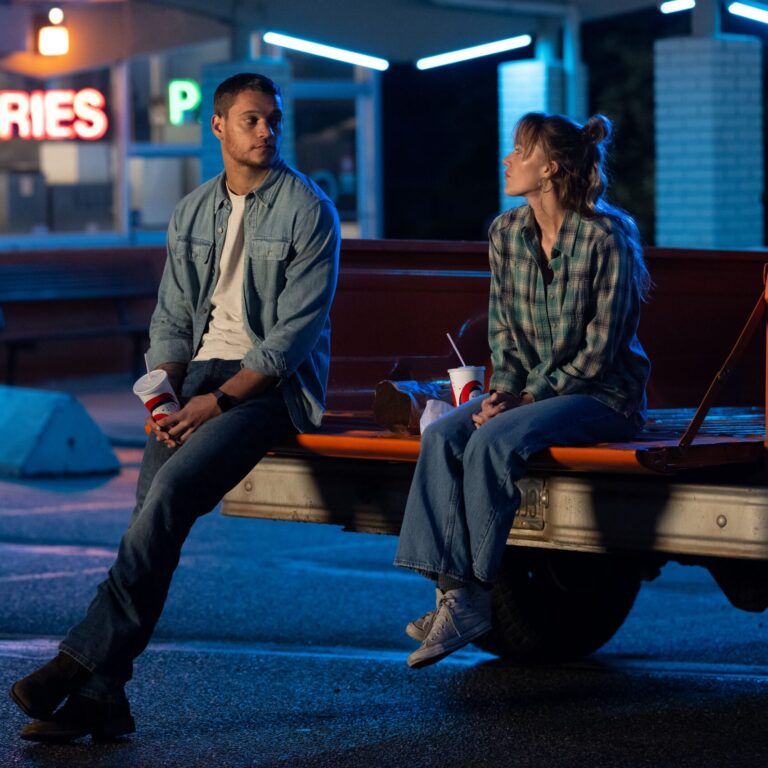
If you are confused, welcome to Atropia the movie. Released earlier this month after premiering at Sundance last January, the 103-minute feature grows out of Gates’s 2019 short film Shako Mako (commissioned by Miu Miu for its Women’s Tales series), and stars Alia Shawkat (also present in the short) and Callum Turner as two star-crossed Atropian lovebirds. The year is 2007, the United States has been at war with Iraq for four years. Turner has already deployed once and is itching to go back; Shawkat is an aspiring Iraqi-American actor doing the most in her role as an Atropian woman. They are both stuck in Atropia, where troops train before they deploy. Hilarity and heartbreak ensue, punctuated by stellar performances from a supporting cast that includes Chloë Sevigny, Channing Tatum, and Shawkat’s own father.
For CULTURED, Gates and her leading lady called each other up to reminisce on what went down on set and to unpack what it was like to make (and release) the film in our own fraught political moment.
CULTURED: Hailey, you were initially thinking of doing a documentary on this subject, and were talking to different sources involved. How did you first hear about these mock villages?
Hailey Gates: Alia and I both grew up in California during the Iraq War, and people knew about them. There’s actually a really big one near where Alia grew up in Palm Desert, called Twentynine Palms. I always try to look for Trojan horse ways into difficult subject matter and I thought this was a really strange play that nobody knew was going on, or at the very least that they were paying for with their tax dollars. It was an exciting way to explore how America casts itself and its enemies and its understanding of its place in the world. The documentary stuff was very difficult because it was just hard to get access. But I thought it was very ripe for comedy, and I knew just the lady to do it.
CULTURED: With the actors and set builders and all, it’s a little bit like being on a film production.
Gates: There’s a lot of similarities, except that they had way more money to make their play than we had for this movie. It’s about $20 million per rotation there, and a rotation is a month, which is, a little more time than we had to make our movie. They have make-up artists, special effects operators… the whole thing. The people that built the sets there are Hollywood set builders, so it’s a real military-Hollywood collaboration.
CULTURED: Alia, you brought in this romance element to the film. What made you feel like that needed to be a part of the story?
Alia Shawkat: We were having kind of a dark night of the soul in our careers and were like, “What are we gonna do?” Hailey pretty much was like, “Okay, what genre have you never done in a film but have wanted to do?” I said romance. I’ve done some comedy where it’s like the idea of us kissing is crazy because we’re related, but I never really played a romantic lead. Now that the project is done, looking back on it, it was kind of the perfect little mix to tie in this whole world.

CULTURED: What made Callum the right person for this?
Gates: Alia was actually pregnant when we were shooting, and for me it was really important for her to be with someone that she felt comfortable with and safe with because it was already a very extreme situation. I knew that she could do it, but I just wanted her to feel really held and not be with someone who maybe she didn’t know. She was like, “I worked with this guy on Green Room, and he grew up big and strong.”
Shawkat: He’s a very brotherly person in my life. You just feel really cozy around him when you know him. He’s also very handsome and a great actor. We had talked to other interesting cool guys, and I think some people were confused by the movie politically. They were just like, “Yeah, maybe,” and Callum was just like, “Yeah, let’s do it.”
Gates: The first day we went to set, it was the screen tests. We all saw this huge hawk flying with a snake in its mouth.
Shawkat: I remember, it’s some Aztec sign. I thought it meant like “the war is over” or something.
Gates: Oh really? I can’t remember. Anyway, it was one of those things where some people would look at that and think it was a really terrifying omen, but somebody was there who told us the lore. There were strange, mystical things like that that kept happening on the set. Lots of snakes.
Shawkat: Mainly snakes.
Gates: Yeah, but we had a great snake wrangler named “Tuesday.” Isn’t that a crazy job? I would love that job on set, a snake wrangler. She just has a bucket of snakes.

CULTURED: You guys mentioned some people being wary of the political tone of the film. How did you feel putting this out at this moment, especially when things are changing so rapidly, from when you started the project to now?
Shawkat: Hailey and I have talked about it, even just in discussion with this movie coming out. From the time that we came up with the idea for it, to actually then us shooting it, to it coming out, things are happening at a crazy pace. I feel like anything that’s somewhat DEI is looked at as not as interesting or as welcomed. A lot of people too, even in our industry, wanna act like they’re really leftist or whatever, just meaning they support people of different cultures, and I don’t think they actually do, cause they’re scared to promote something that’s not gonna make money, and money is God in America.
Gates: Wait, why do you think this won’t make money? [Laughs]
Shawkat: Oh, I mean, I think it’s gonna make money. I think it’s gonna make too much money, and I think people are scared of that.
Gates: I just feel really lucky that we were making something that speaks to the moment, even though, when we were making it, we were still both mad about the Iraq War and felt like it deserved some re-examining. The genesis of that war is really kind of the original sin of the world that we live in now. Even right now, Trump has a naval blockade of Venezuela, and Venezuela has more oil than the entire Middle East combined. He keeps bombing these boats, I think hoping that [Venezuelan President Nicolás] Maduro will attack one of his naval vessels and he’ll have the right of way to get on that oil. For us, this is something where the perils and the humor of how humiliating it is to be an American and the ills of the American empire are top of mind for us, always, and it’s nice to have a film that speaks to that in this moment.

CULTURED: Were there moments on set while filming where you kind of felt a shift change in direction? Or any moments where it was like, “I thought this was gonna work one way and we’ve got to do it completely differently”?
Gates: There’s a scene in Las Vegas, at the Venetian. I had this fantasy about shooting in the fake canal there to represent the River Styx. We couldn’t get the permits to shoot there.
Shawkat: We found out two days before? We were like “We could definitely get Vegas, right?”
Gates: I come from the doc world, so I like to go rogue, but we found out that there was an official wedding videographer of the Venetian, so we basically pretended that Alia was getting married. But he was wearing full Iraq-era army fatigues, and Alia was wearing a hijab and 8 months pregnant.
Shawkat: People were looking at us like, is this the craziest Halloween couple? Also Callum is British, but everyone was coming up to him and being like, “Thank you for your service.” He was like, “Yeah, you got it, man.”
Gates: I was like, “If you drop your accent, I’m gonna kill you.” Eric, our DP, got in the boat and we pretended that he was the wedding photographer. So, we have these amazing, official photos of them in the boat kissing in a Venetian sculptural frame.
Shawkat: They all sing a lot of Italian songs, so we were like, “Do you mind just not singing, we wanna say our vows,” and the vows were a scene. They’re just kind of like, “Oh yeah,” and we did it like three times, right?
Gates: Yeah, it was so fun. But then there was like some big thing that shot there like right after.
Shawkat: We just didn’t have the might.
CULTURED: Since this is your debut feature, is there anything that you picked up that you feel like you’ll be taking into the next one?
Gates: I learned so many things… We were so dirty, so filthy every day, and I was so busy and so completely destroyed by the weekend and working on the weekend with Eric that I didn’t do laundry for those two weekends. The last week of the shoot, I had these linen suits that I was wearing and everybody was like, “You look so fancy,” but it was because I didn’t have any clothes left, so I need to learn how to do my laundry next time on the weekend. You really need clean clothes.




 in your life?