When I sat down to interview Jarrett Earnest over soggy eggs and burnt toast at the Washington Square Diner, my first question was, “How the hell am I supposed to interview you when the show hasn’t gone up yet, and the press release is just a list of artists and a story about you taking acid at a gay bathhouse?”
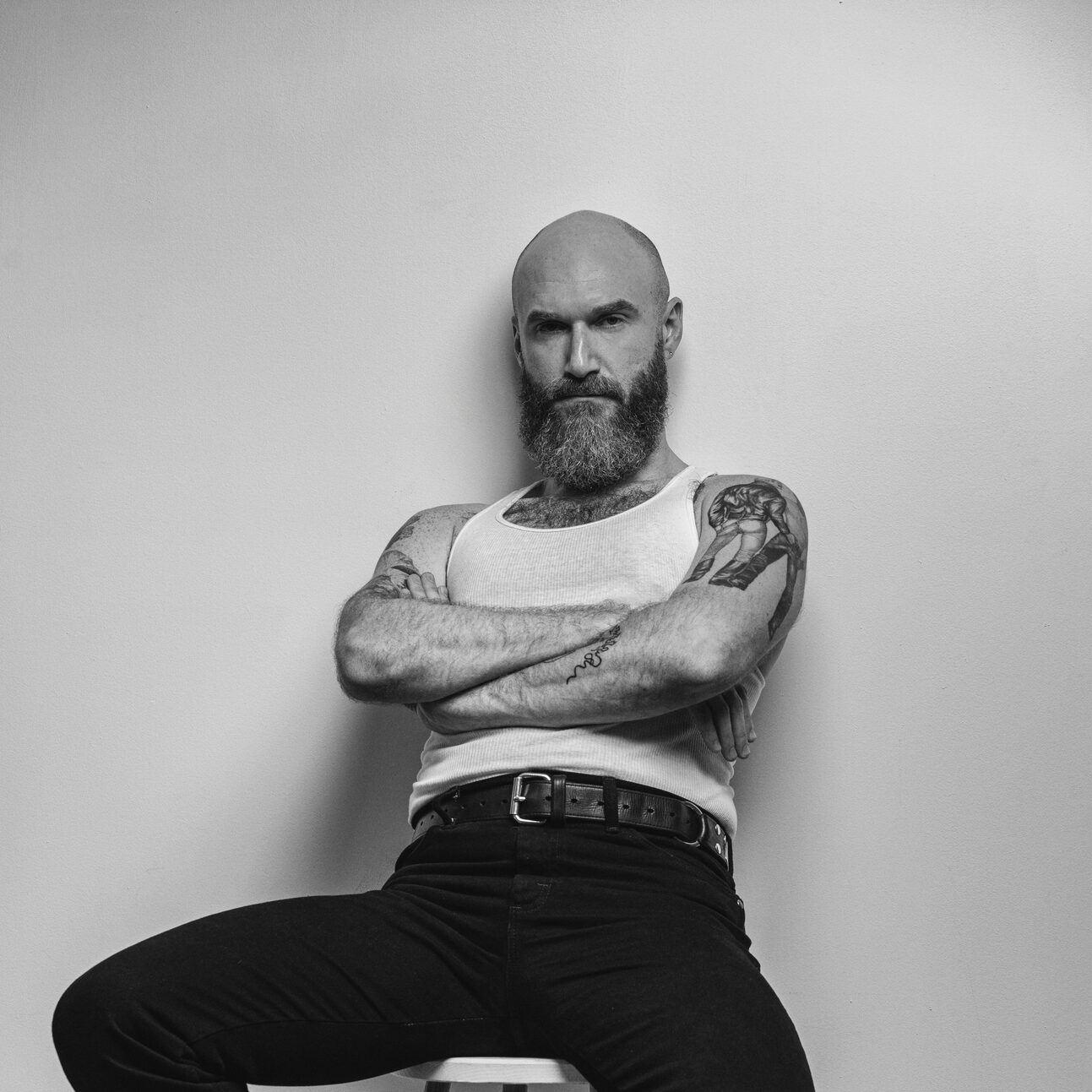
The group exhibition in question—which could only be titled “Acid Bath House”—is on view at Nina Johnson in Miami through Feb. 7. The critic, with his bushy beard and arms tattooed with pieces by Caravaggio and Tom of Finland, has become something of a cult figure in New York’s queer art scene. Some fear him, many desire him, and nearly all seek his approval.
“Acid Bath House” features photography, sculpture, textiles, painting, and drawings on paper from artists including Juliana Huxtable, TM Davy, and Genesis Breyer P-Orridge. Not unlike their curator, the works’ combined effect evokes a reverence for celestial, mind-bending pleasure. To make sense of the séance, I grilled Earnest on his South Florida roots, queer trash, and why getting lost in the sauce is rather glamorous after all.
Tell me about the show.
After the experience described in the press release, I decided to do a show based on queer erotic psychedelia. I’ve curated big group shows before, and I can’t use renderings. I can’t imagine where all of the pieces will go, because an artwork has all of this embodied information that is surplus to an image of it, surplus to how you might describe it. When you place pieces next to each other, it teases out different dimensions—they start speaking to each other. And that’s what is exciting to me about curating a show. It’s a form of crafting an argument. If you could make that argument any other way, then it doesn’t really need to exist as an exhibition. It could be a book, a podcast, an article.
What are you arguing here?
I’m still waiting to discover that. One thing I love about art is that it’s like spending time with someone. A painting holds a physical space in the room but also a kind of presence. It’s an extension of the person who made it. The show is about pleasure and connection. It’s filled with people I’m super excited to think about together. It feels like throwing the best party ever.
In the press release, you ask, “Does ‘queerness’ still exist? Is it a force? Does it push toward liberation, toward fluidity and change, or is it too easily mired in defining architectures of privilege to get out of its own way? Can we separate queerness from ‘identity’ as it currently functions? And, if so, should we?” Can you speak to that?
The word glamour, historically, comes from a kind of magic—a spell that changes one’s ability to perceive you, and reality generally. That’s what I like about queer artists, especially the ones that I am including. For example, I’m including this LSD drawing by Steven Arnold that has never been shown. He was a photographer who made sets and costumes out of garbage, turning them into just the most unbelievably elegant phantasmagoric images. He died of AIDS and isn’t as well known as he should be. There is a lineage of queerness where you are given trash and, through your imagination, skill, and belief, make it into something fabulous. Glamour is probably what I miss the most in our present reality. There’s so little glamour these days.
What’s something that is completely unglamorous?
The internet is not glamorous. Contemporary fashion is not glamorous. The way that so many artists our age want to be little professionals is unglamorous. They act like their interest is in making commodities. When you want to participate in the “market” or the “art world” in a certain way, you’re forced to produce too much too fast. To me, spending time is glamorous. You can get lost, which is the beauty of an artistic and intellectual life—the capacity to forget where you’re going and end up somewhere else.
Not to be a diva or anything, but then why are you showing during Art Basel Miami Beach?
You are so right. I am not an art fair person— I do not set foot in them—but I come from South Florida and I care a lot about how fucked up it is. Florida has become a roadmap of our dystopian future. It’s really leading the country in its insane anti-trans legislation; it is so grim. While the international art world is focused on South Florida, it is important to me to acknowledge this. So the context is not necessarily about Art Basel; it’s about Florida, queerness, and transness in this extremely hostile environment.



 in your life?