
Paris Photo is the art world’s best kept secret. It is the only art fair that the artists and the curators like to go to. And there’s a reason for that: It’s fun! Like actually, really fun.
I first went to Paris Photo in 2018, when I was asked to be part of the Conversations program. I dragged myself to Paris after having been at Frieze London just a few weeks earlier, figuring it would be much of the same: one fun party, a few free awkward dinners, go home. I was wrong. Somehow, all my friends were there, and I had the time of my life. When I found out I was going to be in Europe for most of this fall, I knew I couldn’t miss this year’s heavily anticipated edition from fair director Florence Bourgeois and artistic director Anna Planas.
My week was refreshing, delirious, energizing, and surprising yet reassuring. It’s a hard time to be an artist and an even harder time to be a photographer. There’s no lack of anxiety, or grief, or pain amongst us this week. Despite the hardships, people are appreciating the joy of being together and not taking it for granted.
I think what I love most about Paris Photo is how intergenerational it is. All week, bouncing between parties, I was constantly meeting new artists or longtime heroes, who were anywhere from their early 20s to their late 80s. From the main event at the Grand Palais to a book fair held on a boat to the countless gallery tours, dinners, and after-hours parties, everyone was there to meet each other, and there was a spirit of camaraderie I only rarely feel in contemporary art.
It was a whirlwind, and by Sunday, when I headed back to New York, my voice was hoarse and I was destroyed. But by the time you’re reading this, I’m already ready to do it all over again.

Tuesday, November 11
11 AM: BOOK WORK
I get to Paris a few days before the fair to meet with Aperture magazine senior editor Brendan Embser and photographer and designer Grégoire Pujade-Lauraine, who I am working with on my first monograph that will be coming out with Aperture next fall. The big decision to be made this week is what the final grouping of pictures will be. We’re going for a tight edit, but I make a lot of work. Some tough cuts will have to be made.

We hammer out the final edit over a few hours in the apartment Brendan has rented above a string of vintage stores off République. On my way to meet friends for dinner, I pass by the Kilo Shop on Boulevard de Magenta and find a perfectly fitting pair of brown leather pants for €30. I drop my laptop in my hotel room, throw on the leather pants, and head out.

8 PM: DINNER AT FURIA
I meet up with Brendan and a bunch of photographers with various connections to Latin America—Mexico, Puerto Rico, Bolivia, El Salvado—for vins et tacos at Furia. The dinner has a celebratory feeling because Felipe and Daniel are each having great years: Felipe’s newest book Bravo has just come out with Loose Joints, he has a show up at Maison Européenne de la Photographie, and he is showing at Paris Photo in the highly anticipated Voices section. Daniel’s beautiful work, which looks at his home country of Bolivia, is currently featured on the metro in Paris, and he’s also showing at MIRA, the Latino art fair in Paris. Felipe is an exceedingly gracious host and gets a magnum of white wine for the table. Mari and Daniel get into a very rigorous discussion over the new Rosalía album, and we don’t leave until we get kicked out.
Wednesday, November 12
10:30 AM: GOOD MORNING!
I’m running late to meet Nina Strand, a curator and the founding editor of Objektiv Press at the Fondation Cartier Bresson after a late night catch-up with a friend at Chez Jeanette. I get off at République again—I will definitely stay nearby next time. I’m a Paris newbie, so I’m still getting a handle on the city. Thank God for these vending machines they have in the Paris metro. Nutella biscuits for breakfast?? My parents are in America, so they can’t judge me here.

2 PM: LE VERNISSAGE


What’s your favorite thing about Paris Photo?
Lesley Martin: It’s really the best place to see all the best books, all the people you want to see, and all the people you want to talk to, in the best setting for conversation.


What do you love about Paris Photo?
David Campany: It’s always the discoveries. It’s things from galleries that may be here for the first time that I’ve never seen—overlooked work. That’s the thrill of it for me. The more time I spend with photography, the more I’m realizing I’m grazing on the lowest slopes of my own ignorance, as they say. This year, it’s lovely work by a Turkish photographer, a woman called Yıldız Moran. She only made work for about four or five years in the ’50s, and it’s just incredible. For one reason or another, she got written out of histories, although she did have a couple of big shows. She died in the ’90s, hardly known outside of Turkey. Her work is just a joy—that’s the discovery for me.


7 PM: A STOP AT LIBRAIRIE 7L


There’s a gallery behind the studio. I convinced the guard to let me take a peek at the work (five minutes!) and discovered curator Alona Pardo and photographer Arhant Shresta inside getting ready for their talk the following day.

What does photography allow you to do as an artist?
Arhant Shrestha: There was a moment recently when I looked back at the work and how, in photographing this series, I’ve built this community of men who support each other. I wouldn’t have ever imagined that would happen. Growing up gay, growing up in Nepal, I would’ve never thought that this would be my life now. Shooting this project, being in community with other men, and sharing space with other men, and being friends and lovers—intimate in non-sexual, non-romantic ways—that is not somewhere that I ever thought I would be. Photography has allowed me to get there.

What is special about France’s relationship to photography?
Alona Pardo: There are all these prizes that allow you to discover and create a community of people. That is unique to photography. They are transnational prizes, too, so you cross cultures. In France, they really love photography: They value it, they invest in it, and there are very few places like this.

I text Jordan Weitzman who has just gotten to Paris a few hours earlier. We get a night cap at Le Roi de Pique and gossip about which publishers make artists pay for their books. I didn’t do a book for years because I wanted to make sure I wouldn’t have to do that. After a beer and a whisky, we realize it’s nearly 1 a.m. and head to bed. Tomorrow’s a big day: Jordan’s got a book launch and an opening for the photographer Ann Day.
Thursday, November 13
11 AM: PARIS PHOTO DAY 2

Today I want to see the other half of the fair, get to the satellite book fairs Offprint and Polycopies, go to Ann’s opening, and I have a seated dinner for Aperture tonight. I quickly realize there is no chance I will come back to my hotel when I leave. My outfit has to do it all, so leather pants it is.


I ran into Genesis Báez in the long line to get in on the first public day of the fair. She is up for the Paris Photo-Aperture Photobook Award for her monograph Blue Sun. I’m biased because I wrote an essay for the book, but I think she has a good chance. We go inside and the sun comes out, lighting up the Grand Palais. It’s beautiful in the light. We head upstairs to see her book and the rest of the short list.

At this point I’m convinced the coffee at the fair is the best coffee in Paris—I’ve completely given up trying cappuccinos anywhere else except the second floor where Terres de Cafe has a kiosk. It gives me the energy I need. I wish I had brought something else to eat, but a repurposed snack from the Paris metro vending machine will have to do.

Can you tell me about one of the photographs that means the most to you?
Camila Falquez: My photograph of La Flaca. She is a trans woman in the Pacific, very humble. I think of my photograph in her house. That’s the museum I care about. Everyone I photograph has their photo. I’ve been understanding that this is my real audience. Here, this is my third-wave, fourth-wave audience. But when people see themselves in my work, that’s all I care about. Obviously, the work has to go to more places—but the real audience is a very intimate audience, first.

What’s Paris Photo like for you?
Maria Kelley: Every day I start at 9 a.m., have meetings all day, and don’t go to bed until 1:30 a.m.. I try to see as much as possible. I’m trying to do the whole fair. Yesterday I made it through sections A and B entirely, and today I’m halfway through C.


5:00 PM: THINKING ABOUT DINNER
Dinners are the plan tonight. Ask someone what they are doing, and they’ll say, “I’m going to a dinner…” and let it hang in the air all coy. Then you have to try to figure out if you are going to the same dinner or not. It reminds me of the vibe at the Venice Biennale, where everyone is always so vague about their plans for the next two-hour block of time. Then, when you get to the next thing you are just with the same people again.
By 5:30 p.m., it is hot inside the fair and I am sweating. Linen would have been a wiser option than leather today, but, did I mention I have to go to dinner tonight? My brain has melted. I have reached peak fair. Time to go.
6 PM: GALLERY OPENING
I cool down on a walk over to Galerie Basia Embiricos, where the photographer Anne Day is having an opening and book release for her new book, Les Flashs D’Anne that she made with Jordan Weitzman and Magic Hour Press. The photographs on display, portraits of her late friend, the writer and photographer Hervé Guibert, survived a fire that destroyed Ann’s house in 2013.


What was it like for you to see this work again after so many years?
Christine Guibert: It was a very big surprise for me to see a phantom of my past—and this phantom was Anne. It was very emotional, there were so many years without news of her. I didn’t know her much, I only saw her a few times throughout the ’80s, but I remember her because of him. I’m so happy that I could see her again. And that we are here all together, again, with all the phantoms.
7 PM: APERTURE DINNER
I walk over to GrandCœur, where Aperture is having their dinner with artists from their recent projects and trustees from their board. The vibe is fun and friendly. I quickly meet a number of artists who are longtime legends, like Hal Fischer and Ming Smith, as well as emerging stars like Tania Franco Klein, whose work in MoMA’s “New Photography” show this year was my favorite.


Inside, the dinner sprawls across two rooms. The dinner is classy but feels intimate enough to sneak over to the other room to see your friends.

11 PM: THE AFTERS
After dinner, we follow the crowd to a bar nearby, La Perle, and text friends to meet us there. I think next Paris Photo we collectively need to designate a single bar for everyone to meet at after their various dinners for the after-after-after party. I’m taking recommendations and proposals so that we are ready for 2026.

At 11:50 p.m. I realize I haven’t done my Duolingo. I have a 1000+ day streak, and I’m not losing it! I go outside to cram my Italian. Taous and Julia run into me outside, leaving another dinner. Taous spots a certain chic legend of a photographer whose work she loves, and we scheme on how to say hi.


A little after midnight, I give up and go home to FaceTime my partner Kale in Shanghai from my hotel room.
Friday, November 14
My whole body hurts, from my head to my feet. How do reporters do this? I have so much respect for Johanna Fateman. I am only human, but to me, scene reporters are gods.
The question of the day is who will win best photo book. I text Genesis Báez to ask her what her plan is. “Will be at the fair around 1! Carmen Winant has a talk at 2! Then the announcement at 3! Then idk! I think there’s a Paris Photo party after? Trying to figure that one out! You!?”
I tell her I’m determined to get to Polycopies after not making it yesterday. I text her one last question: “Also, how many times do you think I can get away with wearing the same leather pants??”

I grab a Lime bike with a broken cellphone holder from outside my hotel and carefully balance my phone on my bag and bike over. I can’t recommend you try this at home, but I made it.

Polycopies is a book fair that takes place during Paris Photo on a boat. Yes, a boat. The Concorde Atlantique to be specific. It’s been going for 13 years and more recently has expanded into a tent in the parking lot to accommodate more booths.
I run into Dawn Kim and Justine Kurland within thirty seconds of being there.

Justine tells me she has been making daily pilgrimages to visit the painting L’Origine du monde by Gustave Courbet every morning while she’s been in Paris, to make a feminist tribute to the painting.
I take about five steps before seeing Nelson Chan, artist, teacher, and founder of TIS Books. He recently has moved back east to take a position in the photography department at RISD, and as we are catching up, artist Elena Bulet i Llopis comes to say hi.

What do you love about Polycopies?
Nelson Chan: Polycopies was once the punk upstart of the book fairs and has become an amazing staple within the greater Paris Photo scene. With TIS books being 10 years in, it’s never gotten old for me.
Back inside, it’s all business and all pleasure. I spot photographer Mark Steinmetz looking at books on the main deck.


The books are inspiring, but the smell of french fries wafts through the air and hits me straight in the hangover. For 5 euros, these pommes frites saved my life.

French fries in hand, I run into Maridelis and Steven for the third time, and we catch up outside the boat. We all need the french fries, if you know what I mean, so I pass the fries forward. Steven asks me how my reporting is going. I tell them that I’m still trying to figure out my bit. Since I have already worn the same pair of pants every day, my bit is now officially “Three Days of Leather Pants in Paris.” Mari asks if that will be the headline. Or is “Passing the Fry Forward” better? We throw around a few options, but it’s only 2 p.m. We still have plenty of headlines to go.
2 PM: THE OSCARS OF PHOTOBOOKS
Somewhat more alive after a breakfast and lunch of coffee and french fries, I walk back to the Grand Palais along the Seine the PhotoBook Awards ceremony.
The ceremony is on the balcony of the Grand Palais, and a large crowd starts forming before the 3 p.m. announcement. Judges and finalists sit inside the small cordoned off area designated for the award ceremony.

How was it putting your first book together?
Martha Naranjo Sandoval: It was a challenge. I’m used to thinking about zines, which are short form. Making something that’s 300 pages and still makes sense was a challenge, but I think—I think—it worked. It is the exact book I wanted to make.
Are you nervous?
Naranjo Sandoval: I didn’t think I was gonna be, but I am.


Eleonora Agostini is announced as the winner of the First PhotoBook award, the most anticipated prize, for her book A Study On Waitressing. She received a prize of $10,000.

As champagne is passed around, I ask Eleanora what happens now. She laughs and tells me, “Funding new work. But first I need to smoke eight cigarettes, I think.”

The award ceremony takes 12 minutes from start to finish. Sarah Meister is pleased: “We get better at this every year!”

It’s 60 degrees in Paris and even warmer inside the fair than yesterday. I go outside and immediately run into writer Gem Fletcher and photographer Jack Davison, also escaping the heat.
How’s it going? Is this your first time showing at Paris Photo?
Jack Davison: It’s too hot. Everything is too hot, and I’ve had too much of people’s breath in my space. It’s my second time showing here. The thing I adore is that I get to nerd out with photographers that I’ve loved my whole life and sit alongside them.
Who’d you meet this time?
Davison: Dana Lixenberg and also Bryan Schutmaat—we always see each other here and we have a cuddle. I took a nice photo of him against some mountains, which feels like a little in-joke for me.

I spot Lauren Pranzo, Yto Barrada, and Jessica also taking a moment. Lauren agrees that Paris Photo is unique amongst art fairs: “Paris Photo is the only fair where all the artists want to come—all the curators, and all the artists.”
Later tonight, Pace will be throwing their annual dinner at Liza. Multiple people tell me it is their favorite dinner of the fair because it’s always good food and not seated. I say bye to Lauren and head back to the boat.

5 PM: BACK TO THE BOAT
Polycopies is a full-blown party. The boat is packed with people buying books and beers. I go inside the tent to catch photographer Lin Perryman signing copies of their new book TOPS, out with Palm press.


One thing that has been true at both Paris Photo and Polycopies is that it has been impossible to get into most of the talks because everything fills up immediately. I’ve stopped trying, but one patron from a New York institution is relentlessly trying to get into the David Campany talk. As Sebastian is guarding the door from eager photography lovers, I take the opportunity to ask him a few questions.
How’s this year’s fair going for you?
Sebastian Hau: People are happy. People is a big word, but because we are in contact with photographers, the public, and collectors, we try to hear from as many people as possible. If they like it, you can see it at first glance.
I always want to make things more complicated than they need to be. But it’s also seeing afterwards what happens—if people really go home happy. Publishers need to make money, photographers need to meet publishers. We have a lot of micromanagement to make it all work.
How’d you choose a boat?
Hau: That was my co-founder, Laurent Chardon. That’s the magic of the whole fair.
8 PM: THE PACE PARTY

I head over to the Pace dinner, which is at Liza. I run into Princeton professor Monica Bravo with Emmet and Edith Gowin. Monica tells me that she is doing a show with Emmett that will open in 2028.

The food is really good and also, quite pocketable, which I realize will come in handy later. I stuff a few into my bag wrapped in napkins for later.

10 PM: PARIS PHOTO X NUMÉRO
I bike over to the Paris Photo x Numéro party at Lafayette Anticipations. It’s packed and high energy. It feels like everyone is here. I go around searching for friends.

The courtyard is full, probably two hundred people, many of them young artists, gallerists, or book publishers working the fair. It is finally the night to let loose.


Felipe Romero Beltrán flies over and yells my name—finally! “I was looking for you all day,” I say to him as he hugs me. I had been trying to get a proper portrait of him in front of his work, but Felipe’s week is going 100 miles an hour, so this will have to do.

Introductions come easy. People just walk up to each other. Between my skin-care game and remembering to give out my Instagram handle instead of my full name or phone number, I am doing pretty okay fitting in with the mostly Gen Z crowd.
I get away with my youthful charade until about 11:45 p.m. The party is ending and people ask me if I know about the afters. I don’t. I’m tired. Natalia looks at me and scrunches up her face. I plead my case: I am a millennial who needs to go to bed. Natalia says “Girl, jetlag is finished!” I see her point, but I still don’t know what bar to go to, so we all stand outside until one by one people either figure out a move or go home. I go home.
Saturday, November 15
11 AM: THE BOOK TALK
It’s finally Saturday. I slept like a millennial rock. I bike over to Delpire & Co. on the Left Bank, to give a short talk as part of a talk alongside fellow photographers Lucas Blalock and Carmen Winant for Objektiv.
Gem Fletcher is already inside when I get there 10 minutes before our talk. She sums the vibe up best: “Day three of Paris Photo is like day five of Glastonbury. Nobody’s messages make sense. Everyone’s struggling. The vibes are still strong, though.”


After our talk, I head to lunch with Nina Strand, Emily Watlington, Carmen Winant, and Lucas Blalock at Cafe Louise. I sit next to Emily. She and Lucas are leaving Paris after lunch, and I protest that they will be missing tonight’s dinner. Emily agrees it’s bittersweet but time. “There’s 25 more things I want to do in Paris, but also I can’t keep living like this.”
After lunch, we walk over to see a show at a small independent gallery nearby. Carmen pulls out the room key for her hotel, which Paris Photo put her up in. She laughs talking about how surprisingly fancy it is: “I’m pretty sure Victoria Beckham walked in behind me.”

5 PM: DINNER
I have dinner at Les Deux Magots with Dawn Kim, Betsy Schneider, Sharon Harper, Mark Steinmetz, Irina Rozovsky, and Richard Renaldi.


10 PM: THE HIGHER PICTURES X TBW X SPECIWOMEN PARTY
After dinner, Dawn and I walk deeper into the 5th to go to a party hosted by Higher Pictures, TBW, and Speciwomen. The party is in Philo Cohen’s childhood home, a former factory, and is full of books, art, and thousands of movies. There is good food, deep couches, and bartenders who are making perfect negronis. It’s the perfect house party. It feels like a reward for making it through this whole crazy week.


A small cortile off the kitchen offers night air and cigarettes. I find nearly all my friends outside, catching up on prints sold. Congratulations go around when someone broke even on frames.

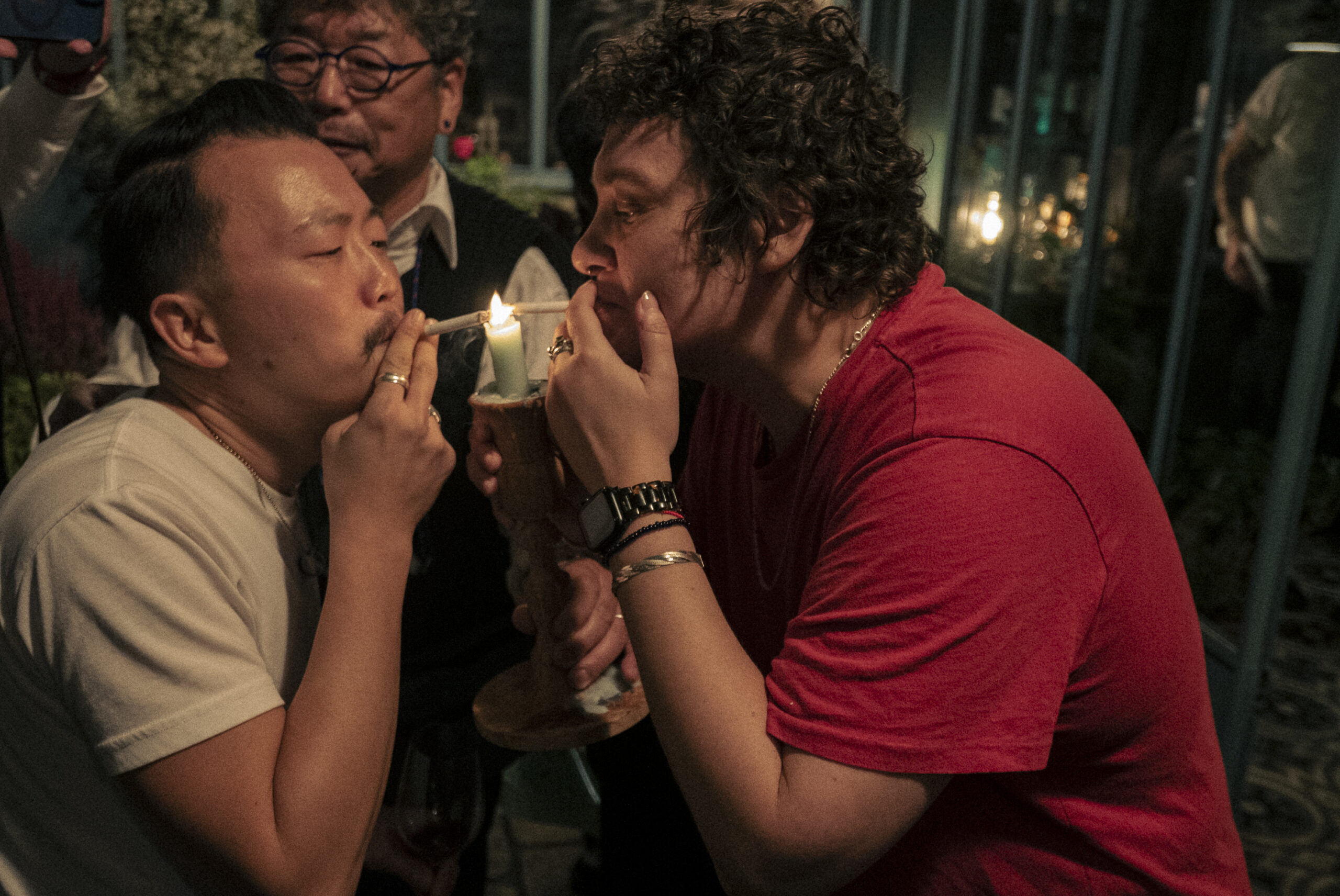
I don’t smoke in New York, but for some reason I smoke in Paris. It doesn’t count right? (It counts, I know.) Everyone’s lost their lighters tonight so we get creative, and steal a candle from inside. Dawn takes my camera. Reporting is hard, and it’s nice to have friends who let you take a break.
Sometime in the early morning, a few of us head outside to go home. My legs hurt and my voice is hoarse, but I love photography and I love photographers. Somehow I’m even more in love than before.

GOODNIGHT PARIS
SEE YOU NEXT YEAR


 in your life?