
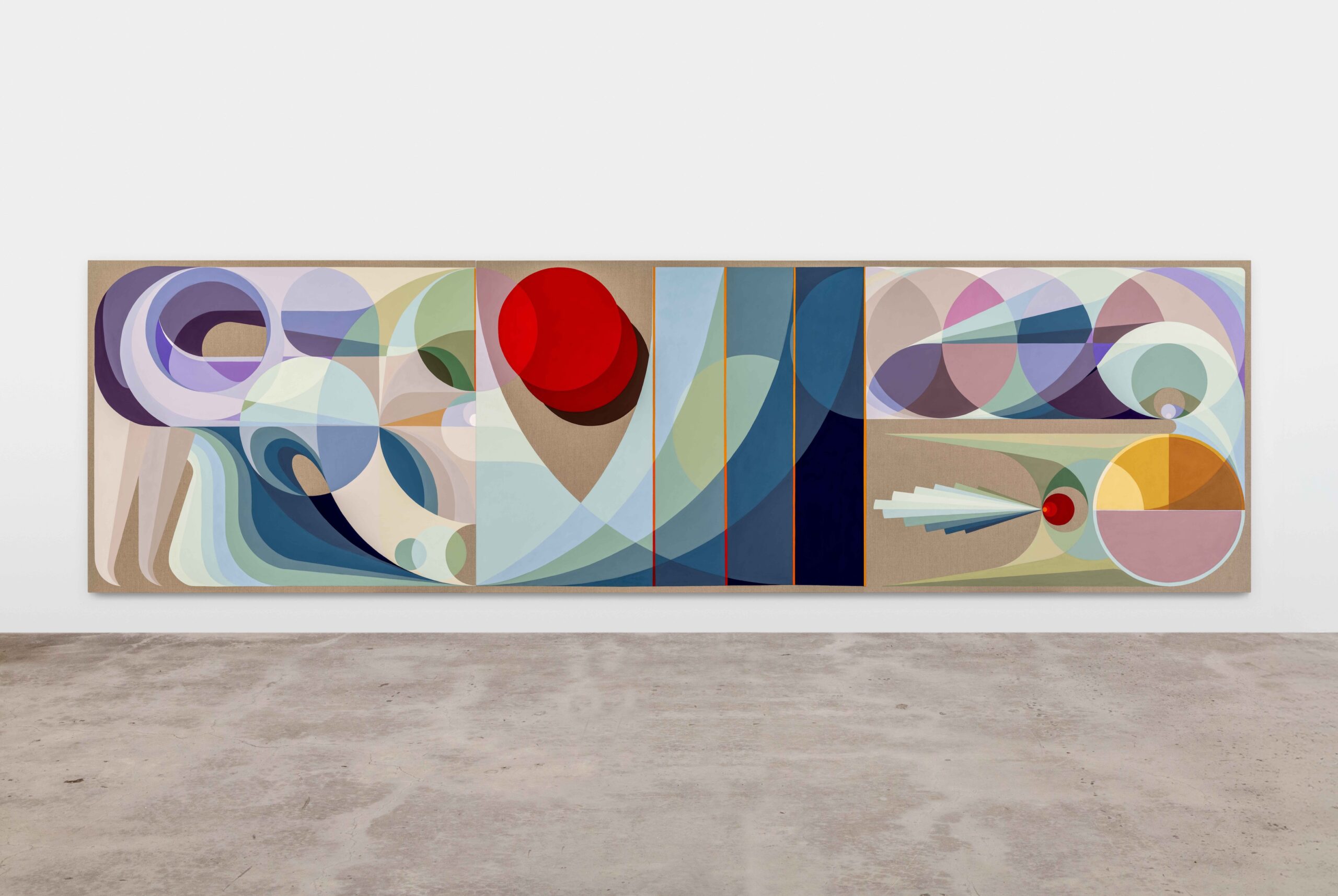
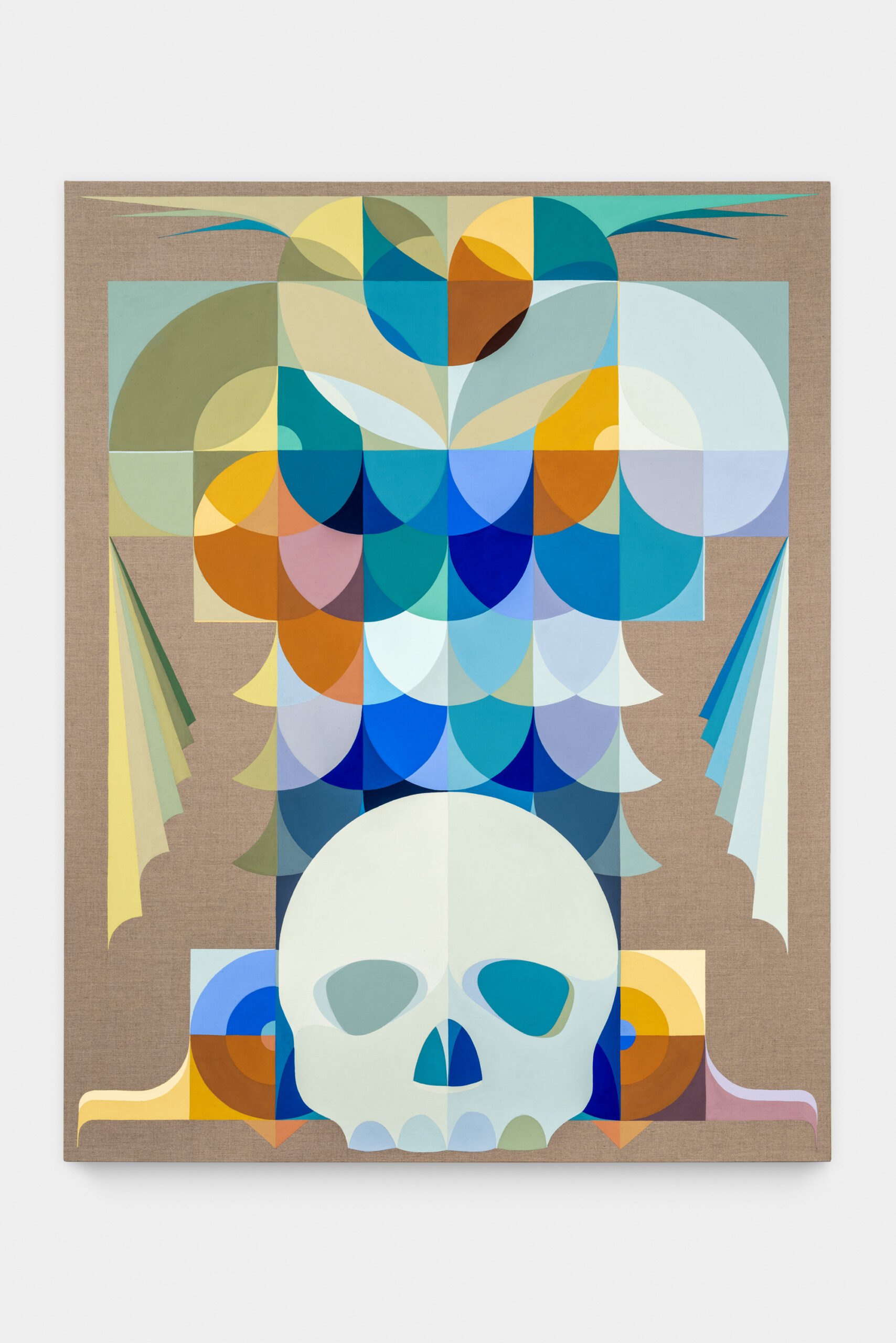
In downtown Manhattan, Eamon Ore-Giron is summoning deities and creatures. The artist has taken over James Cohan’s two outposts with “Conversations with Snakes, Birds, and Stars,” an exhibition of new paintings and mosaics that call upon ancient Mesoamerican and Andean symbology.
Running through Dec. 20, his latest showing sees serpents coil through gradients of color, stars crackle like sonic pulses, and mythic figures whisper back to visitors who linger just long enough. The pieces continue Ore-Giron’s long-running “Talking Shit” series—born during the Los Angeles-based artist’s time living in Guadalajara and shown at the Contemporary Austin, Whitney Museum, and LACMA before arriving in New York.
In the work, old symbols and figures continue to find resonance as their meanings are shifted and reinterpreted to meet the current age. “Painting is an archaic form of language, so when I engage with it, I’m speaking across time,” the artist tells CULTURED. Here, he shares how he delves into mythology, builds out his studio, and maintains a level of intimacy with his audience.

CULTURED: The title “Conversations with Snakes, Birds, and Stars” feels quite alive. How do you imagine these figures talking back to you, or to audiences?
Eamon Ore-Giron: In many ways, I have created a universe with this exhibition, and the conversations refer to the different layers of life in the universe. The snake inhabits the subterranean and the land, while the bird bridges the land with the sky, and the stars connect us to everything beyond. I imagine all of these figures talking to each other as well as to the viewer and me. The snake tells us about life moving like water, the birds sing stories about the sky, while the crackling beat of the stars creates the background soundscape.
CULTURED: Mineral paint and flashe both have an earthy luminosity. How do you think about color as a vessel for ritual?
Ore-Giron: Painting is an archaic form of language, so when I engage with it, I’m speaking across time. That earthy luminosity you are referring to is in contrast to the natural color and imperfection of the linen. That contrast between the vibrancy of the paint and the warp and weft of the brown raw linen opens up a dialogue to weaving, which is where I get a lot of my inspiration. In this context, color can hold emotional value, and that informs how I use it.
CULTURED: Much of this work is drawn from Mesoamerican and Andean mythologies. How do you decide which symbols or stories to revisit?
Ore-Giron: I began the “Talking Shit” series while living in Mexico, so it made sense to start with the most recognizable deities in Mexico–Quetzalcoatl and Coatlicue. I was curious about summoning these gods in their home and how they might be reinterpreted. I like to think of them as surrogates for my love of Mexico, and as guardians of my friends and family. As the series has expanded and I turned my attention to Peru and my people’s myths, I started to look at ceremonial and other cultural objects for guidance. A lot of the symbols and stories associated with these deities involve creatures that are in a state of transformation. I feel a kinship with these shape-shifting creatures moving through different phases of existence.
CULTURED: What kind of environment do you like in your studio when you’re working on these pieces?
Ore-Giron: I like working in the early morning, in an environment that helps calm my mind so I can focus and be present for the work. I listen to music that is more experimental, almost like soundscapes. It helps me to tune out the human world and allows my mind to wander.
CULTURED: A lot of your work plays with transformation—sacred becoming secular, old becoming new. What interests you about that in-between space?
Ore-Giron: Sometimes neglected spaces are sacred—or they once were and now they’ve become something different. In Lima, for example, there are crumbling, ancient pyramids in the middle of the city. They’re filled with stray dogs and trash. Around the corner from my cousin’s house there is one of these pyramids, and I imagine under the trash and dirt there are still golden objects decorated with spirits and beautiful patterns, sleeping underground, vibrating with ancient visions. These pyramids remind me of how things shift, how our priorities—as individuals and as societies—change. The value we ascribe to something is not fixed, and for me, this shifting and evolution over time creates a kind of openness that I’m interested in being in dialogue with.
CULTURED: Your work is full of motion: curves, gradients, and flow. What would you like viewers to feel when they move through your paintings?
Ore-Giron: I would like the viewer to feel a sense of pleasure as they absorb the movement in the paintings. I want the viewer to slowly discover what I sometimes call the broken symmetry—often at the heart of my work. My goal is to create a sense of beauty that pulls the viewer in, so that they can engage with the complex concepts and formal relationships within the work. When I am painting, I like to think that I’m carving space, expansiveness, and creating my own geological and architectural forms. I want the viewer to feel the way my paintings occupy space, to experience them as three-dimensional objects rather than as images on a two-dimensional plane.
CULTURED: The series title “Talking Shit” both feels irreverent and intimate. How do humor and informality serve as a portal to sacred or ancestral subjects for you?
Ore-Giron: You can only talk shit with someone who you know well, and I see informality as a way to access our broken histories, as a way of making them less distant. The artifacts I depict in the series are venerated, sometimes literally placed on a pedestal and in a museum. They become objects of study. They are so far removed from their original context; we forget that they were once part of a living culture, or that they were—or are—expressive objects that were meant to be used, or tell a story, create beauty, or even convey humor. I’m trying to bring these objects back into the realm of the personal and to the living, contradictorily, to bring them back into the present.
CULTURED: How do you balance honoring ancient traditions with creating something completely new and personal?
Ore-Giron: I don’t think I have found a balance, and maybe that’s the point. Maybe the point is to just dive in and see where it goes. I’m not trying to engage with ancient traditions by simply repeating them in the contemporary moment. I’m trying to figure out what they mean now or what they could mean now for me, and so far, what I have come up with is that honoring ancient traditions has become an act of creating community. As I have explored these traditions, as well as myths and artifacts, it has inspired new collaborative experiments and dialogue with other artists, musicians, and scholars.



 in your life?