Robert Goff, a journalist-turned-art dealer, has spent his career seeking out art experiences off the beaten path. He brings that expertise to Out of Office, a new column for CULTURED that explores destinations through the lens of the artists and creatives who live there. Each edition includes a behind-the-scenes look at the place, a recipe from a local, and specific tips on what to seek out.
You hike a few hundred feet through a flat patch of dusty ground, surrounded by spiky, twisted trees. Their formal name is Yucca brevifolia, but they were later dubbed “Joshuas” by Mormon pioneers who anthropomorphized the bearded trunks and imploring branches as prophets directing them, modern-day Israelites, to the promised land. In this case, your promised land, past a broken-down porcelain sink jutting straight out of the ground and a collapsed heap of rusted metal, is what looks like a whopping pair of concrete blocks.
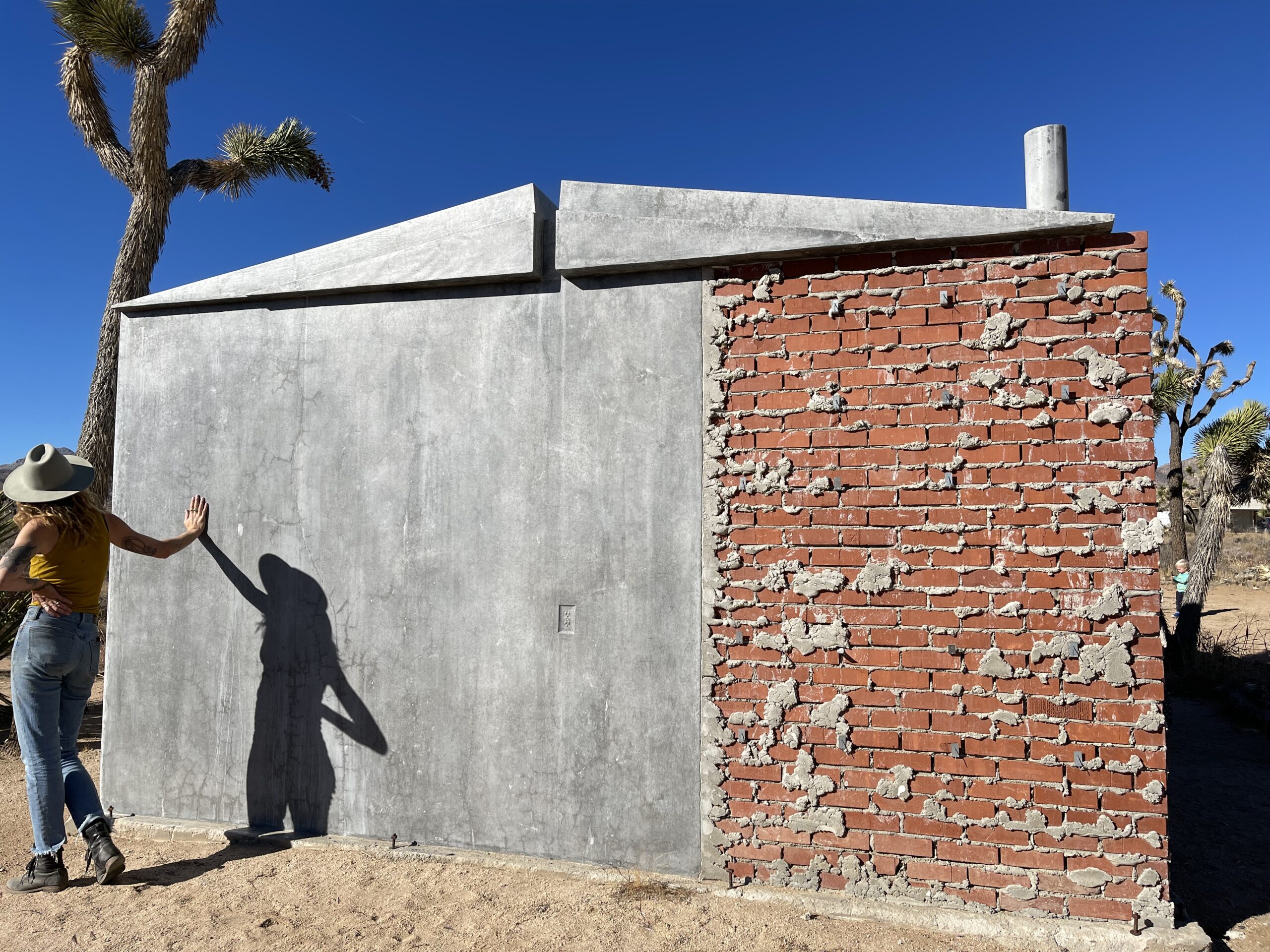
The story of those blocks began in 2010, when the reclusive Los Angeles based art-book publisher and patron Jerry Sohn invited the British sculptor Rachel Whiteread to visit the ruins of two 1950s jackrabbit homesteader cabins, tattered and moldering away on a swath of land he owned a two-and-a-half-hour drive from Los Angeles.
By 2016, Whiteread had cast the cabins in concrete, right down to the minutest socket and window-casing, remaking them into permanent but spectral traces of a time when this place was all but inaccessible and unknown. These sublime works of outdoor sculpture are accessible if you have the correct coordinates. They’re technically on private property—Jerry’s—but hardcore art tourists are welcome. They are among the many works of art that dot Joshua Tree and the Yucca Valley for those willing to seek them out.

I relayed the story about Whiteread’s cabins to CULTURED editor-in-chief Sarah Harrelson over a two-hour lunch recently at Petit Trois in Los Angeles, where we ate endive salads and duck confit in a canopied corner of a Hollywood strip mall parking lot, à la façon Los Angeleaise. After I told her that I used to be a journalist, Sarah offered to let me try my hand at a column on art-related food and travel.
My qualifications are pretty thin: rusty writing skills, strong opinions, and frequent travel for my job. As of this week, I am Deputy Chairman and President of Private Sales at the art advisory Gurr Johns; before that, I co-directed David Zwirner Los Angeles. I also once worked for Barbara Gladstone, where I was frequently in the doghouse for “wandering off.” For me, though, wandering is generative; many of life’s best experiences come from straying from where you’re supposed to be. Wandering is the best kind of travel.
Covid curtailed my gallivanting ways. I’d been hiding out in Palm Springs with my husband and son since March, locked down in an A. Quincy Jones-designed compound of houses with a New York collecting couple, the then-curator of the Palm Springs Art Museum, and Rod Stewart’s chiseled handyman.
I was delighted when, in October 2020, my friend Clayton Baldwin, a realtor and the unofficial art mayor of the High Desert, invited me to an outdoor dinner at the artist Andrea Zittel’s A-Z compound in Joshua Tree, organized by the sculptor Dan John Anderson.
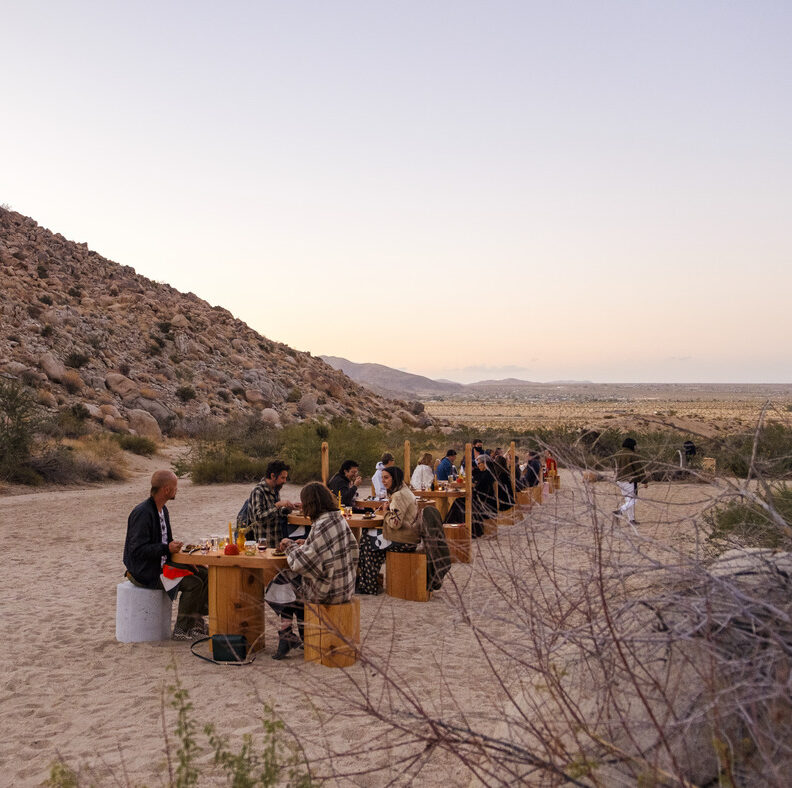
When I arrived at A-Z West, in the foothills of the Little San Bernardino Mountains, a guide showed me up a path past several Zittel camping pods into a natural amphitheater of tawny dirt, scraggly creosote bushes, and round-bouldered megaliths.
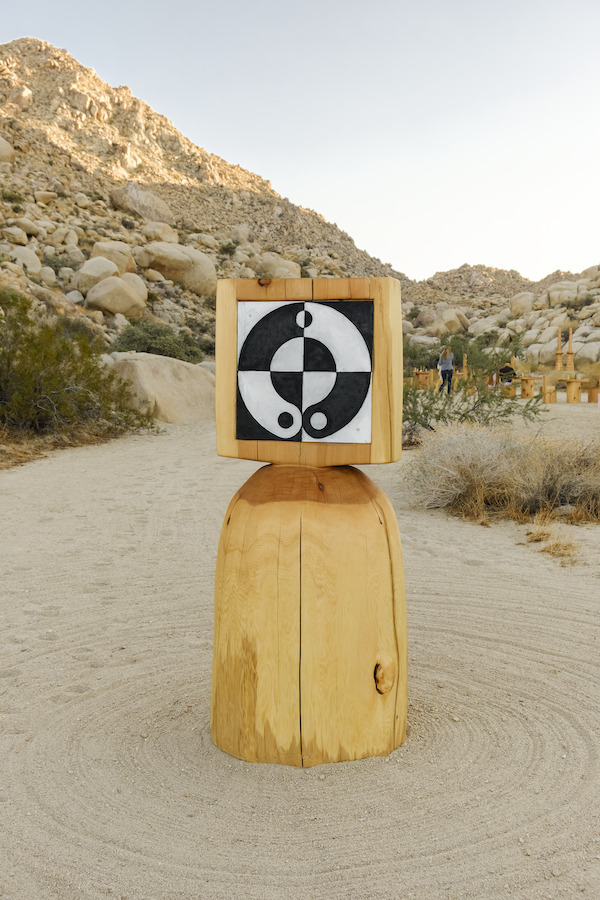
The dinner itself was a Gesamtkunstwerk: Dan organized every part of the experience. The best restaurant in the High Desert, La Copine, served smoked salmon Napoleons with caviar and quail grilled over binchotan coals with melted fennel, plums, and juniper. Stray Ceramics had produced 30 sets of Dan-designed ceramic dishes in 30 days. Farrington Press printed the linen napkins from wood blocks Dan carved. Yucca Valley Material Lab created molds from objects Dan made in wood and cast the glass candleholders, vases, and bronze worry stones for the tabletops. Dan himself made the dinner tables and chairs and installed eight sculptures around the mountain bowl where we ate, socially-distanced, under a veil of stars. A Dan John Anderson worrystone was my first post-lockdown in-person art purchase.
Artists, makers, facilities for artists, and a community of cultured and fascinating creative people abound in the towns that make up the High Desert, which is both a geographic place and an idea about a way of life. There is plenty to do: Pappy and Harriet’s modest outdoor stage in Pioneertown, a neighboring hamlet of Joshua Tree, is one of the best live music venues in Southern California and has hosted acts from Lucinda Williams to Lizzo. (Go to Orville Peck’s Rodeo in November.) You can join a meditation group or zone out in a sound bath at the Institute for Mentalphysics in Joshua Tree. Or take a welding class at Yucca Valley Material Lab.
Within the sublime and restorative natural environment, it’s visual art that infuses the place. Ed Ruscha bought hundreds of acres near Pioneertown in the 1970s and since then, it’s been a haven for contemporary artists working in every medium. Noah Purifoy came in 1989 and Jack Pierson and Andrea Zittel around 2000.
“The greatest luxury for an artist is having enough time to do your work and enough space to do it in,” says the artist Lily Stockman. “Out here you might be poor, but you’re rich in time and space.”
Other artists who currently live and work in the area full or part-time include Liza Lou, Jonathan Cross, Shari Elf, Edie Fake, Harrison Fraley, Colin Holloway, Janelle Pietzrak, and Ryan Schneider. Alma Allen, who now lives and works in Mexico, built much of his career there, conjuring work and forms from nature.
Apart from the Whiteread “Ghost Cabins,” completely accessible installations around the area include Purifoy’s Outdoor Desert Museum, A-Z West (which has many installations on the property, including Zittel’s “Planar Pavilions”), and Pierson’s “The End of the World” in Twentynine Palms.
There are also art installations on private property—including a series of Arata Isozaki “outdoor bedrooms” that can only be seen with special access.
Most of the population of Yucca Valley, Joshua Tree, Pioneertown, and the environs aren’t artists and hipsters. There are far greater numbers of rednecks, dropouts, hippies, and the 60,000 or so soldiers and military families attached to the nearby Marine Corps Air Ground Combat Center in Twentynine Palms. Unlike Palm Springs, the scrappy towns of the Morongo Basin weren’t built for the rich, famous, and old. There is no museum or fancy gallery. You can feel the art there, but you’ll have to get a little dusty to find it.
Location-Inspired Recipe: Lily Stockman’s Autumn Persimmon Pudding
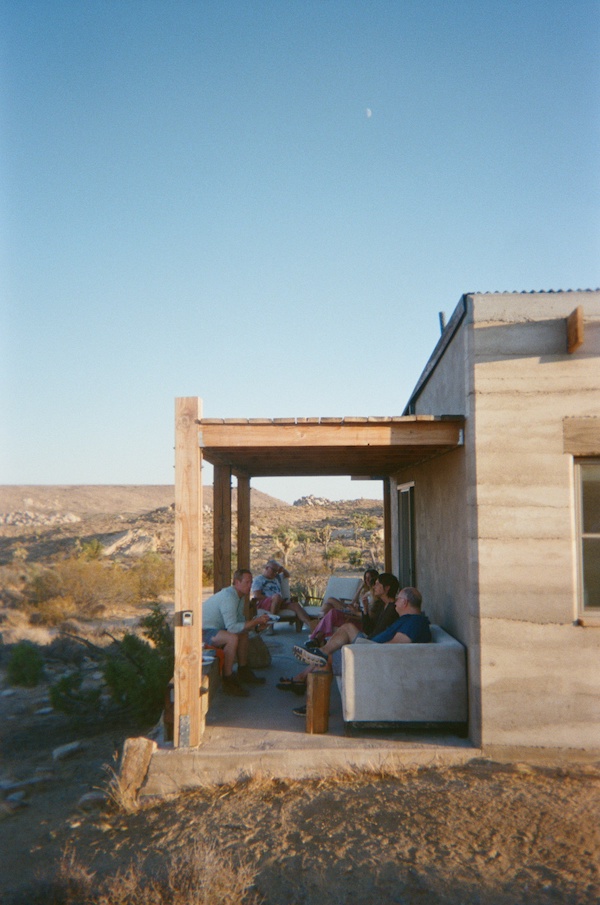
Persimmon season in California is October and November, when the farmer’s markets are stacked with the amber, acorn-shaped fruit. “I get my persimmons from Mr. Mendoza, my octogenarian neighbor in LA.” says Lily Stockman. “The recipe is gospel in my house during the holidays.” She serves this both for Thanksgiving and Christmas at her home nested in the boulders of outer Pioneertown. Adapted from the beloved 1985 seasonal cookbook Taste the Seasons by Linda Brandt, which you can find on eBay, it’s best presented with a crown of stiff whipped cream.
Ingredients
- 3 very ripe Hachiya persimmons (allow a week to ripen until custard-like goo inside)
- 1 1/2 teaspoon baking soda
- 1/2 cup softened butter
- 1 1/4 cup sugar to taste
- 2 lightly beaten eggs
- 1 1/2 teaspoon vanilla
- 1 to 3 tablespoon brandy to taste
- 1 teaspoon lemon juice
- 1 cup flour
- 1 1/4 teaspoon cinnamon (I’ll add a pinch of cardamom sometimes, too)
- 1/4 teaspoon salt
1 cup raisins (I soak them in brandy or bourbon to plump up before adding)
Directions
- Step 1
Grease a 2-quart pudding mold and its lid with butter. (You can substitute foil for the lid.)
- Step 2
Peel persimmons and place in a blender or food processor. Whirl until smooth, then transfer to a measuring cup. You should have about 1 cup of purée. Stir in baking soda; set aside. - Step 3
Cream butter with sugar in a large bowl until fluffy. Add eggs, vanilla, lemon juice, brandy, and persimmon purée, whisking well to combine. - Step 4
Sift flour with cinnamon and salt into persimmon mixture. Stir to combine; fold in raisins. - Step 5
Spoon mixture into prepared mold and secure lid (or cover tightly with foil). Place on a rack in a large pot filled with 2 inches of boiling water. Cover and steam for at least 2 1/2 hours, adding more boiling water as needed. Remove and set aside for ten minutes to cool. - Step 6
Invert pudding onto a serving plate to unmold. Serve warm with whipped cream (I go heavy on the vanilla and beat until quite stiff so it holds its shape). Heaven!
Practical Information
How to Get There:
Driving from Los Angeles: With light traffic about 2.5 hours.
Driving from Palm Springs International Airport: 30-40 minutes
There is a small airport and helipad at the Yucca Valley Airport.
Places to Stay:
Homestead Modern: If you want to wake up to boulders and Joshua Trees, try the Hi-Desert Fade property on Gamma Gulch Road. Pretend you’re Andrea Zittel, or a member of her studio for a day and stay at A-Z West house.
The Bungalows at the Joshua Tree Retreat Center: Better known as the Institute of Mentalphysics) and designed by Lloyd Wright, and built in the late 1940s.
Pioneertown Motel: Built in the 1940s by Roy Rogers, gussied up and a perfect stumbling distance to live music venues.
Places to Eat:
La Copine: lunch and brunch, open 11 a.m.-4 p.m.
Tiny Pony Tavern: lunch, dinner, drinks, drag and karaoke
Pappy and Harriett’s: live concerts, lunch and dinner
Red Dog Saloon: lunch, dinner
Luna: breakfast, lunch, and takeaway
The Copper Room: Dinner and drinks
Desierto Alto: gourmet foods, wine, and a huge selection of tequila and mezcal; take-away


 in your life?