WORDS

DATE

SHARE

Twitter
LinkedIn
Facebook
Email

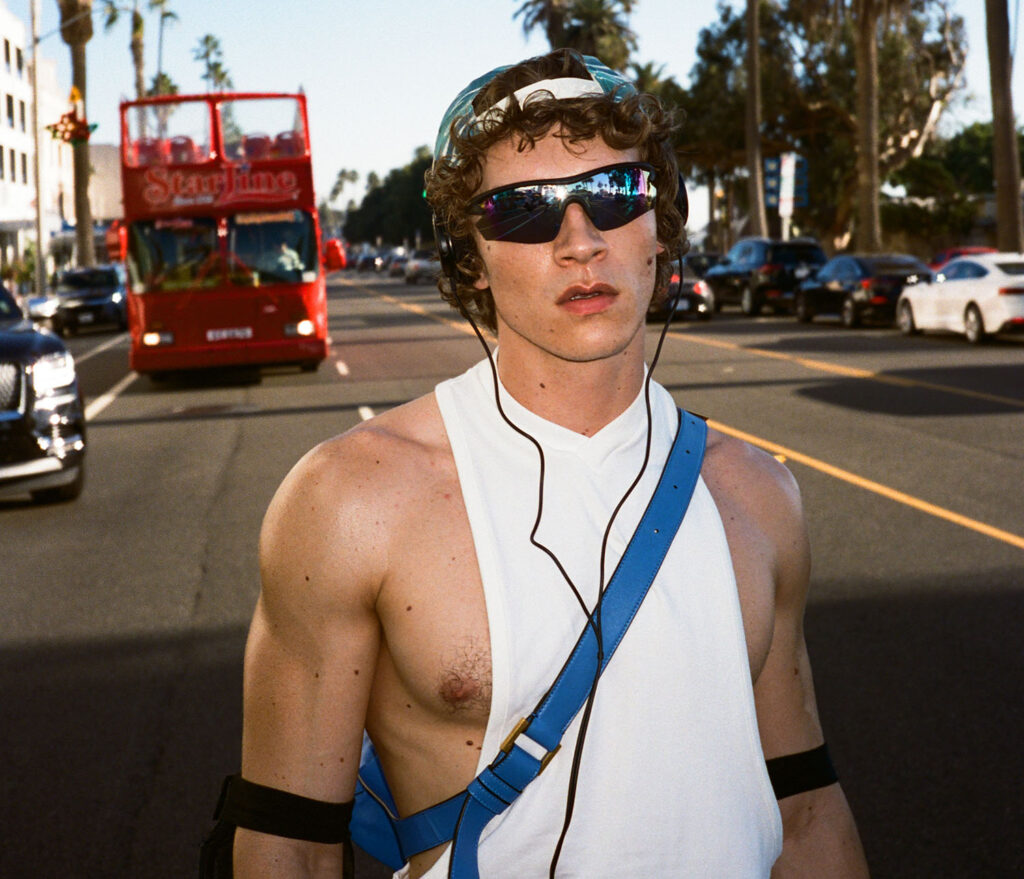
Nancy Lupo in New York, 2018.

Nancy Lupo is gluing tiny polypropylene pellets to the cover of a 1994 Dodge Caravan when I arrive at her downtown Los Angeles studio. “They’re for stress,” she explains of the tiny objects, which are reminiscent of the sort one might find inside a tension relief ball. We slip into a conversation about materials, like stress balls and Soylent, that have been co-opted by Silicon Valley and rebranded for the capitalist worker bee. This interrogation of how objects act in context is oft-visited territory for Lupo.

The bedazzled tarp is one of the pieces she will show at the Hammer Museum’s biennial “Made in L.A. 2018,” which opens in June and runs through early September. Those who know Lupo’s work will recognize her nuanced use of materials that make the familiar less so to the viewer. Her installations generally include ordinary objects— furniture, dog bowls and plastic Rubbermaid trash cans, to name just a few. “It all has to be ‘real’ stuff, because what else is there?” she asks. “Everything is something. Even paint is a mixture of calcium carbonate and other materials.”
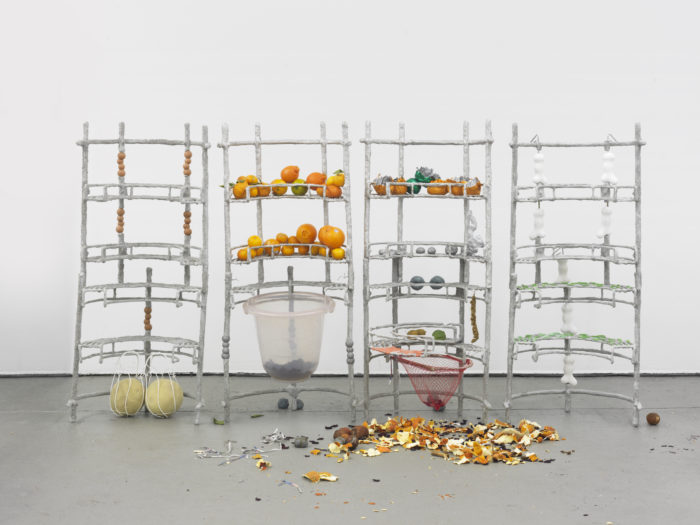
Nancy Lupo’s installation Parent and Parroting, 2016, at the Swiss Institute, New York. Courtesy of the artist and Swiss Institute.

“For me, the art is in the space that a form holds,” she says. “The trash can isn’t exactly a sculpture—it’s an activator. I want the viewer to reevaluate the actual thing they are seeing in the world.” This sort of revelation is precisely what an encounter with Lupo’s art provides. A series of her benches included in “Made in L.A.” are derived from those the artist saw on the streets of Shanghai and LA. “I’m interested in asking how these objects become visible,” she says. “The art is somewhere in between the park, literally as it is, and something else.” We discuss how, when walking in a city, one is likely unaware of the area’s larger context and layout. “There’s a moment when you’re just a body, alive, and you can’t see these geometries or designs in the streets,” she says. “But if you have some sort of vantage, you have access to so much information.”

Lupo’s practice provides both immersion and perspective. To engage with her work is to view the way objects present themselves to the artist, and to then reevaluate how they present to oneself. A park, Lupo says, is a space “to be deeply inside of your body, locked in your emotions, sensing what it is to be alive.” The same could certainly be said of experiencing her work.
We’ve Waited All Year For This…

Our 10th annual Young Artist list is here, comprised of 27 names you need to know ahead of 2026.

You’ve almost hit your limit.

You’re approaching your limit of complimentary articles. For expanded access, become a digital subscriber for less than $2 a week.
You’re approaching your limit of complementary articles. For expanded access, become a digital subscriber for less than $2 a week.

Already a Subscriber? Sign in Here

You’re approaching your limit of complementary articles. For expanded access, become a digital subscriber for less than $2 a week.

GET ACCESS

Already a Subscriber? Sign in Here

Want more in your life?

For less than the price of a cocktail, you can help independent journalism thrive.

Pop-Up-1_c
Already a Subscriber? Sign in Here
Pop-Up-1_c

Already a Subscriber? Sign in Here

Want more in your life?

For less than the price of a cocktail, you can help independent journalism thrive.

Pop-Up-1_c
Already a Subscriber? Sign in Here
Pop-Up-1_c

Already a Subscriber? Sign in Here

You’ve almost hit your limit.

You’re approaching your limit of complimentary articles. For expanded access, become a digital subscriber for less than $2 a week.

You’re approaching your limit of complementary articles. For expanded access, become a digital subscriber for less than $2 a week.
Already a Subscriber? Sign in Here
You’re approaching your limit of complementary articles. For expanded access, become a digital subscriber for less than $2 a week.

Already a Subscriber? Sign in Here

This is a Critics' Table subscriber exclusive.

Subscribe to keep reading and support independent art criticism.

Already a Subscriber? Sign in Here

Want more in your life?

For less than the price of a cocktail, you can help independent journalism thrive.

Pop-Up-1_c

Already a Subscriber? Sign in Here

Pop-Up-1_c

Already a Subscriber? Sign in Here

You’ve reached your limit.

Sign up for a digital subscription, starting at less than $2 a week.

Already a Subscriber? Sign in Here

Want a seat at the table? To continue reading this article, sign up today.

Support independent criticism for $10/month (or just $110/year).

Already a subscriber? Log in.