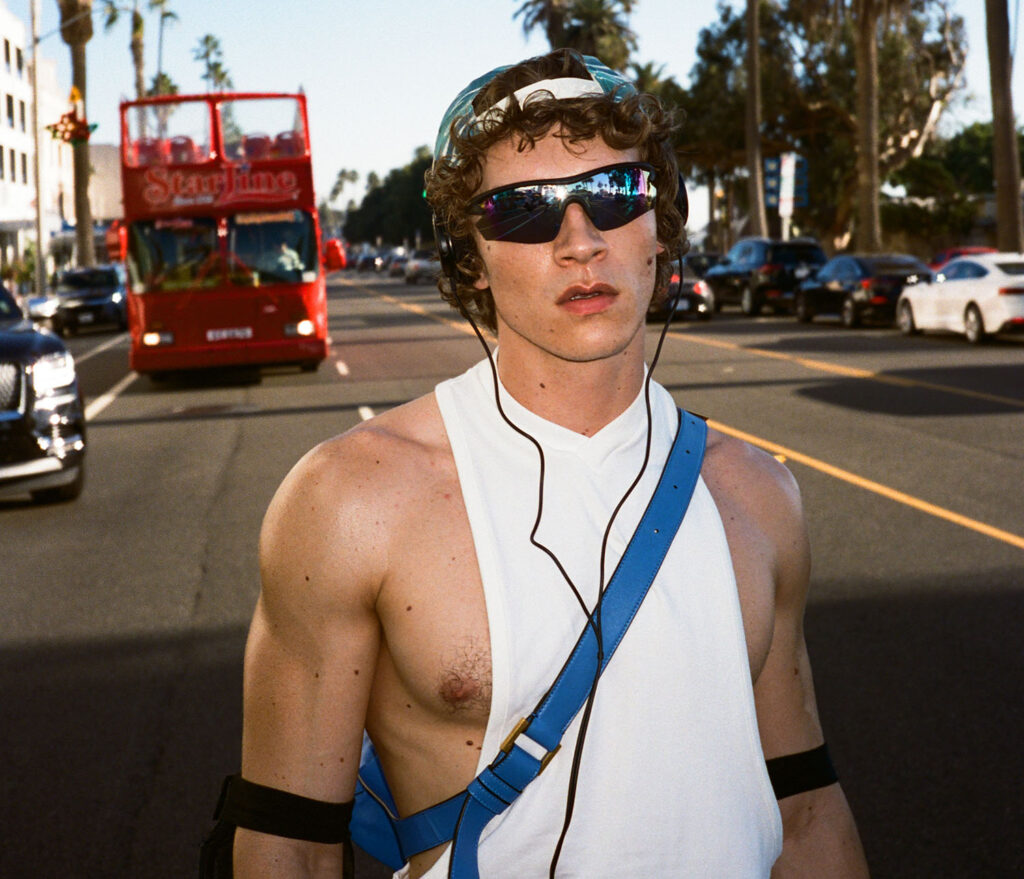
A co-founder of Auto Italia South East–an artist-run space in London–British artist, Kate Cooper, began her career within a distinctively collaborative environment. Evolving over time from a laboratory for individuals into a prolific and often politically motivated collective, Auto Italia’s transition is very much aligned with Cooper’s solo career, which has taken off over the past two years thanks to a string of presentations and appearances at places like the Palais de Tokyo in Paris, where Cooper’s video work was shown alongside post-Internet favorites like Jordan Wolfson and Mark Leckey in a thematic show entitled “Humain Trop Humain.”
Separate from her work with Auto Italia, Cooper still relies on the help of skilled friends, like photographer and filmmaker Theo Cook, to help bring her concepts to life. “I have always been fascinated by group and collaborative practices, the politics and history that work has provided, particularly within women’s groups,” explains Cooper. “My work with Auto Italia is something I have always felt really proud of and has been an opportunity to explore ideas and possibilities to do work in different ways.”
If collaboration is at the heart of Cooper’s practice, then digital media composes its savvy dermis. In the fall of 2014, her simulated smiles, freckled cheeks and yoga-toned bodies lined the walls and floor of Berlin’s KW Institute for Contemporary Art for Rigged, her institutional debut. Made up of uncannily lifelike stills and videos of computer-generated women, the solo exhibition came to fruition in recognition of her Schering Stiftung Art Award. Rendered on neutral pastel backdrops, her animated characters conjure the sterility of a dentist’s office or airbrushed infomercial. The reproduction of the female body as a marketing tool and virtual commodity is an ongoing preoccupation for Cooper, whose work in the past has examined the visual language of hyper-capitalism on both an individual and societal level.
“There was a link to female bodies found in commercials and pornography and I wanted to understand what was at stake with these new highly modified, coded images,” says Cooper of her inspiration. “I wanted to explore my gut reaction, the problematic combination of violence and desire these computer-generated images produced. What was the inherent politics in these images? I simply couldn’t unpack them. I wanted to make work that circulated and existed within the same terrain to uncover their potential function.” Not afraid to get her hands dirty, Cooper often adopts the aesthetic of her subject matter.
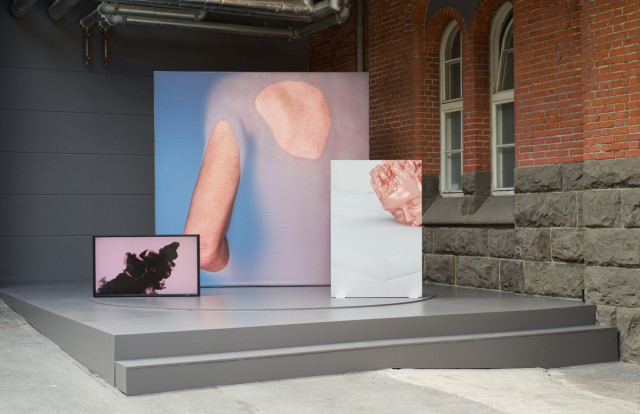 Exhibition view of Cooper’s work, 2015. Courtesy Art Berlin Contemporary.
This playful collapse between subject and medium allows her the freedom to inspect and dissect without a specific goal in mind. “My practice has always been about trying to discover how you might be critical while at the same time being within something,” says Cooper. “The politics of display has always been interesting to me. I’m fascinated by how successful display is integral to an exhibition space but could be conflated with merchandising and other formats of hyper-capitalism.” Next up, Cooper prepares for “Spending Quality Time With My Quantified Self,” a group show at the TENT exhibition space in Rotterdam running through April 10. Her installation will look at the relationship between humans and machines alongside the work of other technologically minded peers like Anna Zett and Jenna Sutela. With Auto Italia, the focus will be “On Coping,” a project looking at how artists work with increasing economic pressures. “The thing that always draws me back in is making work,” she says. “I absolutely love producing projects and thinking through my own ideas, working in collaboration other artists.”


 in your life?