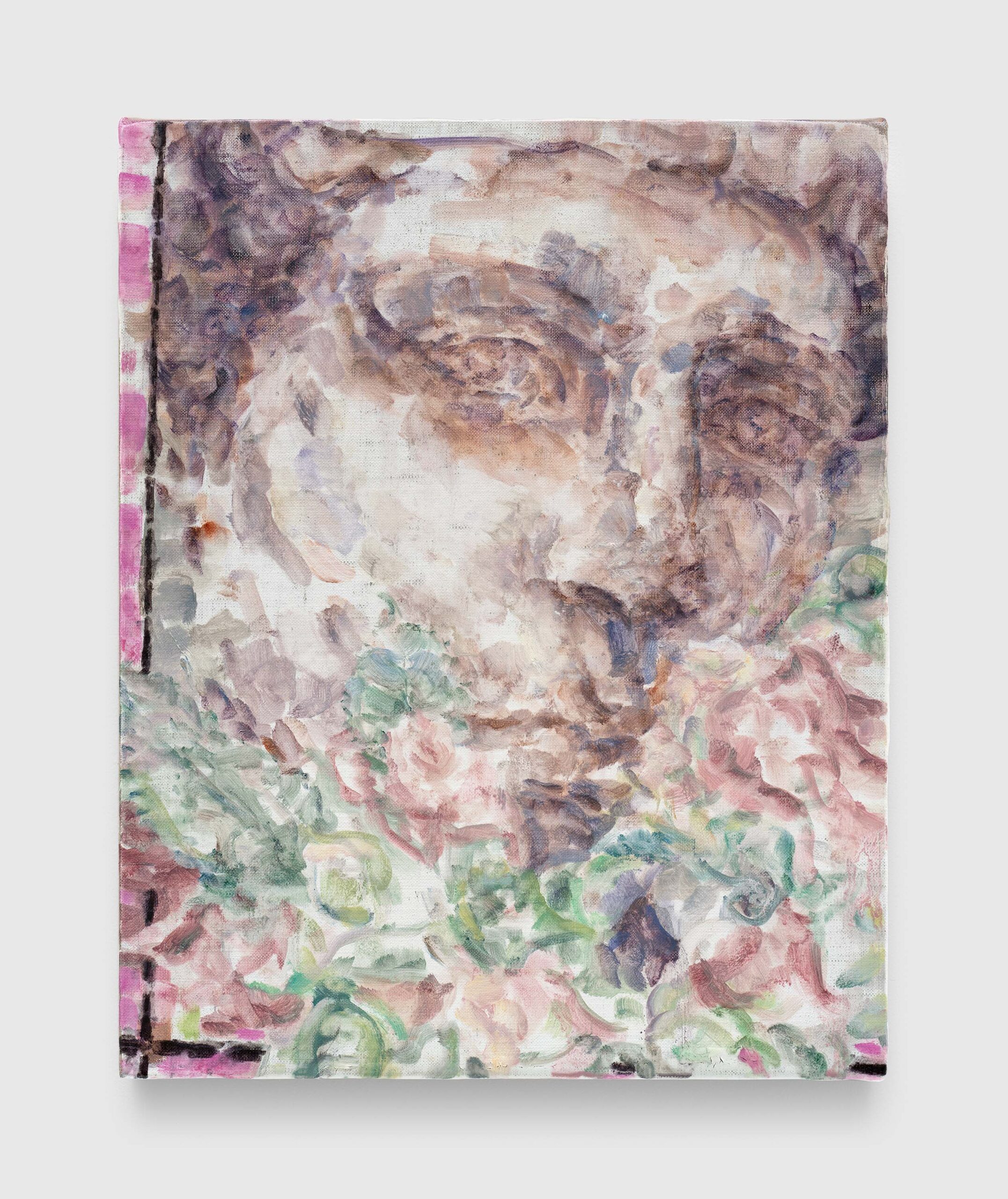
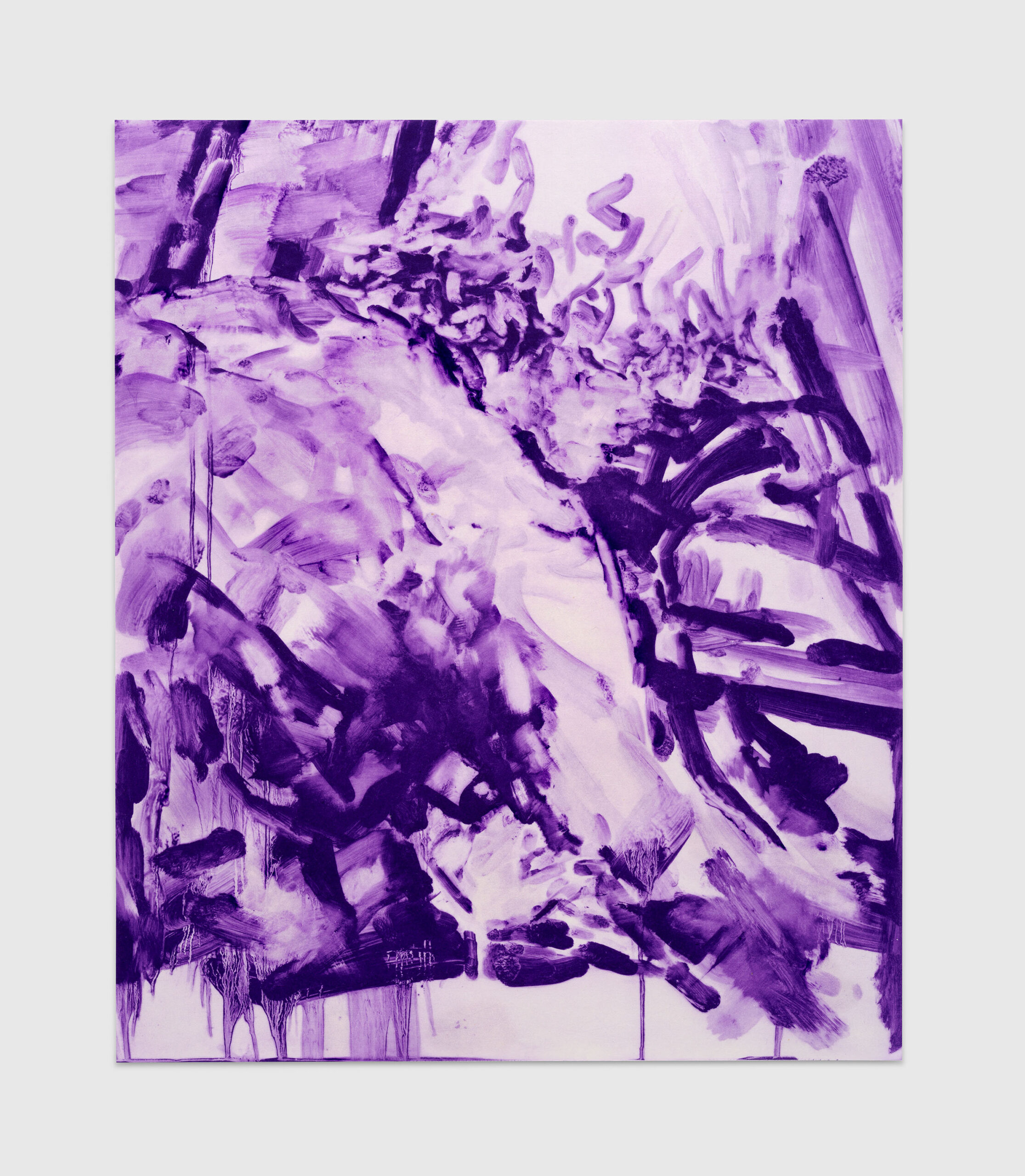
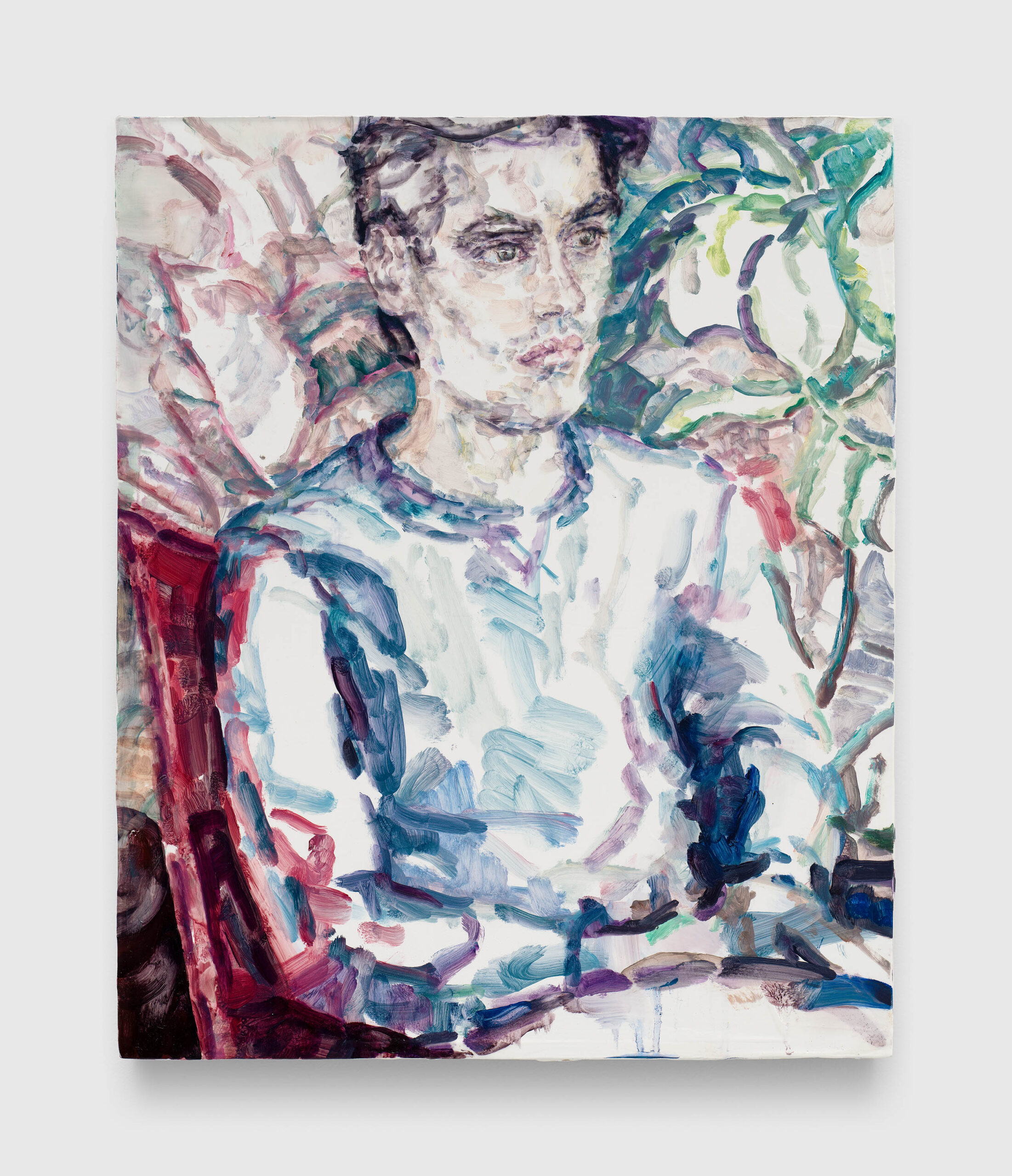
“Elizabeth Peyton: mountains in my heart (the death of Sarpedon),” the painter’s New York solo debut with David Zwirner, fills—or rather, doesn’t fill—the gallery’s airy rooms on West 19th Street. There is plenty of space here, both between the works on the walls and the brushstrokes that compose the small-scale and exquisite, but not delicate, pictures. Peyton has always, since her early shows with Gavin Brown in the 1990s, followed her heart in choosing her subjects, drawing from a pop pantheon (among them, famously, Kurt Cobain and Liam Gallagher) and historical figures (such as Napoleon), as well as from her own circle of friends, capturing each in her lovingly observed, deceptively fey, very serious figurative work. Decades later, the earnest essence of her project and her commitment to it remain unchanged. And, this time, a Trojan hero is her marquee name.
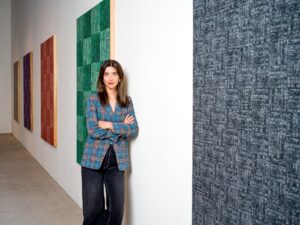
The artist, who has been in Paris—she is an artist-in-residence at the Louvre, keeping a studio in the palace since 2023—meets me at the gallery on an overcast spring afternoon shortly after her show’s opening. I’m struck by how the etheric, mythic space of Peyton’s paintings, in never-overworked pictures of people as different as 24-year-old musician Cameron Winter and 20th century French philosopher Simone Weil, is extended by the gallery’s expansive scale and natural light.
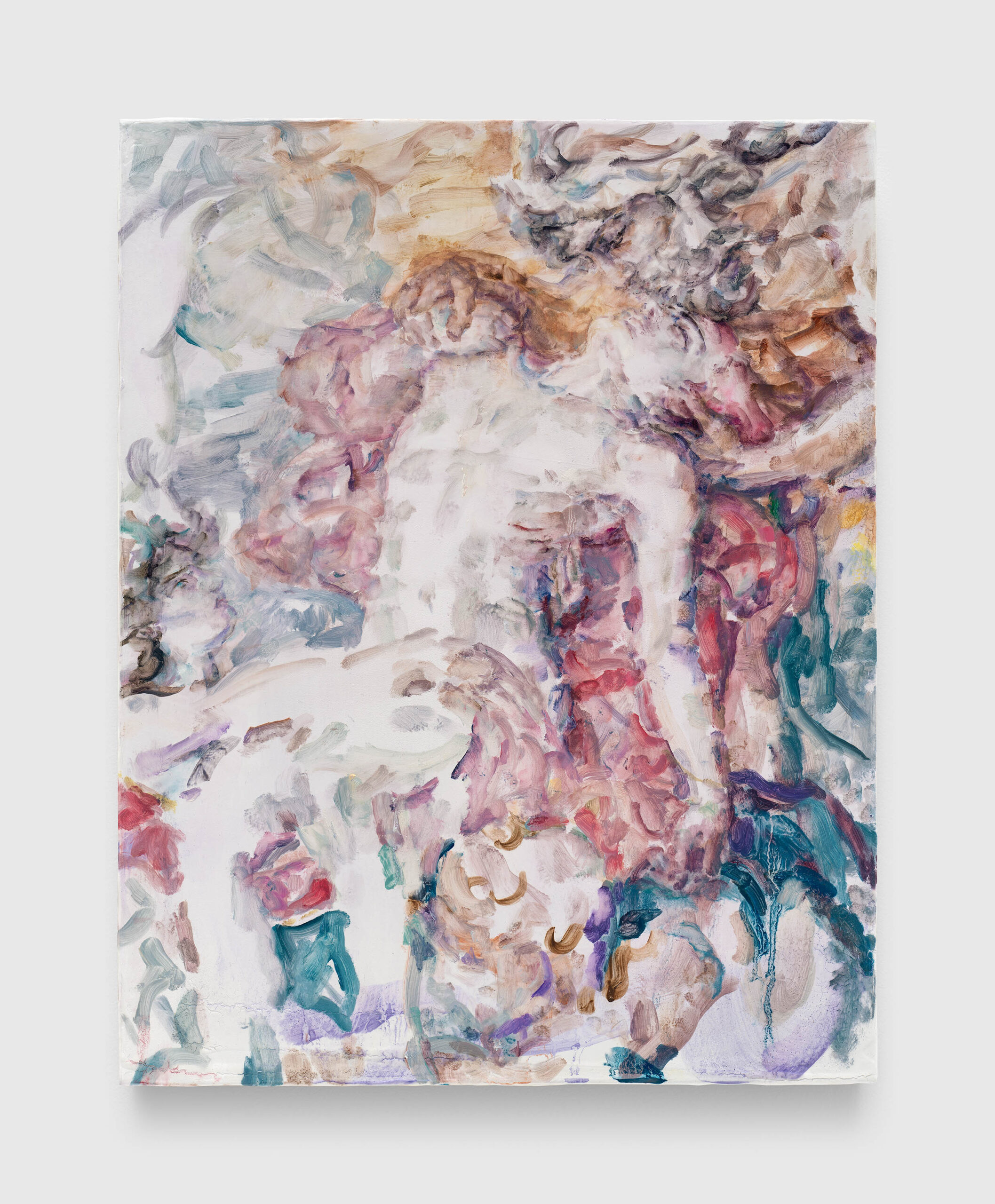
We begin our conversation standing before the exhibition’s title work, her version of the death of Sarpedon, after a 19th century painting by Hénri-Leopold Lévy. I’ve been sure to brush up on the relevant passage of the Iliad beforehand. In the story, Zeus reluctantly decides to let Sarpedon, his son, die in the Trojan War.
The death of Sarpedon is a beautiful story. As I read, I wondered what part of it moved you so much. Was the Lévy painting your entry point?
I first saw the painting at the Musée d’Orsay “Paris 1874” show. I could not get this picture out of my head. At the time, I didn’t know the story of the Iliad—I even thought the bearded figure in the painting might be God. I had been reading Simone Weil. She writes about the Iliad as her favorite poem, about force—about the way those in power always make the mistake of believing that force and power are permanent, that it can be exercised without limit, without ever being reversed, without realizing that the very next day they may find themselves under someone else’s power or dead.
Then someone very close to me passed away, and I kept returning to that painting. Suddenly it opened up in a completely different way—as a very natural, inward sense of what it means to respond to death, of how one might honor it. So I read the Iliad, and that was that. Zeus looks at Sarpedon, his son, and says that he loves him more than any other mortal man. He wants to save him. But Hera, his wife, tells him that he cannot interfere with his fate. There are many sons of gods on the battlefield, and if he rescues his own, the others will want to do the same. He has to let him go. So instead of resisting, he lets it happen. “He rains down tears of blood upon the earth.” And then he asks his son Apollo to lift Sarpedon from the battlefield, to wash the blood from his body in the river, to anoint him with ambrosia, to clothe him, and to entrust him to the twins, Hypnos and Thanatos, angels of sleep and death, so that they may carry him back to Lycia, his homeland, where he can be properly honored. There is something in that gesture that I find both heartbreaking and, at the same time, deeply consoling. Because everything is acting on everything in the same way—the curves, the ascending and descending. I’ve been thinking a lot about this movement, not only in relation to Sarpedon being carried back to his homeland, but also in the mountains, and more generally in everything, and in painting itself. It’s a constant movement of rising and falling, and in a way that is simply the nature of everything that is nature.
That quality of constant transformation—is there a parallel there for you, in your painting?
Transformation … this is life, nature, and making a painting—at least for me—contains this same quality. When I was younger, I used to think that painting was a way of making life stand still—now I feel it to be the opposite. I want the picture to be a place of movement, rhythm, life itself … an open container. When I am working—other than having an urgent desire to do something about what I am being inspired by—there is no plan; I begin with one mark and from there my attention is attending to what is unfolding from the marks—the way they are moving around. Staying in tune with a mark that feels true makes me feel something—and following along as it unfolds, working back and forth into those marks and accidents…
What’s your favorite painting here? Do you have a favorite?
Thank you for asking. I love all of these pictures. They are all from the last three years. The painting of the death of Sarpedon, the two etchings of Cameron Winter, the two still lives, the painting of the Cardinal and the painting of Jules Esteves [a book designer and Peyton’s friend] are the most recent. Some took years to make until I was happy with them, some came flowing down like a river. This is true of the painting of the French philosopher, mystic and activist, Simone Weil—it wouldn’t let go of me until it was finished. It is hard to single out the pictures as favorites, as all of them I am so grateful to have gotten to be a part of.
How did you put the show together? Did you conceive of it as a show, or are these paintings…
Each picture is its own world… not supporting a single narrative. Though there was a kind of work that was going to feel right in this space. It feels like a temple in the gallery. I wanted the pictures to feel quite universal. I wanted to contribute love, things that make me feel the possibilities of life as hopeful with heights to aspire to… I was feeling drawn towards The Feminine, something kept catching my eye at home: fresh flowers with photos of sculptures of female faces. There was something crushing about the eternal life of the beauty of the sculptures and the present, almost dying flowers. With the background of what has been going on in the world, it feels like this is my way of contributing to the equilibrium. I am conscious that making art is my way to add to the landscape of the world—to make a space that can evoke and hold feelings. And I want to do that in a loving, positive way.
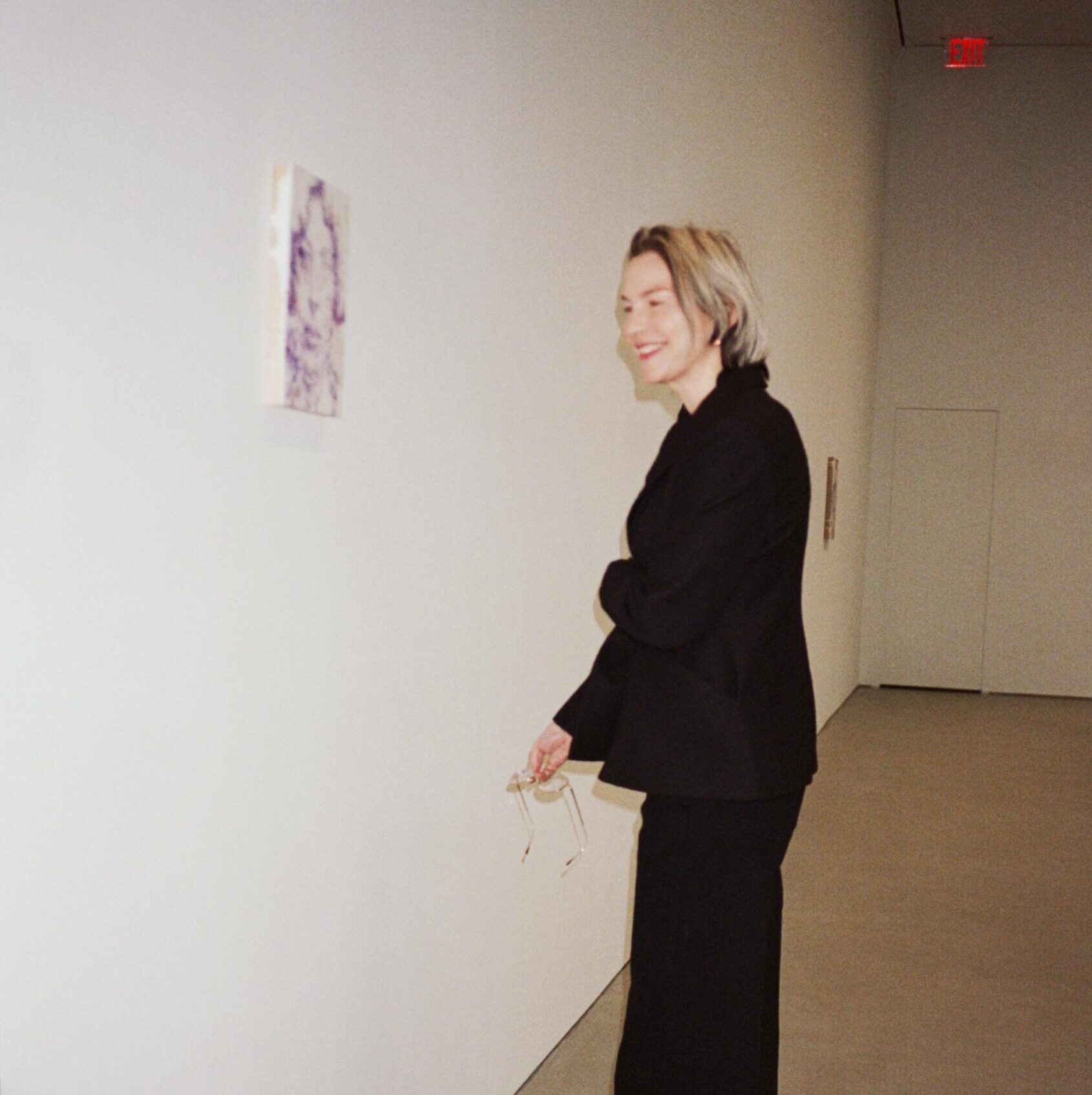
I was so happy when I walked in and saw these small paintings in this big space. You’ve kept your signature scale.
These pictures want space. In this space the compressed energy inside the pictures can expand. For me working in these sizes means I can keep my attention on the overall picture—what is happening everywhere—and the tiniest detail all at the same time.
What has it been like to be in Paris? And to work in the Louvre of all the magical places?
It is hard to describe. It is a dream, an unbelievable gift. I had been making copies of work in the collection of the Louvre since being a teenager; we could say my first teachers are the artists hanging in the Louvre. While I am in my studio there, I am conscious of the work that is below me from thousands of years of humans having to do something about what they are seeing and experiencing. From the Egyptians to the more recent European paintings in the collection, I’ve gotten to be closer to the conversation and community given from artist to artist, the past speaking to the present, the present speaking to the past and bringing it to the future.
Has it changed your work?
It has—it has changed my life. An example is what has come from spending time in front of Leonardo da Vinci’s painting of Saint Anne with her daughter Mary and her son Jesus. I was spending a lot of time alone with this painting, beginning copies of it, and then I invited my students from the Beaux Arts to come 10 at a time and sit on the floor in front of the Saint Anne and go through exercises of drawing it without saying much to them other than I wished them to capture the energy of this picture. The whole universe, love, is in this picture. It is dense with meaning and at the same time quite literal, which was making me think one can depict something in a naturalistic way and still contain the most mystical and abstract ideas.
Looking at your paintings, and now talking to you, I can see how much these timeless subjects—love, for example—are at the center of what you do. But your work has always been characterized also by its awareness of its own time, your engagement with pop culture. In previous interviews I’ve read, you push back a little on this idea that your work is “about” celebrity or fame (and I think anyone can see it isn’t only about that), but I’m curious what you think now about the balance of subjects in your work—between contemporary and historical figures, famous people and personal friends—because this is a through line, from the beginning.
I am not thinking about a balance of people from different times or separating them by a kind of fixed identity. I am interested in the human experience, our commonalities in being alive and what are we are going to do while we are alive. I’m wanting to communicate this universal humanity through the particular, having faith that the one human I am putting my attention on and is moving me has something in common with all of us.
More than anything, I am interested in what people create—art, relationships, the beauty of people living by their sense of truth. These things help me live, help me experience feelings, feel inspired and hopeful.
I am heartened that some of the people I make pictures of are well known—as they should be celebrated for what they are creating, the love they bring to us, and the safe places they make for us to process our feelings and experience of living. There is a mystery to being human, and that is expressed in all of the pictures, I hope. And I want to give viewers enough room to get inside of that. I think that’s quite literally why I leave so much space in my paintings—because it leaves a lot of room for other people. I never want to close it down, that mystery.
More of our favorite stories from CULTURED
Legendary Art World Deviant Paul McCarthy on Santa Claus, Trauma, and the Rise of Fascism
Gabby Windey Shares Her Book Recommendations for the Manosphere and Depressed Women Everywhere
15 Collectors Offer Their Best Advice For Getting Started
Bryan Stevenson on What Social Justice Movements Can Learn From March Madness
A Guide to the Real-Life New York Restaurants Where Characters Eat on TV
Sign up for our newsletter here to get these stories direct to your inbox.


 in your life?