In 2015, the work of Peter Hujar found its way onto the cover of Hanya Yanagihara’s best-selling novel A Little Life, a campaign for menswear designer Patrik Ervell, and the Christie’s auction block, where the artist’s 1973 photograph Candy Darling on Her Deathbed sold for $50,000, twice its estimate. Twenty-eight years after his death, works by the image-maker—once synonymous with the downtown underground—experienced a mainstream resurgence whose arc can still be felt today. (Ira Sachs’s film from last fall even zeroes in on the minutiae of his everyday life, and a new show at the Morgan Library opening in May will give fans an “unprecedented look” into the artist’s practice.)
Two new publications—Stay Away From Nothing and The Wonderful World That Almost Was—focus on Hujar’s enmeshment with Paul Thek, whose haunting sculptural interventions made him an art-world legend. The pair met in their 20s, and they would continue to orbit around each other—as lovers, brothers, and bitter adversaries—until their deaths nine months apart from complications of AIDS.
I sat down with Andrew Durbin, the author of The Wonderful World That Almost Was, out April 14, and the curator of “How Beautiful This Living Thing Is,” a group show on view at New York’s Ortuzar gallery from April 22 through May 30 that brings together work by eight of Hujar’s peers and friends, to discuss their elusive relationship, the competitive streak that undergirded it, and the women who witnessed it all.
A key theme in the book is the undefinable nature of Peter Hujar and Paul Thek’s relationship. You write, “They had become more than boyfriends, they were brothers, with an intimacy such that sex was hardly the most important thing… They were lovers; they were friends. The distinction was confused, and out of that confusion they had only grown closer.” Their relationship seems more fluid than many of the queer relationships, including the non-monogamous ones, I see today.
Peter and Paul had so many models for queer relationships and yet also so few. Queerness hadn’t been taxonomized in the way that it is now. And if you look at the artists and writers who immediately preceded them, there were so many different arrangements, whether you think about Lincoln Kirstein and Fidelma Cadmus, or Glenway Wescott, George Platt Lynes, and Monroe Wheeler. [But] I think they weren’t primed in the way we are today in a post-Stonewall world to even reach for an identification, to even need to put language to it. It was in many ways irrelevant to them. That also reflected who they were as artists and as individuals in general. They were people who were quite indifferent to categorization.
Another theme in the book is rivalry and how Peter and Paul really turned against each other. Gay men often compete with each other, and this book is a vivid portrait of that.
The theme of rivalry came very naturally out of the research because it’s a word that Paul uses a lot, and it’s a word their friends would often use when thinking about them. It was clearly painful for people who loved them both to watch these two people who they’d never seen closer in some ways, and who never seemed better matched, descend into not just a sort of quiet distance but actually something that was closer to rivalry.
I’m not surprised that it resonates with you and resonates with me as well. There is something about queer sociality, the intermingling of sex, and the small worlds we occupy that naturally engenders competitiveness. It’s probably to the benefit of the system that has put us in this situation to begin with. If a small community is constituted as an outsider, their internal conflict is to the benefit of whomever made them other.
Is there anything in the research of the book that you found particularly surprising?
There were so many things that surprised me because they lived very full and exciting lives. The research that became most meaningful to me was the sections around the women who were part of their lives. The relationships with these core women became sort of the substructure of the book—Linda Rosenkrantz and Ann Wilson, Sheila [Levrant de] Bretteville, Fran Lebowitz, and a few others as well. Going in, I didn’t know much about Ann Wilson. I found the role she played in their lives to be so profoundly moving. Obviously the book is dedicated to her memory. She herself was such a fascinating artist, thinker, and writer. I was reminded yet again that as much as someone like me is prone to thinking about erased queer histories, that [erasure] is inherently tied to how many women have been erased from these histories as well.
Alongside the book release, Ortuzar is putting on two shows, “Peter Hujar: The Gracie Mansion Show Revisited” and “How Beautiful This Living Thing Is,” which you curated. How do you see the two shows working together and how do they interact with the book?
The [1986] Gracie Mansion [Gallery] show doesn’t need to be touched and stands alone. Peter created it at the end of his life, and it is as perfect a representation of his work as ever will exist. He was an amazing curator of his own work. So when thinking about the group show I curated, I wanted to stay as far away from the Gracie Mansion show as humanly possible. The way to do that, I thought, was to bring out some of the friends, influences, and community surrounding him in the time that led up to Gracie Mansion, in particular artists who are not really photographers, to indicate that there’s a deep painterly quality to Peter’s photography. I thought the show could be this lyrical, meditative space on the living qualities that brought him to where he ended up. It’s similar to the book in that it’s meant to have a very low barrier of entry. You don’t need to read a lot of wall text or a whole book to understand it.
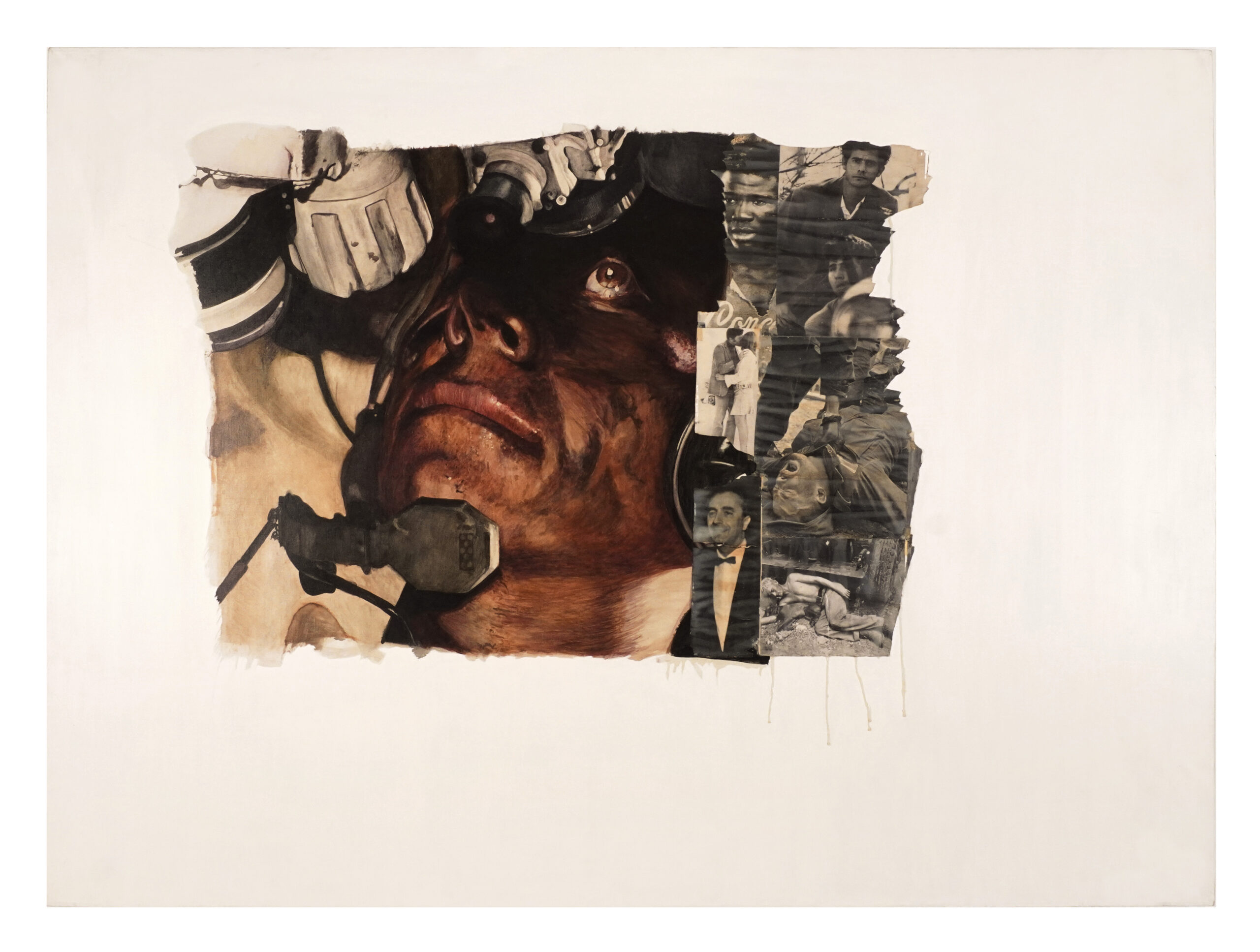
Joseph Raffael has three pieces in the show, which makes sense given his integral role in the story. He introduced Peter and Paul but has largely been overlooked within this corner of art history. Why do you think that is?
Joseph is someone who checked out of the art world at a certain point. He moved to California, then ultimately to southern France, and his work changed a lot. And I think it changed in ways that, to be very frank, did not maintain the quality of his earlier work. There are lots of really brilliant people who have a splashy debut, a really solid 10 years, then for whatever reason, disappear and don’t come back. Or they transform into a different kind of artist, and the people who originally championed them no longer do. There are so few people who actually fundamentally “make it.” In many ways, Joseph has a very normal trajectory.
That said, I hope that this exhibition and other exhibitions like it bring more attention to his work, particularly his early work, which is really great and has a complexity and a weirdness to it that’s totally fun.
The bulk of the book is based on first-person sources like diaries, letters, interviews, photographs, etc. However, you do add your own analysis. For example you write, “Over the years, Peter developed a type, of which Paul was an exemplar: smart, literary-minded artists whose brilliance made everything a kind of stage for their intellect and charm… Peter sought boyfriends whose extroversion—and self-regard—compensated for those qualities he felt he lacked in himself, men whose brilliance was also its own form of beauty.” How did you toe the line between hard research and your own analysis?
That line in particular actually came from conversations I had with individuals who knew them very well, almost to a tee. So while it doesn’t come from any direct letter, it brings together all the research that allows me to make a claim like that. I try throughout the book when I’m doing that to signal to the reader where it’s coming from, whether it’s a footnote or in the prose itself. I try to resist leaping too far into the moment myself. I never tried to go places that I couldn’t go based on the research and what was available to me.
With that said, it was very important to me while writing to lower the barrier of entry into this world. While researching and reading, I reflected on my career as an art critic and how truly difficult it is to reach these histories for people who are not familiar with what was happening in the New York art world in the ’60s. There is a lot of jargon and insider knowledge that many writers cloak their words in. I wanted to do as much as I could to make this a frictionless entry point for people. I wanted this book to be something that would give people access to Peter and Paul but also this very big moment in counterculture, in queer history, without it feeling like an overwhelming experience. I didn’t want people to feel like they had to do a lot of reading outside of the book in order to get it.
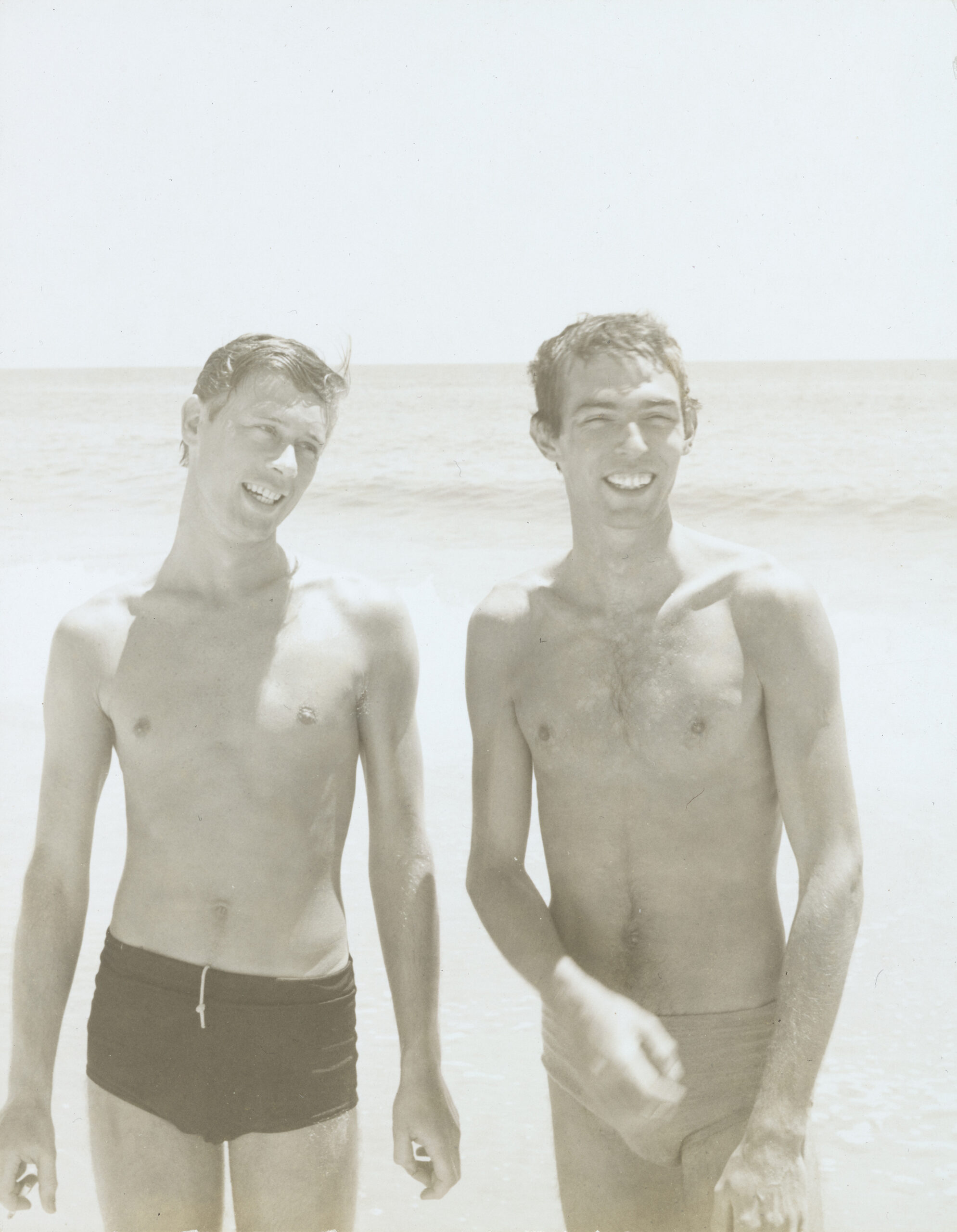
Something I am compelled to mention is that the book is hot. Paul’s hot and Peter’s hot—famously so, actually! And they are on the cover in Speedos. The book covers their sex lives, as it is an integral aspect of the story. Those scenes were frank, honest, and not graphic or smutty. But they were still hot. I mean, these are two generationally hot men whose beautifully photographed nudes are easily available. Is that something you considered while writing the book, that folks may have sexual reactions to it?
I met people who were lovers with both of them. I met people who had crushes on them, who knew them. They exerted such a powerful sexual force on everyone in their lives in a certain way. I think, if I’m doing my job correctly, it emerges. But when I write, I try to let all those things figure themselves out, if that makes sense. When I wrote about sex in the book, I wanted it to feel alive and sweaty, without it being overwhelming for the reader as well. You know, I wanted to keep it classy.
Which you did, but it’s still hot.
Good, good, I’m glad.
More of our favorite stories from CULTURED
How Blue Ribbon Survived a Mob Run-in and Transformed Late-Night Dining
Why Cookbooks Are the Next Frontier for Narrative Writing
You’ve Heard About the New Museum’s New Building. The New Show Is Even Better.
Everyone Was Afraid to Touch Nadav Lapid’s Satire of Israeli Artists. Now, It’s Being Released.
Where 27 Artists Are Hanging Out in New York Right Now
Sign up for our newsletter here to get these stories direct to your inbox.







 in your life?