Doron Langberg
Jeffrey Deitch | 18 Wooster Street
Through April 25
Sometimes a tipping point is reached when an artwork cannot bear the weight of the story told about or around it. In other words, the narrative constructed around the work causes it to become diminutive and embrittled, even causing it to collapse before our eyes.
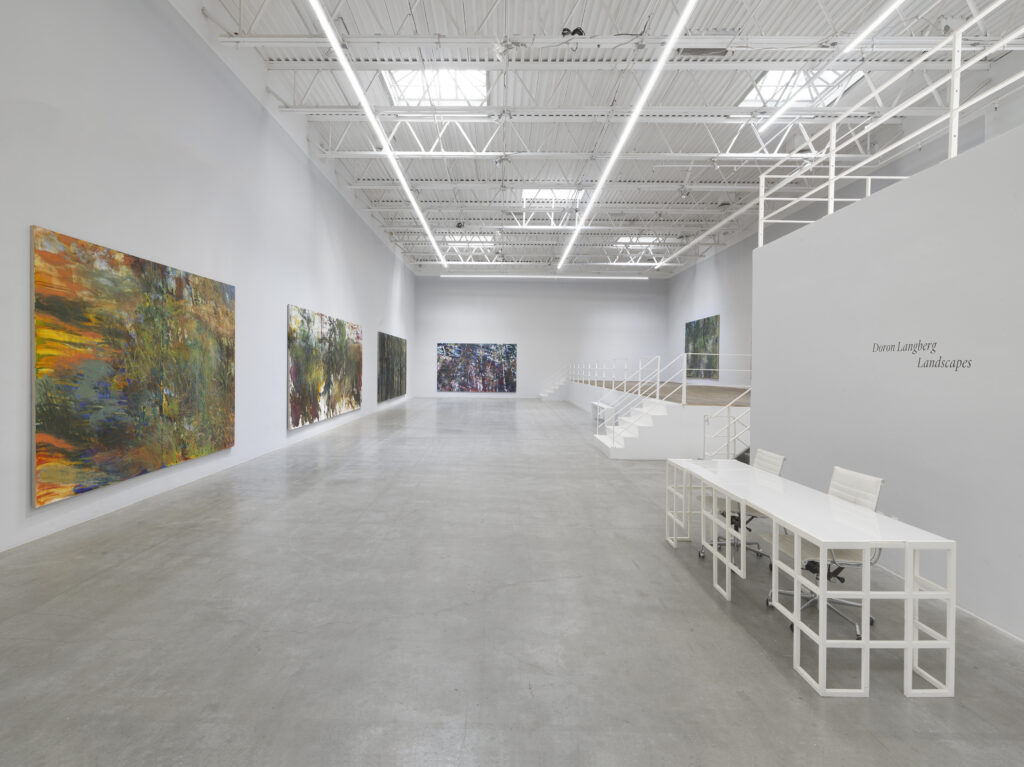
There is nothing small about the paintings by Doron Langberg that confront you as you enter Jeffrey Deitch on Wooster Street in Soho. Six expansive oil-on-linen pictures, as big as 8 by 20 feet, fill the garage-like space of the gallery. A lofted mezzanine platform above the office exhibits 10 more smaller, related works.
The landscape paintings, we are told in a nearly 750-word text written by the Israeli-born, New York-based artist, are a reflection on what it means to be a Jewish Israeli painter after the events of October 7, 2023 and the subsequent genocide in Gaza. Langberg addresses this by representing three places of personal significance: locations near where they grew up in Israel, including their hometown of Yokneam; Drohobych, the Ukrainian town where the artist’s father escaped after surviving the Holocaust; and a queer beach community located on Fire Island in New York.
The artist concludes their statement with the following:
Making these paintings gave me the structure to contend with what is at the core of all of this—that no matter the circumstances, Palestinians deserve justice and liberation. By choosing to look away from unspeakable horrors under the auspice of protecting Jewish life, we destroy ourselves and countless others. Painting is my way to keep looking.
While the act of painting may be the artist’s way to keep looking, what Langberg’s paintings show is another matter.
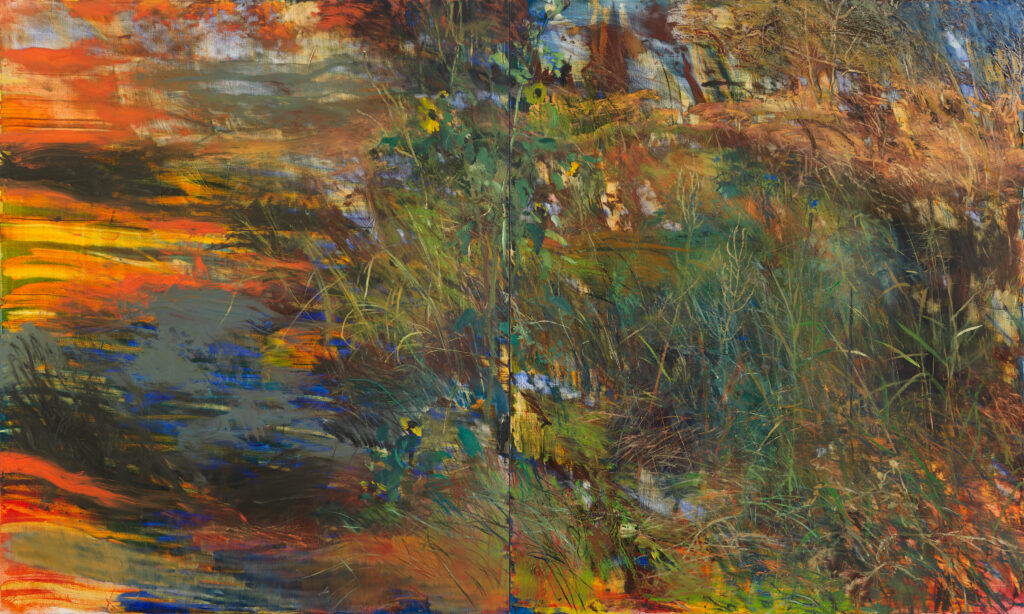
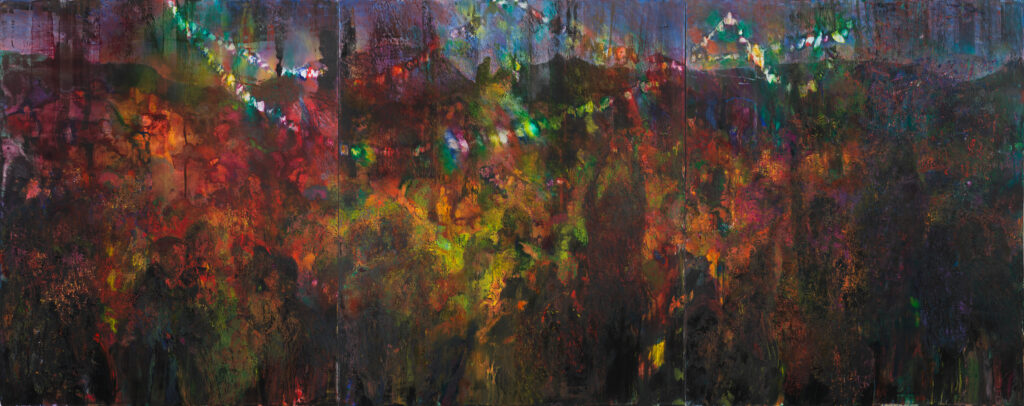
The first painting in the exhibition, Yokneam, 2024, measures some 8 by 13 feet across two panels and locates the viewer in Israel, in a pastoral scene. The orange and yellows, at left, contrast with passages of blue, recalling aspects of 1970s Joan Mitchell paintings, but, at center, Langberg focuses with more precise attention to details of grasses and flowers. Is the expanse of fiery color at left an allusion to the bombardment occurring mere miles away from this placid, vegetal scene?
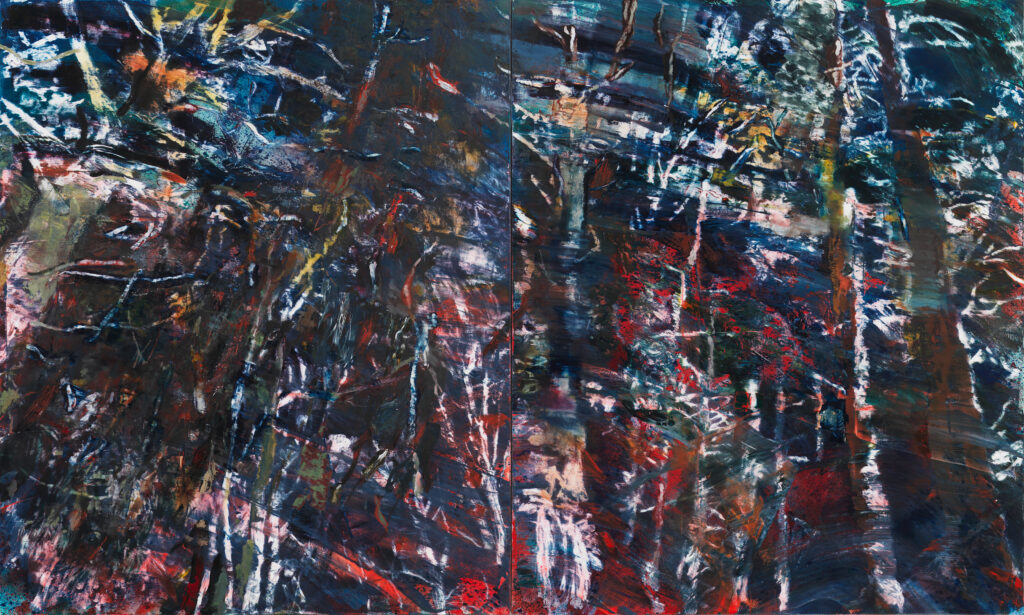
Farther down, two paintings shift the geography to Ukraine. The vertical dark trunks of Bronica Forest, 2025, somewhat recall Anselm Kiefer’s haunting pictures of woods, like his Winterwald (Winter Forest), 2010. Bronica Forest at Night, 2025, the strongest painting in the show, is also the most abstract, with blues and reds dominating against black and white. Compositionally, it nods loosely to Gerhard Richter’s early squeegee works, and, in turn, his later “Birkenau“ series, for which he overpainted his reconstructions of the famous photographs secreted out of the death camp.
“Doron Langberg: Landscapes” provides a setting for thinking about the possibilities and challenges of painting as it relates to atrocity. However, none of the paintings in the show approach the achievement of Anselm Kiefer or Gerhard Richter. Or Joan Mitchell. The work approximates aspects of these artists only vaguely, as if Langberg has dragged their work backward into the 19th or 20th century, rather than into the present or toward some promise of painting’s future.
Langberg’s canvases, stripped of their narrative, have little new to say, either about the possibilities of the medium or of current events. Comparing the vertical slashes in Bronica Forest to Kiefer is to note how Kiefer pushes the space of the picture further, by incorporating collaged elements like snakeskin, synthetic teeth, and thorn bushes (even if Kiefer can become a parody of himself with this tendency). If there is a compositional kinship with Richter, Langberg achieves it without a squeegee.
Even in the potential ecstasy or communal feeling to be found in the Fire Island paintings, the works do not fully cohere or add up to much. The bright blue of the sea cutting through the pines of Meat Rack, 2024, is a nice detail in an otherwise unremarkable picture. The garish yellow-orange magma of light, illuminating the anonymous nighttime crowd of Meat Rack Rave, 2025-26, does little to enliven the picture. Throughout, colors are muddled and the compositions generally struggle to stretch and hold together at this large scale. The smaller paintings upstairs don’t provide any further revelations on their own, nor do they as studies for the bigger pictures.
If this exhibition demonstrates anything clearly, it is the limits of personal expression in the face of atrocity, calamity, and history. Is the medium of painting, in 2026, just not up to the task? Langberg’s attempts feel stuck in the past.
But contemporary painting can address the present. Nicole Eisenman’s paintings at 52 Walker last fall provide just one example. (Exhibitions by Salman Toor, Ali Banisadr, and Nengi Omuku were other shows of fresh, politically responsive work in recent years.) In “STY,” Eisenman ambitiously took on current events with a tricky brilliance that enfolded and layered history, mixing a range of styles, while parodying the role of the artist, offering herself up willingly for examination and critique. In one picture, Eisenman depicts herself as a pickpocket within an art opening scene. The Israeli director Nadav Lapid in his just-released film, Yes, takes a similar approach with cinema, parodying the role of his main characters—an artist couple—as akin to court jesters or sex-workers, complicit and subservient to those in power, partying while war crimes happen mostly out of the frame.
Langberg’s paintings don’t fall short because of any flaw in their politics or because of the limit of their subject position as an Israeli painter. They fall short because they offer only a singular vision of an individual recording details, or their feelings, captured within a landscape. Without self-awareness, self-criticism, or genius, mere personal expression of this sort is ultimately a feeble way of looking.


 in your life?