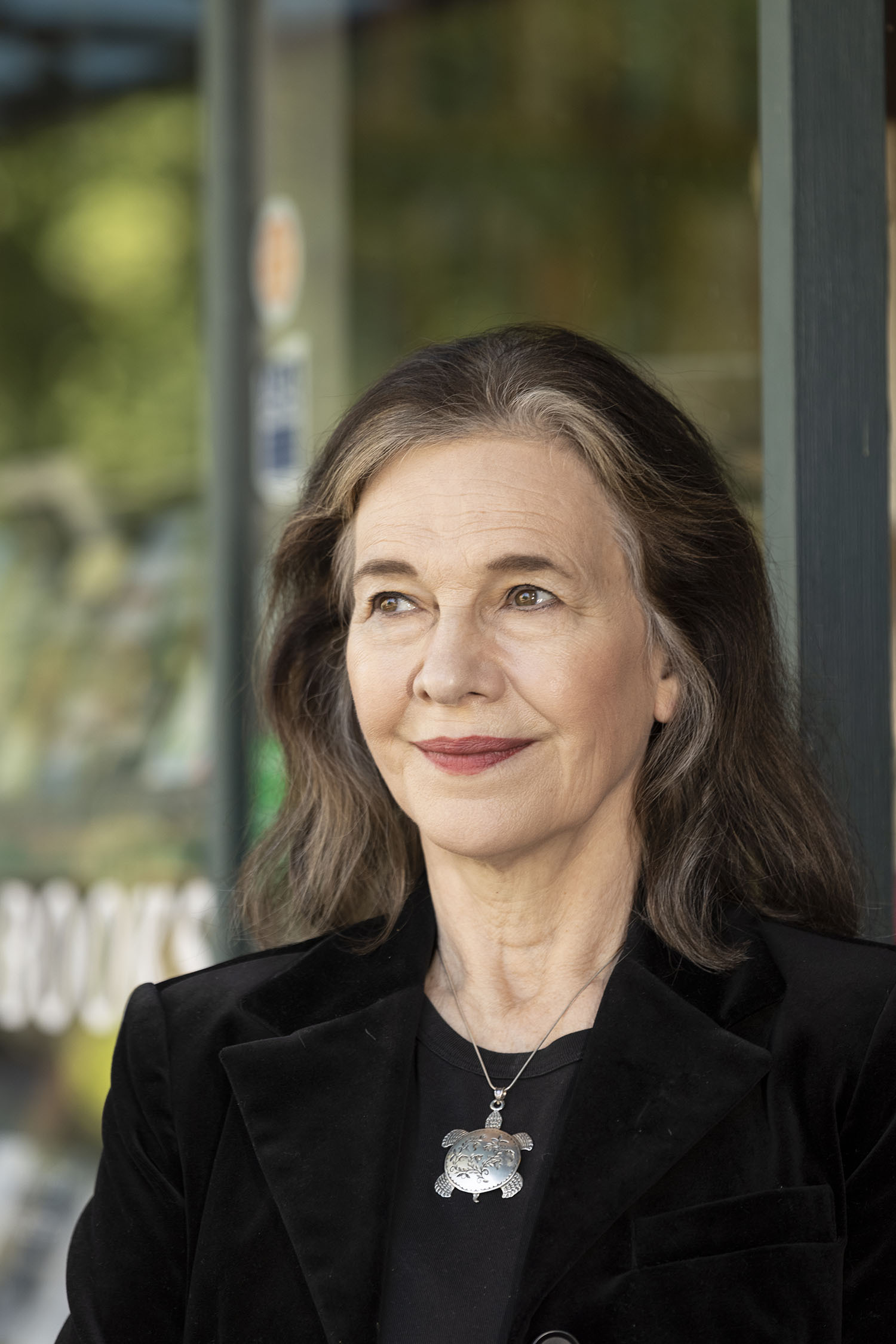
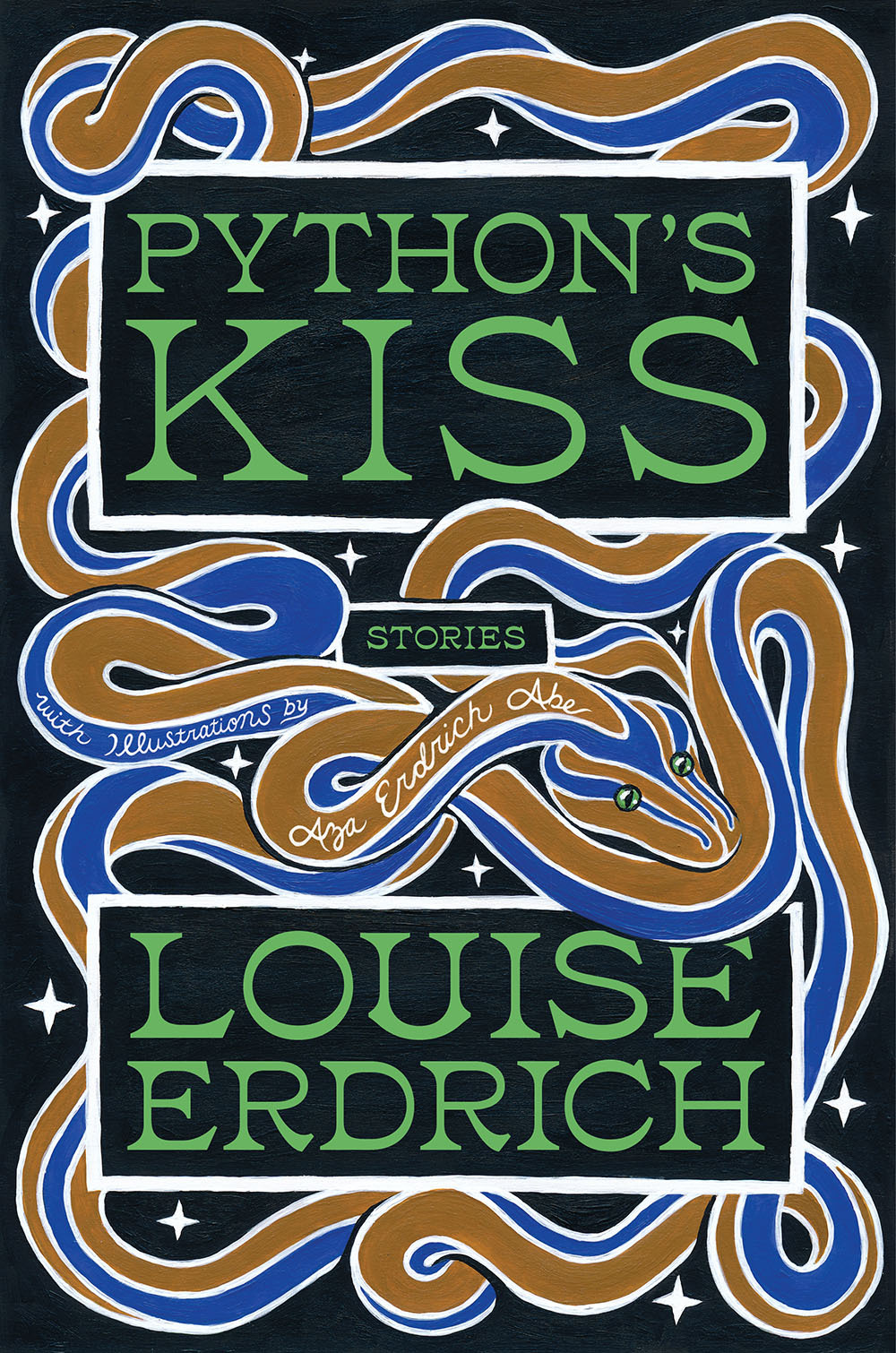
Louise Erdrich’s Python’s Kiss, a collection of new and adapted shorts, out this week, sees the Pulitzer Prize winner, now 71, pull together early writings on a tech-dominated future, musings on man versus nature, and eerie, surreal fantasies—all started, completed, and retooled over the past two decades.
The title essay opens the book, in which a young character is sent to live with their grandparents. The couple’s watch dog, Nero, is a regularly punished escape artist. Our narrator watches the casual cruelty with the kind of wide-eyed, sympathetic curiosity only a child could muster. In short order, Erdrich makes us question when we lost our own. Alongside the text is an illustration showing Nero’s menacing fangs, his all-too-cognizant eyes. The sketch was drafted by the author’s daughter, Aza, who, throughout the publication, provides illustrations that enhance the fable-like affect of her mother’s storytelling.
Ahead of the book’s release, Erdrich shared the genesis of the pair’s ongoing collaboration, the questions that remain after decades at the writing table, and the stories behind a few particularly peculiar imaginings.
I would love to hear about working with your daughter on the illustrations here.
Aza started doing my covers in 2012 and then did all my back lists. I’m thrilled about it because I love her art. I feel very lucky to have this professional relationship as well as [being her] mom. I knew this was going to happen on some level because she was a child who drew everything and was fearless. That was her way of experiencing the world.
I found it to be an interesting compliment, as there’s a lot of strong children characters in the book. You have the mother and daughter relationship, and you’re also writing about these characters, like the girl on the bus who’s comforting an adult, or there’s stories where the children seem tuned into something that the adults aren’t. I wonder how writing those children characters evolved as you were raising your kids.
I guess I’ve been struck throughout my time as a mother by how often children are heroic, because they have a moral sense about the world that is very clear. They have a clarity and a strength and it’s terrible to betray that because it’s so clean. For instance, you’re talking about “The Hollow Children” where a bus driver is driving through a storm, all the children’s lives are literally in his hands, and she manages to sustain him through that. It appears that he could not have done it without her stepping in at the right moment over and over.
In the title essay, you’re also looking through the eyes of a child at our relationship to the animals around us, to the earth around us, and the cruelty of adults who are fighting and the child maybe doesn’t totally understand why. How did that end up becoming the title piece in the collection?
There is a python [in the story that is] sensing a person. It’s not really a kiss. It’s how they understand the world through their flickering tongues, and that became the first [story] because I looked through the book and I realized that there was so much in that moment, where the child has an immediate sense of something almost supernatural happening. This is a watershed where I’m going to understand something. I don’t know what it is, but I do know that this is a defining, unforgettable moment.
There’s a few moments like that in the book about the changing relationship between the characters and the natural world around them, even in the last story with this rock that follows the character through her life. Has your relationship to writing that changed?
I don’t think my relationship to the non-manufactured world has really changed a lot. I started a lot of these stories 20 or more years ago, so I added to them rather than writing them all in a sudden birth of inspiration. I’m not able to work like that. I have to accumulate a story over time. I think it’s striking that you say the stone follows her because in Ojibwe, stones are animate and that’s a language I studied and I’ve always thought since I learned it, that maybe stones are choosing to come with us when we casually pick one up on a beach or something. Are they choosing to come with us or do we make that decision, you know? With her, it’s even more so since this stone has a strange symmetry that she really needs.
It gives an interesting agency to these natural elements or animals that we might think of as passive, that we’re just enforcing our will upon.
That’s closer to the way I do see the world. I mean, especially dogs who have evolved alongside us and know our emotions better than we know them. People always say, “My dog can read my thoughts.” Dogs can read supersensory signals that we really can’t, and we think somehow that we are calling the shots in every situation with the non-human world, but we’re obviously not. We’re obviously missing so much about the world. The world isn’t suffering, the world is fine without us, but we are not fine without our place in the world. We’re not fine if we destroy our place. So it’s really the opposite of what we imagine.
Is it important to you to have those through lines in a collection like this? How do you group these stories together, especially when they’re created over such a long stretch of time?
Well, let’s say two of them are related. They’re the more speculative ones about the corporate afterlife. We very well may have manufactured a non-human entity that does tell us what to do. We don’t understand what has happened with A.I. There’s no one who really understands what we have now. So this is another question in the book. What is this afterlife composed of? How did we become conscious? What does it mean? And what is happening with A.I.?
There’s an interesting dichotomy of us writing about A.I. while A.I. is writing about us. The line between those two just keeps getting slimmer.
Right, from what I would read and hear, most people are very wary of A.I. and want to slow down, but humans have this drive, this curiosity. It’s a drive as powerful as anything and it’s not going to slow down. We don’t know where it’s going to lead us. These stories happened a long time ago. They were before we were really talking about A.I.
How did you feel revisiting these works and when you read them, do you feel like you’re able to see how you have evolved as a writer?
Sometimes I have a more ornate way of expressing things and thoughts and emotions in a story. Sometimes it seems to have grown simpler. The last story that was written was the “Wedding Dresses” one. I had been writing it for about 10 years, just thinking I was getting somewhere. Then I talked to my editor who said, “I don’t think this is it. I don’t know if it should even be in the book.” I thought I’d rewrite it and I did within a week. I think it came out a lot better. I was excited about it because I didn’t think I could write something that quickly that worked.
I was going to ask if you feel like you’re able to put something down. Or, if every time you come back to it, you’re still tinkering.
I used to think the only way to stop was to publish it in a book. But I’ve gone back in books that I haven’t been satisfied with. For instance, The Antelope Wife became Antelope Woman and changed enormously.
Can you share the origin of one or two of the stories here? Were there moments that sparked them?
There’s always some bit of truth in a story. In “Amelia,” I love writing about food service work because I think it’s one of the most important ways a person can gain knowledge of human nature. I’ve had all sorts of jobs, but that job I think taught me the most. I was a waitress many times and in many different situations and this particular job was funny because there was a man who would come into Kentucky Fried Chicken every night while I worked there dressed up as the Colonel. This was a small town and everybody knew about him. I loved him. He was a great guy and he lived alone and it may have been one of the reasons he just loved dressing up and coming in.
It’s the intersection of every part of society when you work one of those service jobs.
There’s always somebody who you become close to. This was part of his life. I thought it was great.
More of our favorite stories from CULTURED
James Cahill Saw the Best and Worst of the Art World. His Latest Novel Exposes It All.
Marc Jacobs Doc ‘Marc by Sofia’ Makes the Designer Look Cool. But Is That It?
Margaret Cho Grew Up in a Gay Bookstore. Of Course Her Reading List Is Incredible.
20 Years and $720 Million Later, Michael Govan Takes Us Inside the New LACMA Galleries
Revisit 5 of the Late Legend Calvin Tomkins’s Most Essential Art-World Profiles
Sign up for our newsletter here to get these stories direct to your inbox.

 in your life?