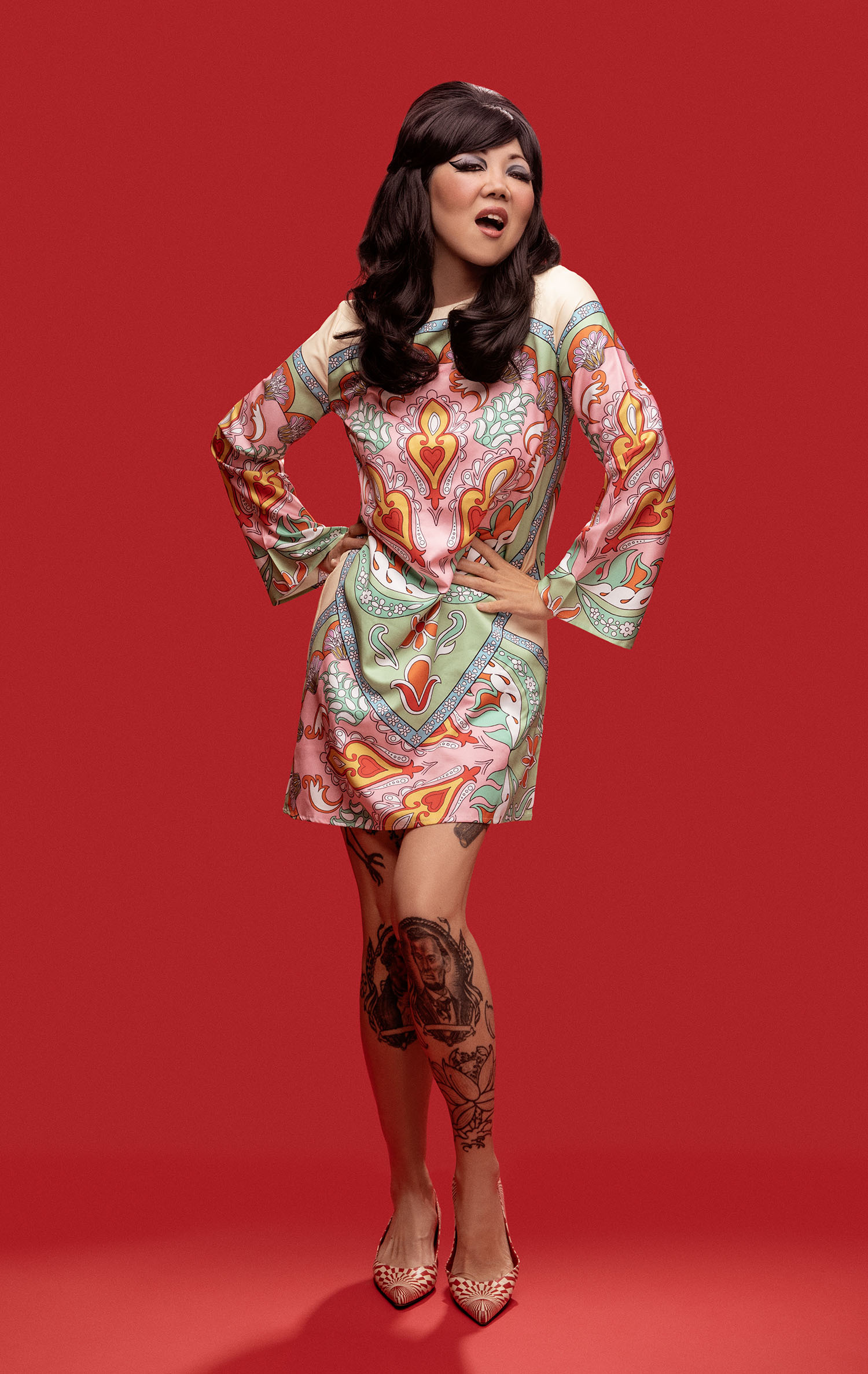
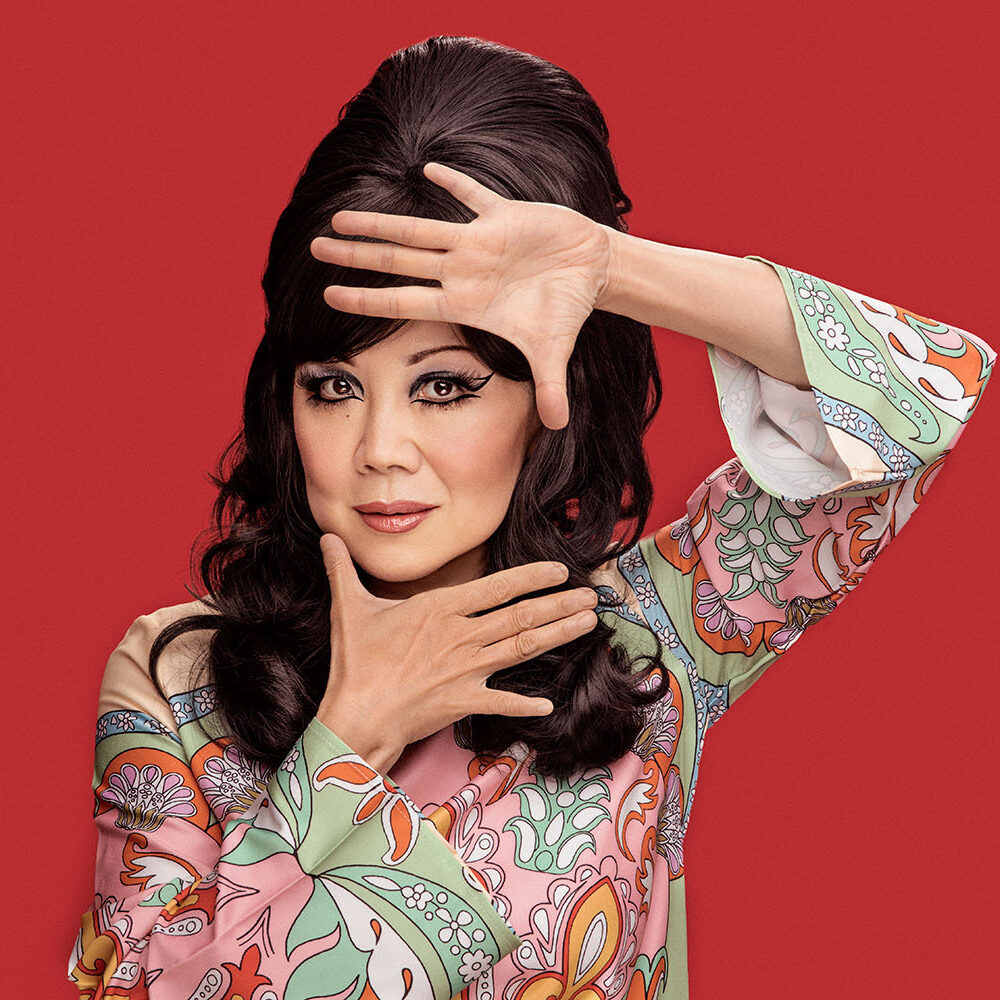
Getting to know Margaret Cho’s backstory is like throwing open the door to Mr. Magorium’s Wonder Emporium. In conversation, she drops passing mentions of hanging with Courtney Love or getting tatted by Ed Hardy. There’s flashbacks to when the full-time comedian, actor, and author worked as a dominatrix or a bellydancing attire retailer or same-sex marriage officiant. But perhaps most informative was Cho’s childhood growing up in her parents’ gay bookstore, Paperback Traffic, in San Francisco.
Writers, hipsters, rebels, filmmakers—they all passed through, each imparting core memories on a young creative who would grow up to deal in the same kind of brash, politically uncompromising fare. When we speak, Cho is in the midst of a cross-country stand-up tour, where her Trump remarks have drawn hecklers. One threatened to pump her head full of bullets, then report her to Homeland Security. “I’m like, bitch, which is it?” Cho later fired back.
Her easy navigation of these difficult moments comes by way of a life spent onstage, in the Hollywood meat grinder, or even coming forward with her experiences as a bisexual woman and addict at times when both were looked at as baffling personal demerits. Cho retells it all in her own memoir, 2002’s I’m the One That I Want, but here, she goes back even further to her first encounters with writers who shaped her voice and the tomes that continue to direct her reading habits. And trust us, as a reader, Cho is as voracious as she is in every other aspect.
So, you grew up in a bookstore.
That’s right, and I think that my reading habits stuck there. I’ve always read the same kind of books I read growing up as a kid—anything by John Waters or anybody that John Waters worked with. I actually just read Role Models again. And then his first book, Shock Value, I read when I was growing up in my parents’ bookstore. They had a John Waters section. We had different bound copies of his scripts because it was a gay bookstore. We had a lot of that kind of counterculture stuff. As a pretty young teenager, I would go see him speak. Up at the counter, the employees had gone to Polyester, so they had the scratch-and-sniff card you get at the theater.
Did it feel then like the worlds of film and comedy were close and accessible?
For sure. People who work at bookstores always have the best lives, because they’re so keen on culture. They always knew what kind of music that I should be listening to. As a young teen, I was listening to Psychic TV and Throbbing Gristle, very erudite choices. But then my reading never shifted. Anything that John Waters has done. Then also Cookie Mueller, who’s an incredible author, who is a star from his films as well. I’ve also gone into that universe of Eve Babitz, Joan Didion. I love the snapshot of the time period. That ’60s, ’70s Los Angeles is so appealing to me.
What was it like being in that space at that time? I imagine that having a gay bookstore back then was a wealth of knowledge for people that might not be in a normal bookstore, or the library even.
There was a rolling rack of gay romance novels that were all literal Harlequin romances, but they were for the male market. They would have these drawings of young men who are standing by a lake in cut-off shorts and tank tops and a puka shell necklace. We had a lot of magazines like Honcho and Blueboy. We even had some old-school bodybuilding magazines that were black and white, Charles Atlas guides for the male body. We had a lot of tattoo magazines because Ed Hardy—who is an incredible tattooer, he tattooed me—would come in and sell his books on consignment. He had all of these periodicals that had all of the latest tattoo designs and work he had done. There was a lot of stuff that was not just gay, but it was geared towards counterculture.
I remember there being one very thick periodical magazine that was for trans women. It highlighted all of the mail-order places where you could get very large shoes, high-heel shoes and stuff like that. This is before the Internet, and before there was the comfort level of being openly trans in the marketplace. There was a publication that catered directly to people who were transitioning who wanted to be able to mail-order everything and feel comfortable in their new lives.
Besides John Waters, were there authors coming through that you met and read?
Armistead Maupin. I’ve read everything he’s ever written, he came to do signings at the store. I believe when Quentin Crisp was still alive he would be doing events there. This was before my parents took it over.
Are there authors in that lineage that you’re excited about now?
My actual favorite genre is either the celebrity authorized biography or the unauthorized biography, usually. I love it when a biography starts out authorized and becomes unauthorized. You know, like the writer has an issue with the subject and then it reveals too much. This happens a lot with David Ritz, who’s extraordinary. When I was on tour, I had a little friendship with him because I’m just such a fan. He did Respect, which is the best Aretha Franklin book. But he had done another book on Aretha Franklin that was authorized and it was so censored and she wouldn’t let him say anything about her real life. He kind of waited a little bit and then wrote the bombshell book called Respect, which was just laying everything out—all of her idiosyncrasies, but also all of her grandness, all of her greatness. She’s really the greatest singer of all time.
I love Kitty Kelley. I love J. Randy Taraborrelli. I love all of these authors who make it their business to go into the lives of celebrities. And I like to read different authors’ interpretations of, say, Elizabeth Taylor and Richard Burton. They get classier and trashier depending on which way you go. I also do that with Seattle grunge. The best book on Seattle grunge is Mark Lanegan’s book [Sing Backwards and Weep]. His books are just scintillating. And if you like that kind of music, it’s just so phenomenal to hear about all of the things that kind of let him down.
I imagine that it’s a different experience now than when you were younger, reading celebrity memoirs, having worked in the entertainment industry.
It’s interesting. I was just reading a book about Carolyn Bessette, focused on that whole relationship with JFK Jr. And you know she had put together an APLA show that was at the Hollywood Bowl. I’m reading it and I’m like, Oh my god, I was at that show. Tina Turner comes out at the end and I remember physically being in the audience for that and not even knowing that this was Carolyn Bessette. Kathleen Hanna’s book [Rebel Girl] talked about all of these things that I was there [for]. I was there at all these shows that she talks about. I was there at different award shows that they were there at. I placed myself very outside of the perimeter of these things happening. Same thing with Ione Skye’s book, Say Anything. I was really at the perimeter of all of these films that she’s talking about, experienced parties that she was at.
In the worlds of recovery, rock and roll, and entertainment in general, I really had a bit of a far-away seat, but I was still at the show. It’s super interesting to have that perspective and have these books come out now that are about a period of my life that I rarely examine. It inspired me. I’ve written a book that actually is really more just focused on my sobriety and my addiction.
Which authors were you reading when putting together your own writing? Are there direct correlations that you see from some of these books?
I think Patti Smith for sure. Patti Smith has really, I think, reinvented herself as a memoirist and I love that. I love her style and I love her writing and I think she’s just brilliant. It’s really powerful. Eileen Myles is incredible. I just love the way they put words together. They’re a friend of mine and just an extraordinary person and the most gifted poet in the world. I was, again, super inspired by Kathleen Hanna. Her style of writing, it’s similar to her style of music. She has a kind of shorthand to get to your heart and your muscle.
Are there bookstores that you frequent now?
I go to Skylight. I also like Lost Books. That’s a really special place because they have plants everywhere. I am on a lot of publishers’ lists. People send me everything and they know what I like. So I’ll get really good advance copies and then often I’ll donate them to Lost Books. And I find books there that you wouldn’t normally find. I think there’s somebody from the U.K. that also donates books, because I found biographies or autobiographies that I didn’t expect like Shaun Ryder, who has just an extraordinary autobiography. Also Nick Lowe’s book, who is a recording artist and a songwriter that I have worshiped for decades.
Is there a book that you keep circling back to when you’re looking for inspiration?
I just love to hear people go through the themes that I’m looking towards, whether it’s addiction, alcoholism, whether it’s career strife, whether it’s artistic frustration. David Ritz has an extraordinary book about Marvin Gaye, who was such an incredible artist, but the book is a really poetic view of self-sabotage and how a great artist can really be ruinous to their own spirit. I don’t want these stories to be forgotten, because we know these songs and we know a little bit of the legacy of these incredible artists. I don’t want any of it to be lost. That’s why these books are so important.
Are there books that you turn to in this political moment, that are charting what we’re going through?
There’s an amazing book by John Fugelsang called Separation of Church and Hate. His parents actually were clergy, like a nun and a priest who met and fell in love and then had a family, so he was raised within Christian ideology. He knows the Bible. He knows his stuff. He wrote an incredible book about the hypocrisy that goes on with the Christian Right. He’s so astute and he’s so funny because he’s also a stand-up comedian. That’s a humor book, but it’s also just so hard-hitting, the way that he’s juxtaposing the Bible to what’s happening over there.
Margaret Cho’s Required Reading
Respect by David Ritz, 2014
(Amazon, Barnes & Noble)
“Oh my god, if you love soul music and you love Aretha Franklin you have to because I had my mouth hanging open the whole time.”
Devil in a Coma by Mark Lanegan, 2025
(Amazon, Barnes & Noble)
“Anything by Mark Lanegan. He’s such an extraordinary artist and he’s passed away but his books live. You cannot believe what the man has been through. It’s so phenomenal. He has a book about getting long Covid, which is really, really difficult to read. I was a big fan of him when he was alive and I would go see him perform.”
Shock Value by John Waters, 1981
(Amazon, Barnes & Noble)
“Anything by John Waters. I’m on his Christmas card list so every year I’m so impressed. You might get a blow-up doll in the mail. You don’t know what’s going to happen. Every year it’s something extraordinary. This year it was almost like a pop-up book but it was him vomiting all over you for Christmas.”
Eve’s Hollywood by Eve Babitz, 1974
(Amazon, Barnes & Noble)
“Anything by Eve Babitz. I know that near the end of her life she became MAGA—she had four MAGA hats found in her belongings when they came to clear out her living space, and it’s very sad. But Lili Anolik did a wonderful book just about her life. And then there’s a great book that came out, Didion and Babitz. The juxtaposition of these two incredible women from a time in Los Angeles. I would have loved to be there, but I love to read about it. But I think Eve Babitz’s Eve’s Hollywood is like the ultimate young woman in Hollywood going from Hollywood high to being Jim Morrison’s lover. She’s a perfect writer. I want to go visit her. She has a little crypt at Hollywood Forever and you can go see her grave. So I’m going to go check it out.”
More of our favorite stories from CULTURED
Our Critic’s Favorite Show This Month Is Hidden in a Subway Station
James Cahill Saw the Best and Worst of the Art World. His Latest Novel Exposes It All.
If We’re in the Golden Age of Documentaries, Why Are All These Documentarians So Worried?
Sign up for our newsletter here to get these stories direct to your inbox.

 in your life?