
Renée Nicole Good was killed by an ICE agent on January 7, 2026 in Minneapolis. Six years earlier, she won the Academy of American Poets Prize for her poem “On Learning to Dissect Fetal Pigs.”
It’s about, among other things, an education—that catapults out of the biology textbook into the spiritual and existential—and where knowledge sits: stagnating in the pit of your stomach or touching your soul. “Can I let them both be?” Good asks, pointing to both a “fickle faith” and the “science that heckles from the back of the classroom.” She ends, as if to quote a final lesson scribbled down,
life is merely
to ovum and sperm
and where those two meet
and how often and how well
and what dies there.
I love this poem. Like everything read posthumously after a tragedy, it feels prophetic—not because it predicts anything, but because it insists on the right question too late. What is life merely? What kind of life does learning count or discount? What can we believe in? I want to know how often and how well—what a word her name sounds—and what dies there.
I am possibly teaching the last class I will teach at the New School for Social Research. I have spent more than 20 years inside institutions of higher education as a student and a professor. I find myself wondering what the future of teaching will be—because of A.I., because universities failed to stand up for themselves or refused to imagine how they might change, because learning is unprofitable and ungovernable. The New School once imagined itself as an exception: a university in exile, founded after World War II by Jewish European intellectuals fleeing fascism, committed to critical thinking and education for the people. It seems unlikely to survive this administration nor the willful transformation of learning into a business enterprise. What dies there?
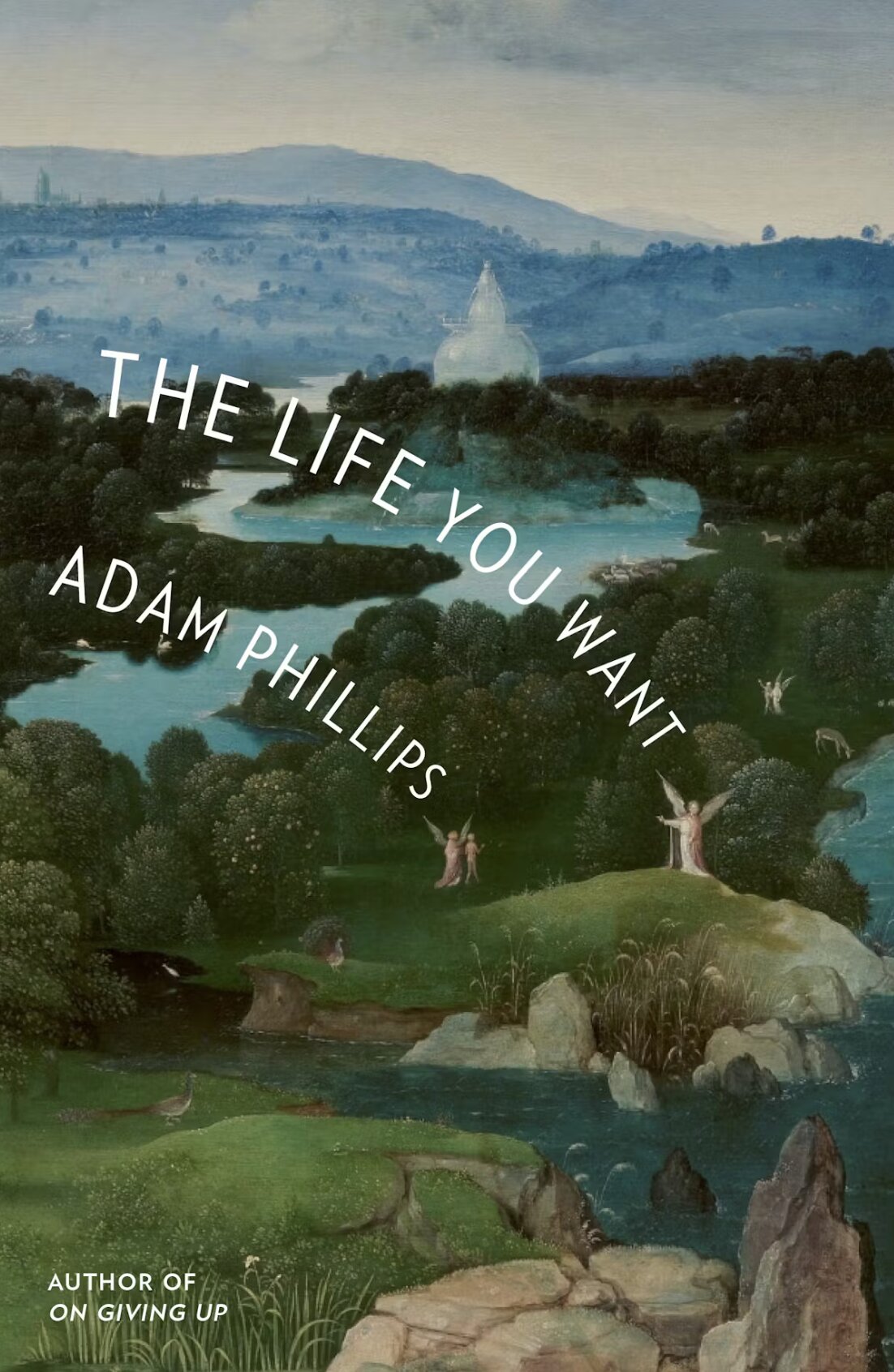
These questions find an unexpected resonance in the British psychoanalyst Adam Phillips’s new book, The Life You Want. Without naming the political moment that gives his questions their urgency (the U.S., as some like to say, being the U.K. on steroids), Phillips asks what it means to want to live at all—and what happens to wanting under conditions that increasingly dictate what a life should be. In his chapter “On Not Being Taught,” Phillips frames teaching as less about getting it right, or being right, than about experimenting—a way of picking things out of chaos. “How can anybody know, in any absolute sense, what is good for someone else?” Resistance, too, is a form of curiosity. In Phillips’s hands, it is redefined away from heroism or opposition or even self-protection, and understood as something quieter and more oblique: a way of not consenting too quickly to the available forms of life.
A life of prescriptions is a life lived in a state of panic. Phillips wants to offer something else: “enlivening incoherences” and “unheard-of-open-endedness.” Thus at the center of The Life You Want is a deceptively simple claim: life is wanting. Wanting is not redemptive, not a guarantee, not even really a problem. On the contrary, wanting is an ideal of exposure. It keeps life unfinished. For Phillips, wanting is less a puzzle to be solved than a condition to be protected. Below, we discuss not wanting to be born, the sadomasochism of teaching, and the problem with symmetrical revenge.
Do you think that we’re living in a dogmatic moment that’s any different from before? I was struck reading your book by the question of omnipotence in various guises, like, what kind of life are we being told to want? What are we being taught? What are we rebelling against? What are we resisting? What are we escaping into? The worry is that you paint yourself into a corner when there’s so many kinds of conversations that could be had. But seemingly we aren’t having them?
Yes, and we just don’t know the cost of adapting to this political reality that we’re living in, what we’re having to annul to survive it. And what we have to do to adapt, we don’t always know. But it wouldn’t be odd if people became more withdrawn, more immured, more impermeable, more remote, etc. Because to be fully alive to this present reality could easily feel unbearable.
Part of what you were asking for was for us to be more curious about how we’re surviving. I see a lot of panic. “Oh my god, we’re all lost in our phones.” But then you feel bad about everything that you do to survive.
Part of the art of what we’re doing [as psychoanalysts], presumably, is enabling people to find out what they’re enjoying, to protect their pleasures. Because if they’re not sustaining pleasures, then obviously everybody is going to begin to wonder, What’s the point of this? Now unless you’re not religious, the real question is: Why would you put up with suffering at all? Obviously one thing psychoanalysis does for us, so to speak, is enable us to generate meaning out of suffering. It’s got to have a point, otherwise there’s no point.
I think, even though analysts don’t say this, we’re involved in a very unusual kind of moral education. We’re not saying, “This is how you should live and these are the rules.” We’re offering people an opportunity to think about themselves with somebody else. One of my colleagues’ patients said to her, “I want to finish.” And she said to the patient, “You can’t finish, because you’re not kind enough yet.” That’s a sentence of genius. Psychoanalysis gives you a language for this mystery. We all know that when we are kind and people are kind to us, it allows so much. We’re so much happier. So why isn’t there more kindness?
Psychoanalysis gives us lots of good answers to that question. Psychoanalysis is a theory of original frustration. And everything depends on this story, on what you do with your frustration. Another way of saying this would be, psychoanalysis is an education in transforming and bearing frustration.
I often think that psychoanalysis helped me overcome a certain frustration and be able to move with myself. But then that made me more frustrated when the world gets in the way of me protecting my hard-won pleasures.
If this worked as it should, it would be crucial that we knew about our frustrations. Because our frustrations would be the clue about what it is we feel is lacking or what we’re deprived of. So in the perfect picture, I feel frustration, I recognize it as frustration, I bear it for a sufficiently long time to find out actually what I am frustrated by, and then I do something good to transform this into something better. In other words, I don’t have a tantrum. I don’t kill the people who frustrate me. I don’t enviously attack them. It’s a tall order, but an interesting project.
When I was just recently in a morass of not liking everything, that was a lot easier.
The advantage of that is you learn not to put up with things. That matters quite a lot. Because we know the consequences of long-term putting up with things. If we don’t do anything, we feel complicit. And if we feel complicit, it’s as though we betrayed ourselves, which in a sense we have. But as you’ve said, if we take that seriously, what can we actually do? Most people feel politically pretty impotent. In 1917, Lenin said, I don’t know why people vote for politicians in capitalist democracies, because everybody knows politicians don’t run countries, businessmen do. That either makes you feel sort of deranged and extreme, or you have to have another kind of thought. And it’s very hard to have another kind of thought. It’s very hard to be collectively political in a way that genuinely feels valuable now. That’s terrible.
Or I guess you idealize a businessman.
That’s all that’s left.
This reminds me of your chapter on not wanting to be born. I thought a lot about being interested in nihilism and the impotent rage in it. And the ideals that are still there, especially willing the impossible. I see a lot of this in the younger generation.
If I wish I hadn’t been born, if I believe that, how do I then live? I could become vile. I could become all sorts of things. But it’s not obvious what the consequences are. Of course killing yourself doesn’t solve the problem. There’s nothing you can do, and that’s why it’s rather wonderful and funny.
So funny. But serious. I often hear the untransformed nihilism of parents in our current doomerism.
The bland version of this is to have tantrums. That’s one available desperate measure. But as we all know, it doesn’t actually get you anywhere. I’m sure you’re right that children are very attuned to what their parents are suffering from, even if they don’t explicitly say it. We’ve all failed to cure our parents. We carry that with us. There must be in everybody, some real question about if they can bear their lives or want to go on living. The children are going to be very attuned to this; after all, they are supposed to be growing up and supposed to love life. And it looks like until about the age of eight or nine or ten, they do kind of love life. They have lots of appetite. You have to do a lot to trounce a child’s vitality. But once they get preteen, they begin to have different kinds of thoughts. They have to work out whether they’ve been given an alluring picture of growing up. If it doesn’t look like a good thing, then you have to attack your development.
I was reading a book with my daughter in the doctor’s office, actually, and it said, “You can be a doctor or you can be an artist or you can be a teacher.” I said, “What do you want to be?” And she said, “I don’t want to be anything. I just want to be with you.”
That’s the perfect answer. There’s nothing to achieve. A teacher said to me about my daughter that the problem was that she only works at things she’s interested in. So you should work at things you’re not interested in? It creates a feeling of futility and a potential to attack yourself.
Your chapter, “On Not Wanting to Be Taught,” stuck with me. I love the [English pediatrician and psychoanalyst Donald] Winnicott line about picking something out of chaos. I feel like everyone’s trying to teach someone a lesson.
Yes, or persuade them of something.
Convince them, get it right. A.I. is a teaching machine.
Nothing else it can be.
There’s this whole idea about how it’s going to transform life. Can knowledge of this kind, information, do anything for us as human beings?
What is the desire for information a desire for? At its worst, it’s the worst kind of omnipotence, you know, the knowledge and power coming to a head and so on. That’s a cliché, but I think it’s true. But I also think, you know, that’s one of the reasons Winnicott caught my eye—why I found him interesting. Because Winnicott is much less interested in insight and self-knowledge than in the possibility of experience. And that seems to me where the action is. You know, Winnicott said, “Madness is the need to be believed.” Once you ditch needing to be believed, then you have a conversation on your hands. You don’t need to be right. You don’t need to persuade the other person. You don’t need consensus.
I can imagine a world, a better world, where people have no interest in persuading anybody of anything. It’s very sad—the sadomasochism of teaching, isn’t it? That for me to be right, you’ve got to be wrong. For me to feel strong, I’ve got to make you feel weak.
Everybody feels diminished. This sounds like a digression, but bear with me. In an online group of psychoanalysts—and these are some of the worst conversations that happen on earth, in my opinion—they were asking whether one should shame another person, or shame an institution.
That can’t be a question. This is so mad. This is terrible. This is the end of civilization.
I felt that. But people were really, honestly vying for the idea that this is a very important tactic politically, institutionally, even clinically.
I’m still baffled that people believe in punishment. And people punish people when they don’t know what else to do with them.
We have a president who really believes in punishment.
And intimidation.
And insult. And shame.
The trouble is that a kind of symmetry is created so that those of us who don’t like Donald Trump think, I’d like to humiliate Donald Trump. But then, of course, we become Donald Trump. We’re not thinking, what would be the best way to deal with Donald Trump? It can’t be by being vengeful.
How do we?
Well, I think not being tempted in the first instance by symmetrical revenge, not being tempted to do to somebody what they’ve done to you. Retaliation must be one the worst things we do.
This was important in Freud’s self-analysis. He had all those dreams that were the lesson, an eye for an eye, the law of lex talionis? He wanted to undo this in himself.
And of course, the Oedipus complex is all about revenge.
Does irreverence have a symmetrical quality to it? I used to love irreverence in the days when there was a thing called a subculture or an underground. It felt like irreverence was so important. And now, I see it wielded by power.
Irreverence was the most fun we could have, right? But it very soon became clear that we are likely to be irreverent when we fear being controlled by somebody. That it’s the attempt to, if not get even, then certainly dominate back. That again quickly becomes sadomasochistic. It’s very hard to find non-sadistic irreverence.
What if irreverence is somehow aimed more at yourself? Making a joke out of a situation that you’re clearly implicated in, as opposed to the irreverence that’s meant to take someone down a notch.
Self-importance is obviously an absurdity. And superiority is really tyrannical, socially. So the ability to be irreverent about oneself would be a great developmental thing.
Do you have the life you want? Why are you writing this book now?
I can remember a very long time ago reading Richard Rorty writing about pragmatists being interested in the life they want. And I thought, This is amazing because on the whole, people don’t talk about the lives they want. It’s just not a phrase in circulation. And it’s a very evocative one. People are interested in it. And how could they not be? So there was a lot of life in it for me, if you see what I mean. I did it with vigor. I’m retiring this Christmas. So that’s got to be an ingredient in this. What is the life I want next?
It’s nice that there’s a next. I hope to have nine lives, like a cat. I think it’s very hard for next to be in there when you think about the idea of the life you want. You do a lot to dismantle any idea of the life you want as an object that you acquire, dominate, possess.
Of course, it could be very tyrannical, but if there is a simple description of it, the life you want involves following your curiosity. The life you want is to do with what and who you love and what really interests you matters. Find that, and do not be fobbed off by spurious pleasures.
It sounds so simple.
But it isn’t.
You write so much about what you have to do to really give up omnipotence and embrace the kind of open-endedness you keep bringing to the table. It seems so difficult for us these days.
It’s presumably linked to a real lack of confidence in the future. What kind of futures can we possibly imagine? That’s presumably what the idea of development is at its best: you go on making an unknowable future. To some extent, you prepare and you predict, but the actuality of it is that your life is going to be way in excess of your intentions.
If you want to follow this thread even further, find Adam Phillips and me in conversation at the 92Y on April 9 and at the Foundation for Community Psychoanalysis on April 11.
Some other angles of resistance…
Resisting our new reality: Hannah Baer, “Loving the World on Fire: On Perverse Dependency” in Parapraxis
We are all gaslit gaslighters: Leslie Jamison, “So You Think You’ve Been Gaslit” in The New Yorker
She knows how to keep writing…: Patricia Lockwood, “How Do We Write Now?” a lecture from Tin House’s 2018 Poetry Winter Workshop
On not resisting dissection and a change of prosody: Ben Lerner, “Cardiography: After Open-Heart Surgery” in the New York Review of Books
More of our favorite stories from CULTURED
The Substack Stars: 21 Newsletters That Your Favorite Writers Can’t Get Enough Of
In Wayne Koestenbaum’s First Novel in Two Decades, Gay Lust Incarnate Is a Rabbi With a Dad Bod
Eva Victor Made the Breakout Indie of the Year. Now, They Have to Do It All Over Again.
What Is It Really Like to Work at a Black Art Institution Right Now?
In Paris for Fashion Week? Catch These 11 Must-See Exhibitions While You’re There
Sign up for our newsletter here to get these stories direct to your inbox.







 in your life?