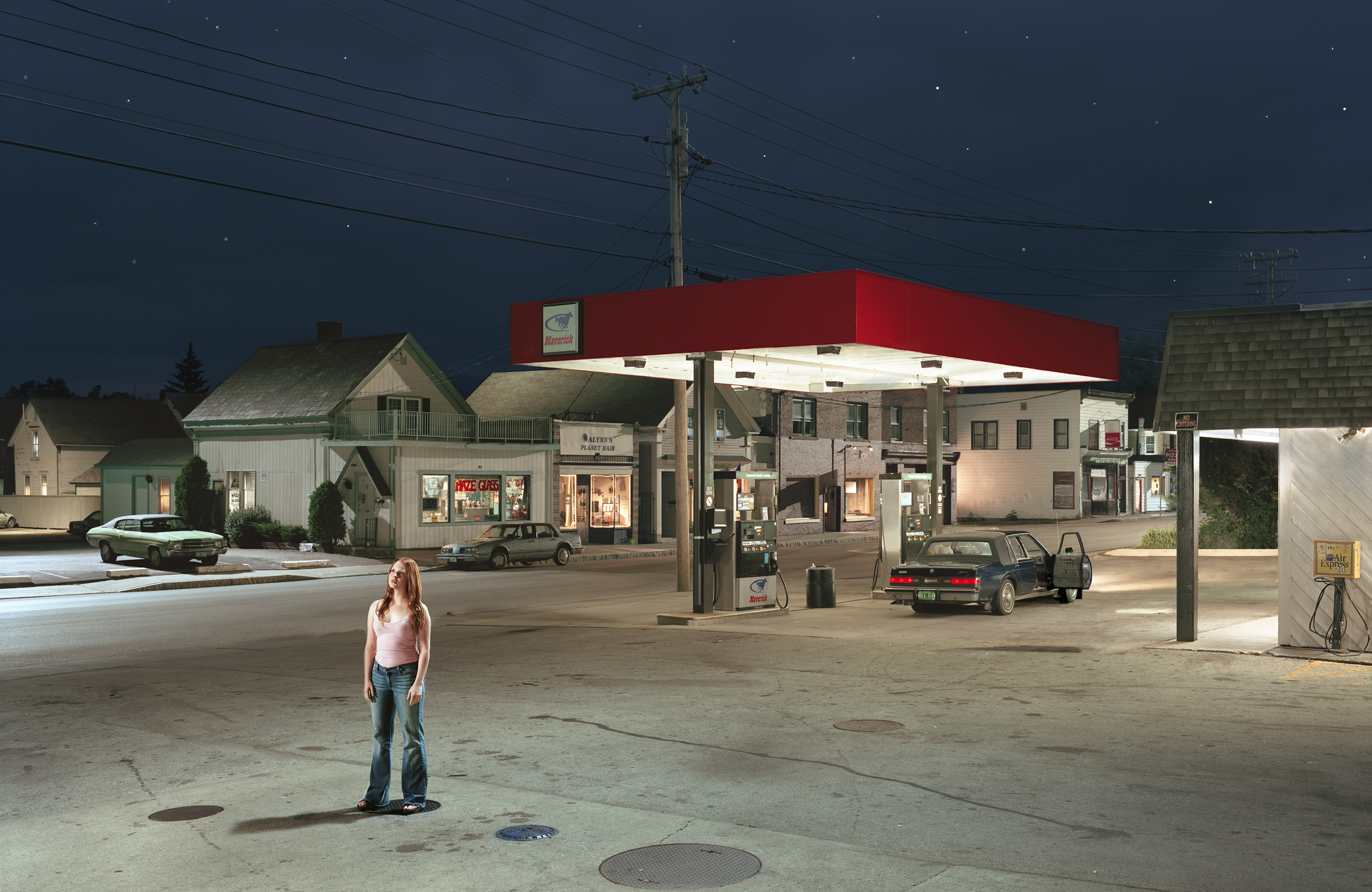
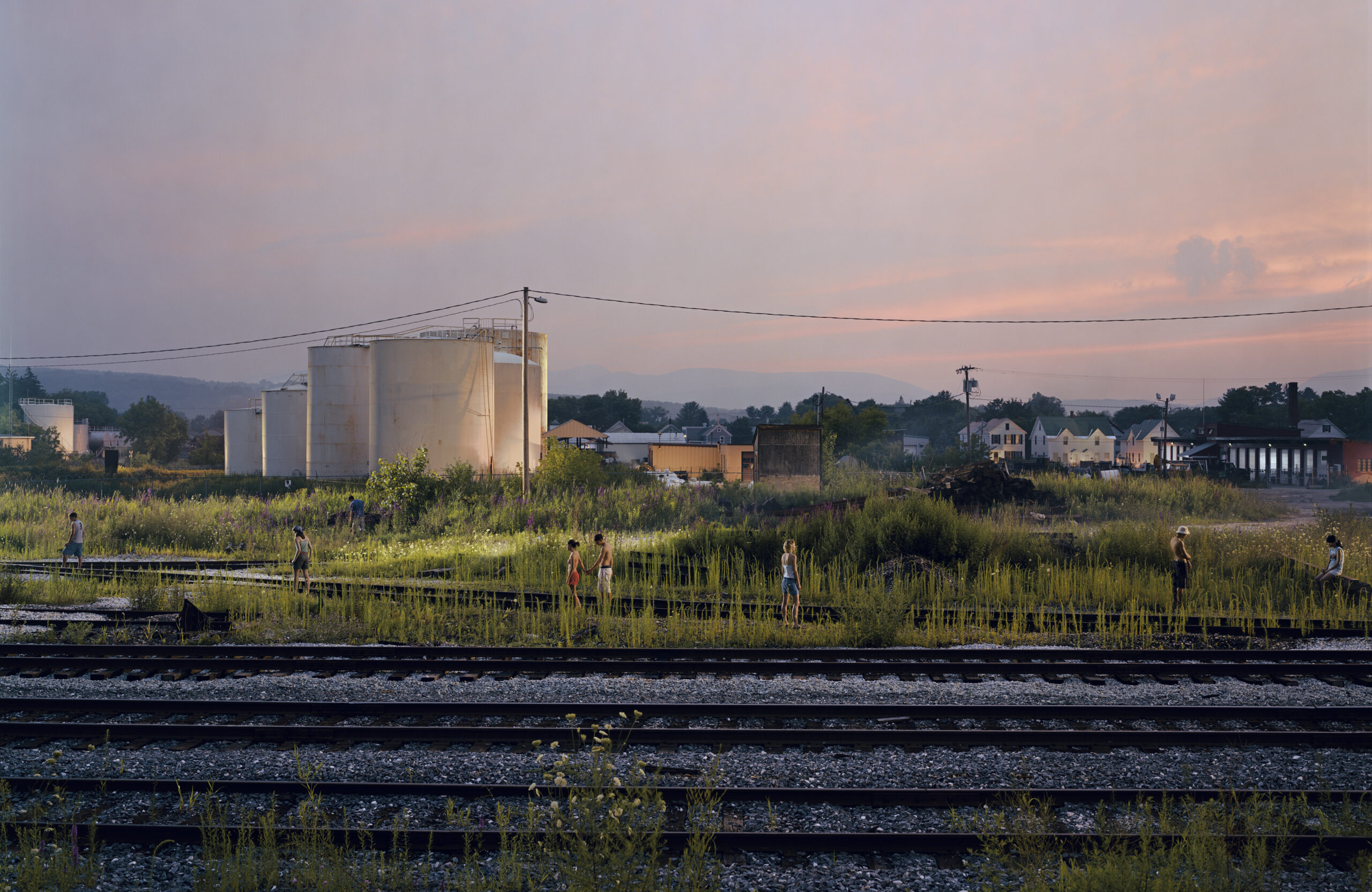
Gregory Crewdson photographs a disappearing America. His images—staged with a novelist’s attention to character, realized with a filmmaker’s production-level, shot with a cinematographer’s eye—elevate small town life with a near mythical vibrancy. They’re meticulous, evocative, and steeped in character. Once upon a time, before the era of screens, there were only a few places to find images like this: at movie theaters or museums, in magazines, and at the mall, where fashion adverts created a fantasy around the clothing. Now, Aritzia is reviving the practice by bringing Crewdson’s photos to its stores, online retail, and to a limited edition line of shopping bags.
The collaboration is part of Aritzia’s Artistic License Series, which has championed the work of some of the biggest names in photography for over 20 years. Previous artists include Juergen Teller, Ryan McGinley, Harley Weir, and Jamie Hawkesworth. This year’s edition is also accompanied by an exhibition, featuring Crewdson’s work alongside bags from the brand’s previous iterations, all unveiled with a dinner party hosted by Aritzia and CULTURED during Frieze Week in Los Angeles.
Aritzia has long been known for eye-catching shopping bags (remember the giant installation at Astor Place?), and this new rendition featuring Crewdson’s work is no different. The images featured have the affect of precious artifacts from a pre-screen world—when photography wasn’t taken for granted. During a chat with Crewdson, the photographer shared his influences, the role fashion plays in telling his characters’ stories, and what happens when forces of nature intrude on his meticulously planned shoots.
Your photographs are firmly rooted in the mythic or even spiritual dimension of the American landscape. What is it about this space that entices you aesthetically and thematically?
When I was coming of age as an artist, I was greatly influenced by other photographers who were making pictures within the American landscape: William Eggleston, Diane Arbus, Stephen Shore, and Joel Sternfeld. I was also influenced by artists in other mediums such as Edward Hopper, writers like Raymond Carver, and most especially filmmakers such as David Lynch, Hitchcock, Spielberg, and others. These all became part of my inspiration and my view of the American landscape.
But it also comes out of my own life. I grew up in Park Slope, Brooklyn, and when I was very young my father bought some land and built a cabin in Becket, Massachusetts. I loved it there. We would go to the neighboring towns for groceries, to see movies, eat in diners and restaurants, and visit bookstores. Those places took on some kind of mythic quality. I loved spending time in those towns and being an outsider viewing the townspeople going about their daily lives. It was so different from Brooklyn.
I have made nearly all my work in those towns throughout my entire adult career, and as of about 15 years ago, I live in a small nearby town, not far from where my parents had the cabin. I’m still fascinated by the area and never tire of making new pictures using these same small towns as a backdrop for the stories I’m telling. Even though I live here now, I consider myself a bit of an outside observer.
Can you share the backstory of one of the photos included in the Aritzia collaboration?
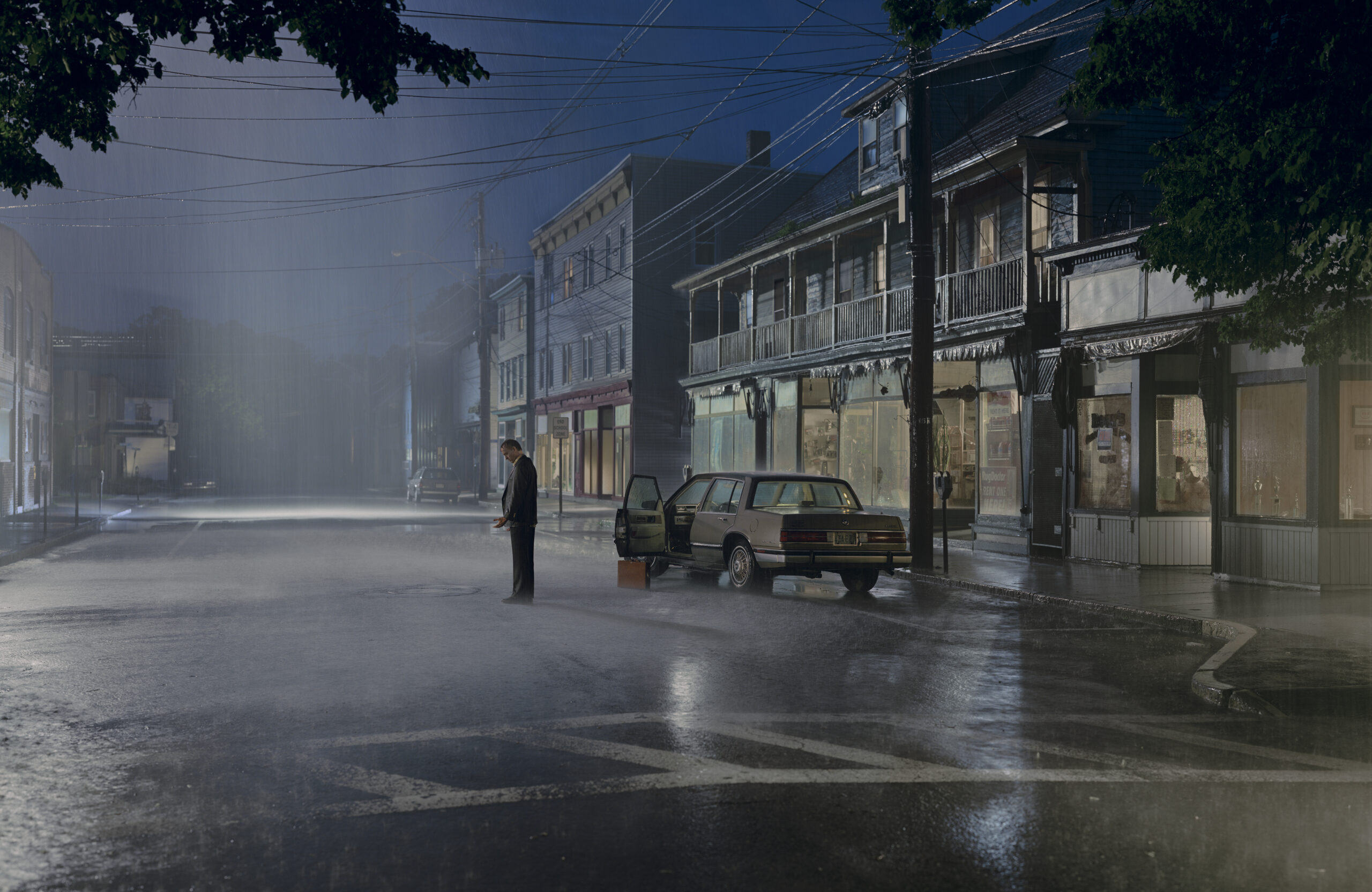
When we were shooting the picture Untitled (Summer Rain), we had a rain machine on set. We had the man in the photo put a wetsuit on under the business suit we had him wearing to stay warm, as we knew he’d be soaking wet by the end of the shoot. We closed down the street, set our cranes and lights, and prepared the rain machine, but then an actual rain storm came through—accompanied by lightning. I like to say that we actually had to cancel shooting the rain picture because of rain. In reality, though, it was the lightning that made us close down for the day because we can’t put people in cranes and use that level of electrical equipment if there’s lightning. In any case, we went back the next day and got the rain picture, and it turned out to be incredibly beautiful.
Can you tell us about the inception of your images? Does a story or a character come to you first, or do you envision an image and work backwards?
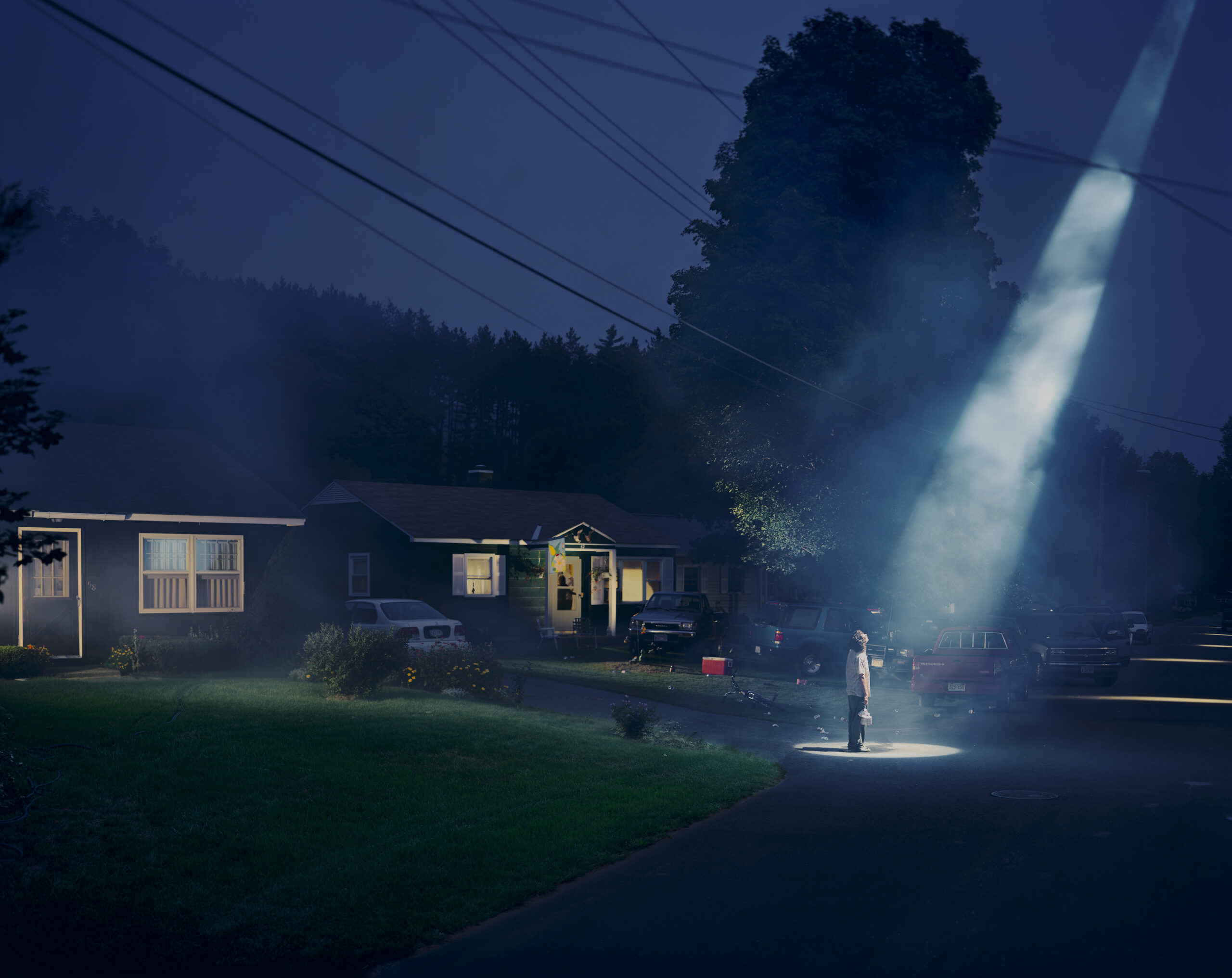
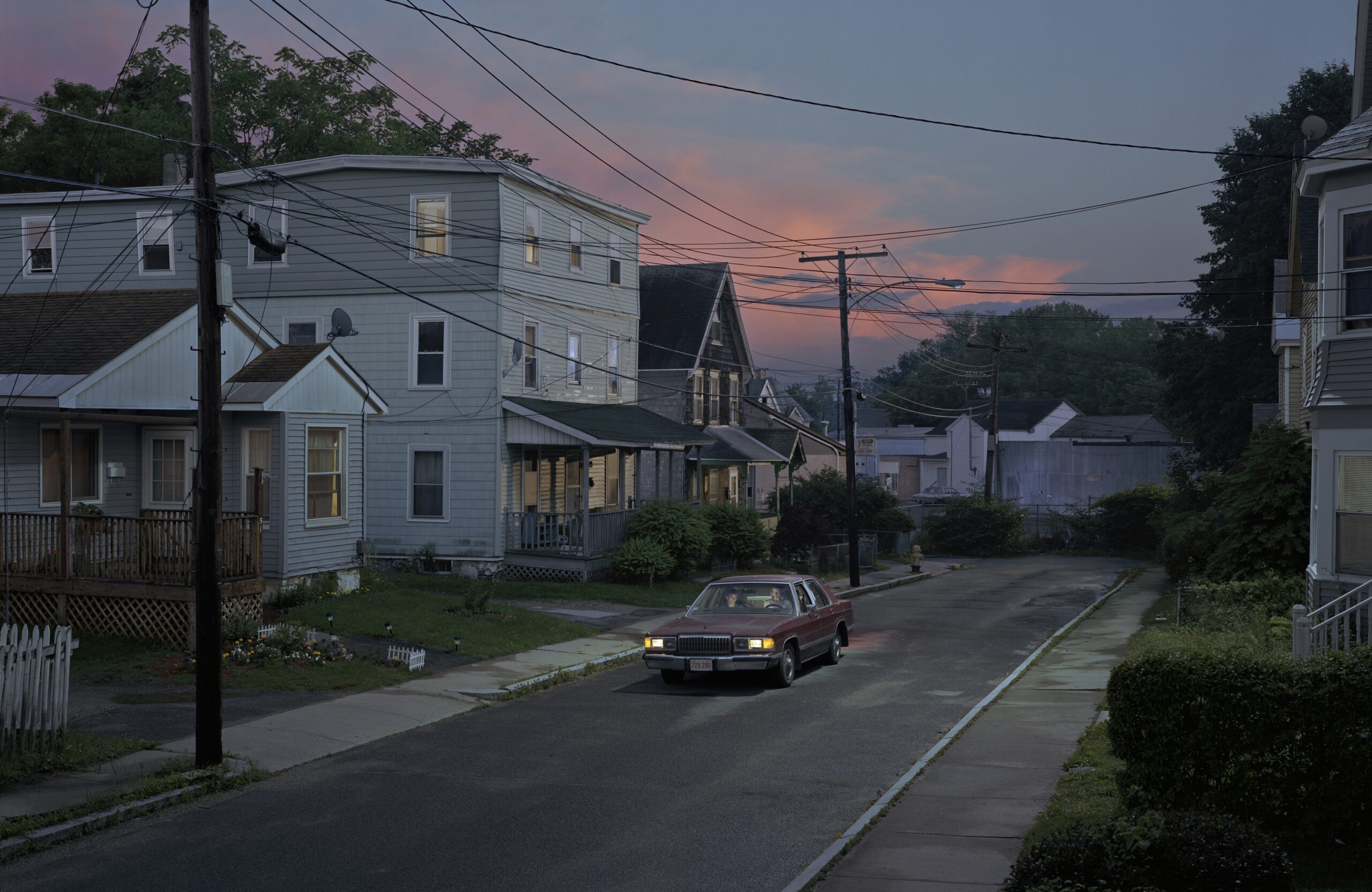
With the exception of the interior pictures we made on constructed sets on soundstages, I always start with location. I drive around, almost in circles sometimes, in search of places that can accommodate one of my pictures. I’m looking for areas that feel timeless, and a bit dated but in a nonspecific way. But I’m also looking for something formally beautiful in a location: its architecture, the scale. Once I find a location I like, I return over and over until the story emerges.
What do you look for when casting your subjects?
Casting, much like location scouting I guess, is an elusive process. It’s hard to explain what I’m looking for because it’s something beyond physical characteristics. I’m looking for people who evoke a stillness, a feeling of introspection, depth, sadness, quiet contemplation, some emotional or psychological quality that runs beneath the surface.
You once said, “Every artist has one central story to tell and that story is told and retold over the course of a lifetime.” What central story would you say that you’re trying to tell?
I think my pictures all circle around my own story: the way I see the world, my fears, longings, and desires. It’s an open-ended and elliptical story, not a literal one.
Your work is elaborately and meticulously staged, often requiring months of preparation. How do fashion, uniform, and personal style influence the images included in the Aritzia collaboration and how you think about the characters within your images?
A great deal of thought goes into what the figures in the pictures are wearing and what that does and doesn’t convey. First of all, we want the figure, their clothing, and how their hair is styled to feel like part of the world they’re inhabiting. We don’t want anything in the pictures—cars, buildings, and homes included—to draw attention to itself, and that extends to the people in the pictures as well. So we tend toward muted colors, nondescript wardrobe, items that look like they’ve been well-worn by that person, all in an effort to build a world that feels familiar and ordinary.
In more recent bodies of work, I’ve become interested in outmoded uniforms, what people wear while out in the community performing jobs, etc. So, in that respect, my interests have moved away from the domestic space for the moment.
Before the era of smartphones and social media, unless you went to a museum, one of the few places that many people encountered images that were stylized or mediated was through fashion editorial. Did that particular language inspire your development as a photographer?
I was very influenced by being brought to museums with my father in New York as a young child. When I was around 10, I saw the Diane Arbus retrospective at MoMA, and that really struck a chord with me. It showed me that photographs could have a lot of power, could move you emotionally, and change the way you see and think.
I look at fashion photography as a bit of an outsider, but I’m nonetheless interested in it, as I’m interested in filmmaking and other types of visual mediums as well. I love that each field has its own language and lexicon, and I appreciate the language of fashion photography and the stories told through that.
Conversely, these days, audiences are much more likely to receive your images unintentionally or in transit. Do you have an ideal way that you wish for people to encounter your photographs?
My pictures exist, first and foremost, as physical prints. That’s their medium. In a world of screens, social media, and other digital formats, images have become ubiquitous and disposable. So it’s still important to me that my pictures exist as physical prints on a wall because I think their power and authority and lasting quality in that context is meaningful. I’m not bothered by people also viewing them on screens, however, as it makes them accessible to so many more people.
What does it mean to you to participate in this collaboration with Aritzia?
The pictures Aritzia and I decided to use in this collaboration were made almost 25 years ago. They’re all images that I think have taken on a larger life and have become part of the collective visual lexicon. So I was pleased to share them with a whole new audience and in a different context on these beautiful shopping bags. It’s exciting to have them out in the world, being carried through streets and then I imagine them placed in closets or on chairs or hanging from a hook in someone’s home, and in a way they become part of everyday domestic life.
More of our favorite stories from CULTURED
A Movie Deal Is a Writer’s Dream—or Is It? 5 Authors Get Real About the IP Machine
Shrinking Actors Sherry Cola and Jessica Williams Talk Therapy (On Screen and Off)
Kenturah Davis Lost Her Home and Studio to the LA Fires Last Year. Here’s How She’s Remade Her Practice.
The Pitt’s Shawn Hatosy Is an Emmy Winner, a TikTok Star, and a Secret Literature Nerd
Why Are Artists So Interested in Making Playgrounds?
Sign up for our newsletter here to get these stories direct to your inbox.


 in your life?