
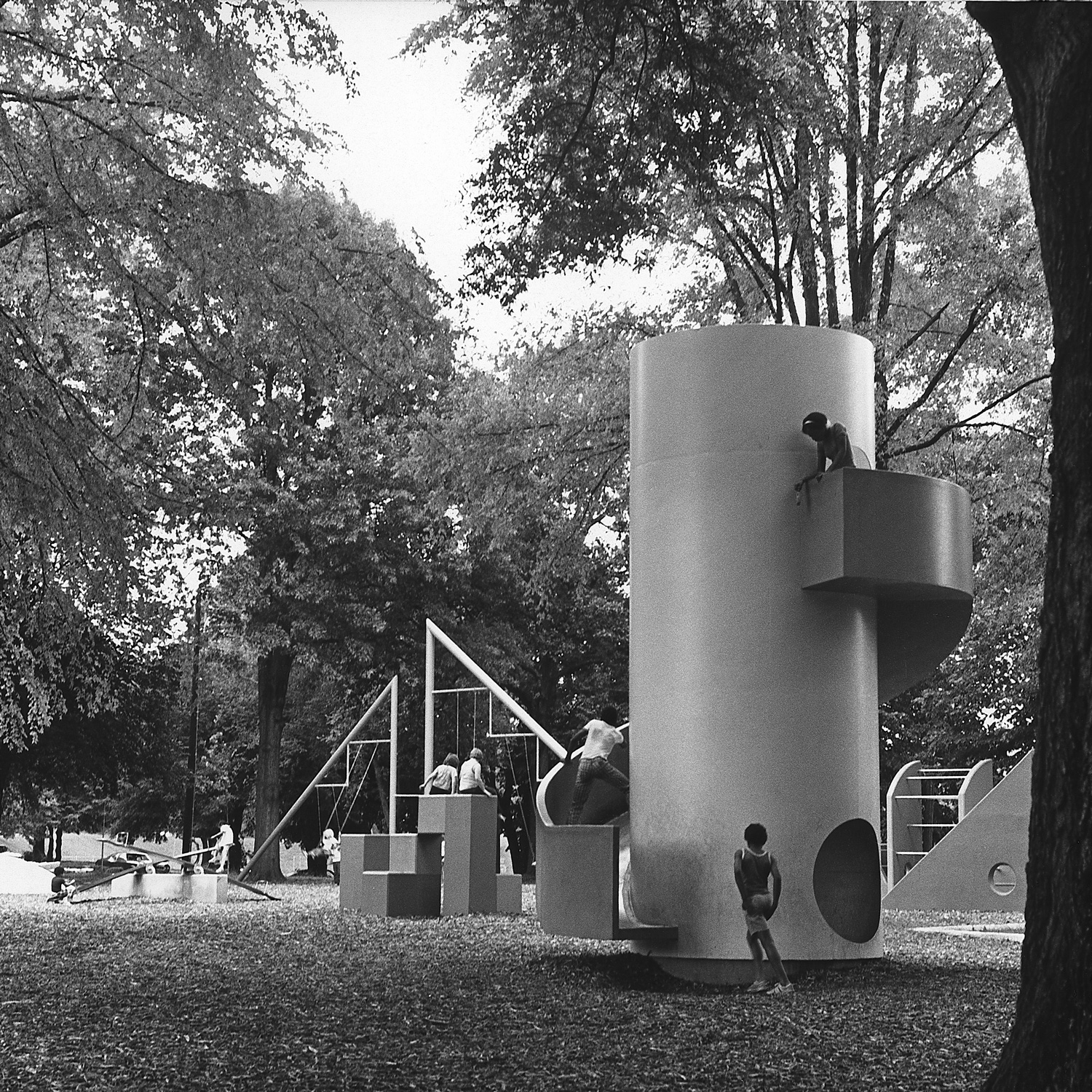
In 1954, the Museum of Modern Art in New York held its first and only competition for creative playground equipment designs. The top submissions, culled from 360 entries from around the world, were presented in the exhibition “Playground Sculpture.” Three of them went on to be commercially produced.
“Play and art have a lot more in common than we might think,” the historian Emmy Watts points out in her 2024 book The Art of Play. Both “derive from the same root—that of humanity’s endless creativity.”
Perhaps that’s why artists have created some of the most inspiring playgrounds. The first-place winner of MoMA’s competition was Fantastic Village by painter Virginia Dortch Dorazio, a series of concrete-paneled cubicles with organic-shaped openings to crawl through. The mini huts were fitted with climbing pegs, ladders, ropes, and sliding poles, providing ample opportunity for self-directed play.
Sculptor and landscape architect Isamu Noguchi proposed numerous unbuilt Playscapes and completed his first playground outside Tokyo in 1965. While he attempted for decades to build a playground in New York, his only U.S. Playscape is in Piedmont Park, Atlanta, commissioned by the High Museum of Art in 1975 and completed the following year. The remit was a children’s playground that was also a work of art: Noguchi’s abstract sculptural forms often evoked ancient civilizations, an open-ended invitation to explore and make your own rules. To coincide with the project’s 50th anniversary, the High Museum is opening an exhibition of Noguchi’s work, including his innovative playscape designs, on April 10.
Here are my four favorite playgrounds—one for each season—that double as works of art.
Winter
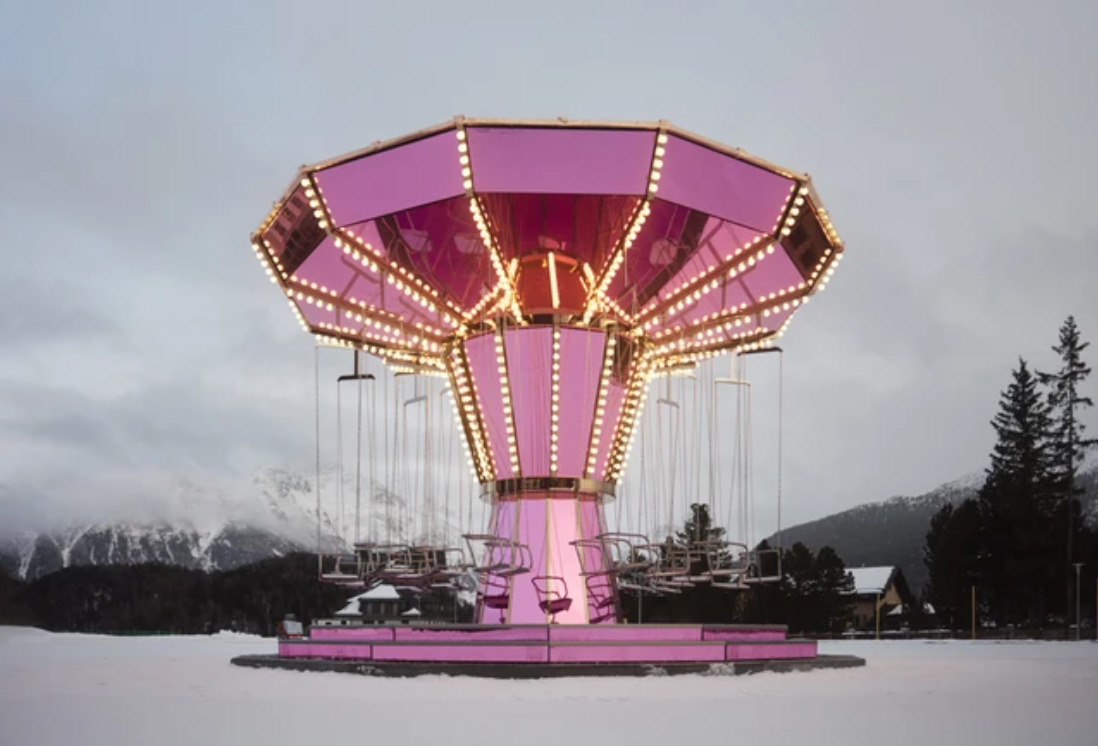
Pink Mirror Carousel, Kulm Hotel, St. Moritz, Switzerland
Created by Carsten Höller
Opened 2025
St. Moritz is known as a playground for the rich and famous, and at the Kulm Hotel, the city delivers on that promise—literally. Founded in 1856, the grand property is considered the birthplace of winter tourism. The candy-colored carousel is situated on the hotel’s ice rink. It’s an apt and ironic location for the work by conceptual artist Carsten Höller, who often re-conceives playground equipment as contemplative art installations that bore children and amuse adults. Here, he replaces painted horses with suspended single seats that face outward. This mirrored ride rotates very, very slowly (it takes 12 minutes to complete one revolution), enabling viewers to take in the wonder that surrounds them.
Spring
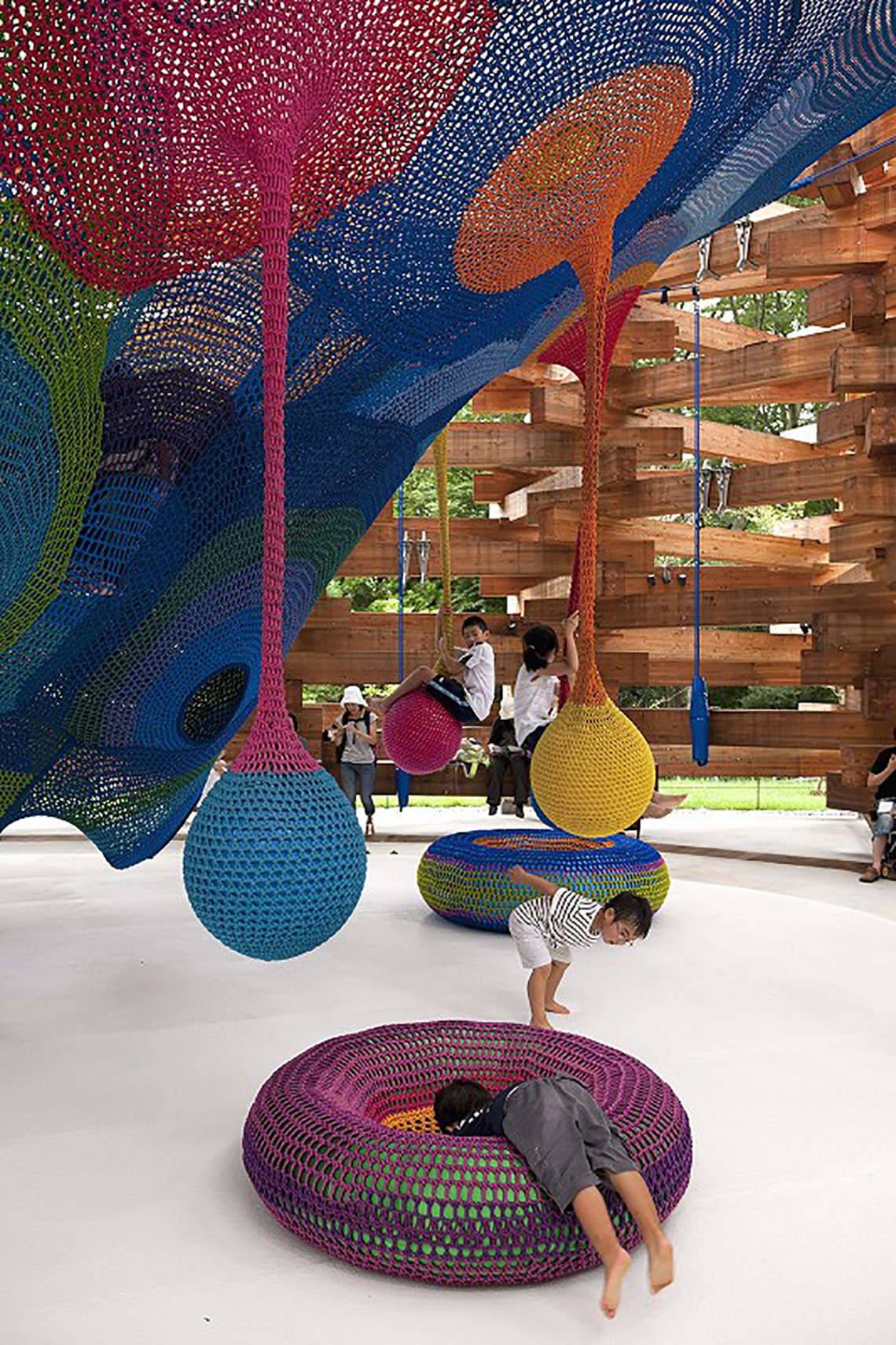
Woods of Net, Kanagawa, Japan
Designed by Toshiko Horiuchi MacAdam and Tezuka Architects
Opened 2009
The Japanese architecture firm Tezuka Architects teamed up with artist Toshiko Horiuchi MacAdam to create a timber-beamed pavilion in the middle of a Japanese forest. Part of the Hakone Open-Air Museum, Woods of Net employs traditional temple engineering: The trusses are fastened without metal and provide a monumental nesting structure for the showy climbing net, hand-knitted by Horiuchi MacAdam. The spirited dreamcatcher captures the youthful energy of hundreds of thousands of visitors each year. Kids (and adults) crawl into the primary-colored knitted, crocheted, and knotted nylon cocoon while upside-down lollipops provide maximum interaction: push, pull, and ride. Horiuchi MacAdam began making work expressly for children in the early ’70s, and over the next 30 years, her interactive spaces flourished. In 1990, she and her husband established Interplay Design and Manufacturing to develop play sculptures specially engineered to entertain children.
Summer
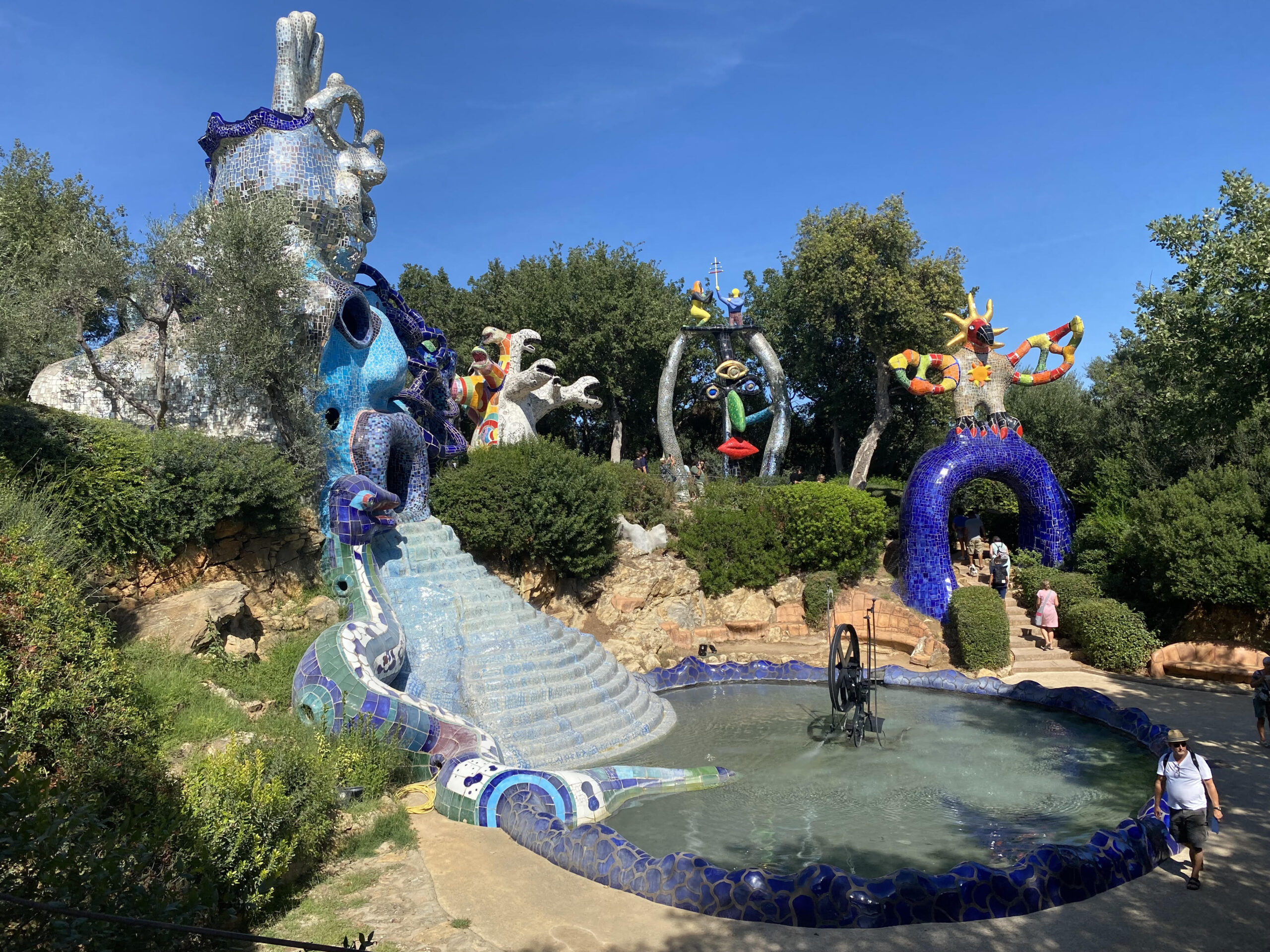
Il Giardino dei Tarocchi (The Tarot Garden), Grosseto, Italy
Conceived and overseen by Niki de Saint Phalle
Opened 1998
Ninety minutes from Rome, nestled in the hills of Tuscany, is Franco-American artist Niki de Saint Phalle’s monumental artwork, The Tarot Garden. This five-acre fantasy village is filled with 22 sculptures celebrating the life lessons also known as Major Arcana in Tarot. Funded with her own money and that of the Agnelli family, who founded Fiat, with engineering expertise by her husband Jean Tinguely, Saint Phalle spent nearly 20 years creating a wonderland of architecture, craft, and art. Her elaborate structures—named after symbols including the High Priestess, the Fool, and the Lovers—are formed in steel and iron, plastered with concrete, and then painted or inlaid with mosaics of glass, ceramic, mirror and stone. When the project finally opened in 1998, Saint Phalle decreed there would be no tours. The Tarot Garden was strictly to be a place of discovery—and, perhaps, a place to discover oneself.
Fall
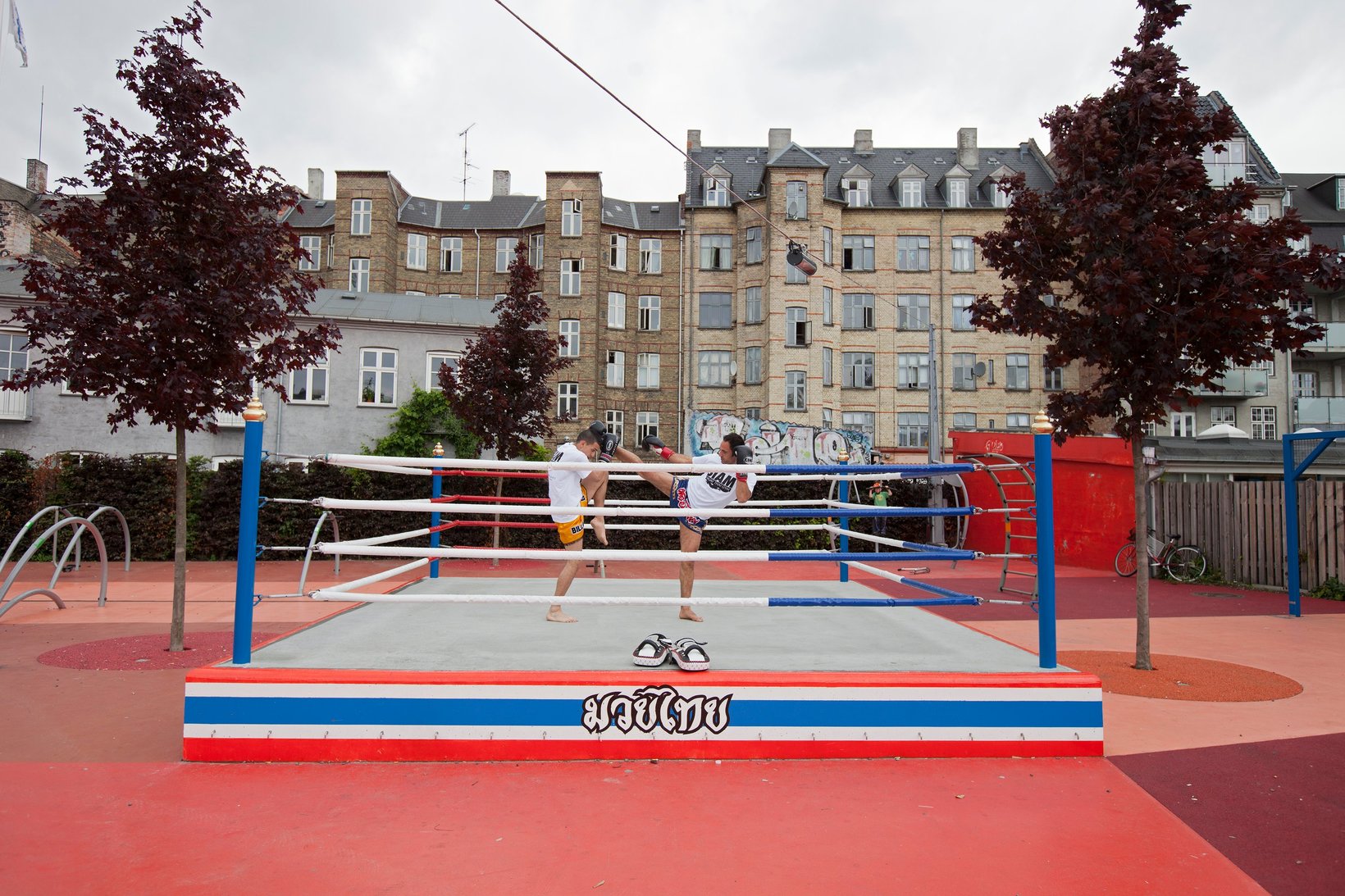
Superkilen, Copenhagen, Denmark
Designed by BIG, Topotek1, and Superflex
Opened 2012
Superkilen is an endurance playscape—a color-coded, half-mile-long trail in the Copenhagen neighborhood of Nørrebro. In 2005, the city partnered with the Realdania Foundation to commission an urban playground celebrating local immigrant communities. It offers periodic stops along the way: The Red Square hosts cultural activities and sports; the Black Square is an outdoor living room for games, including chess; and the Green Park is a set of artificial rolling hills for picnics. The art collective Superflex also asked locals to nominate their favorite benches, bins, playground equipment, trees, and utility holes from their homelands, which the artists imported or recreated for the park site. The result is an international showcase of 100 playground objects from 50 different countries—a participatory work of art in more ways than one.
More of our favorite stories from CULTURED
10 Collectors Share the Book That Changed How They Think About Art
Nobody Sings About Sex Like Peaches. With Her First New Album in a Decade, She Shows Us Why.
Stylist Jason Bolden Spotlights 3 Young Black Designers You’ll Soon Be Seeing a Lot More Of
The 14 Horniest Places in New York, According to Jordan Firstman, Francesca Scorsese, and More
Sign up for our newsletter here to get these stories direct to your inbox.


 in your life?