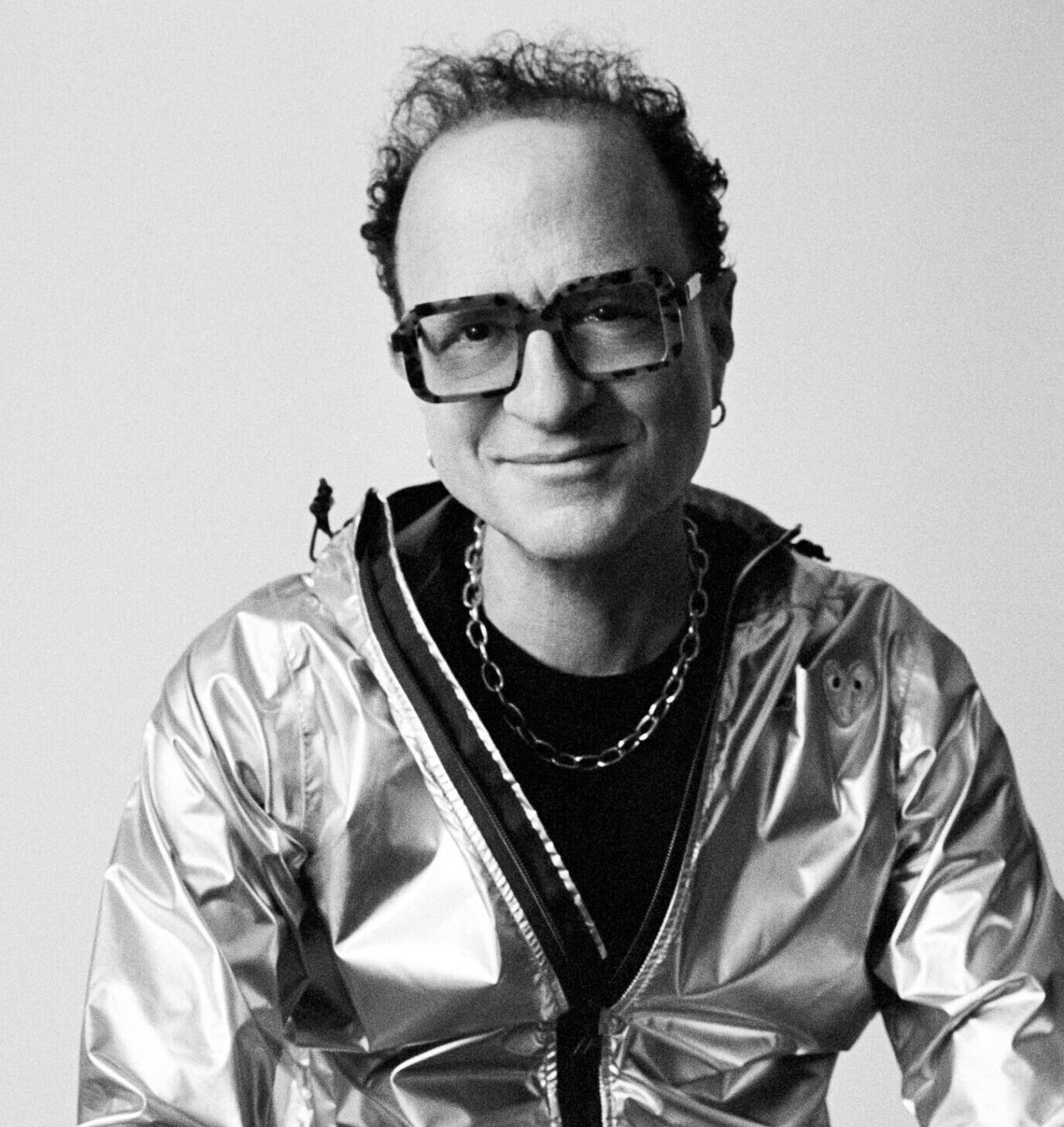
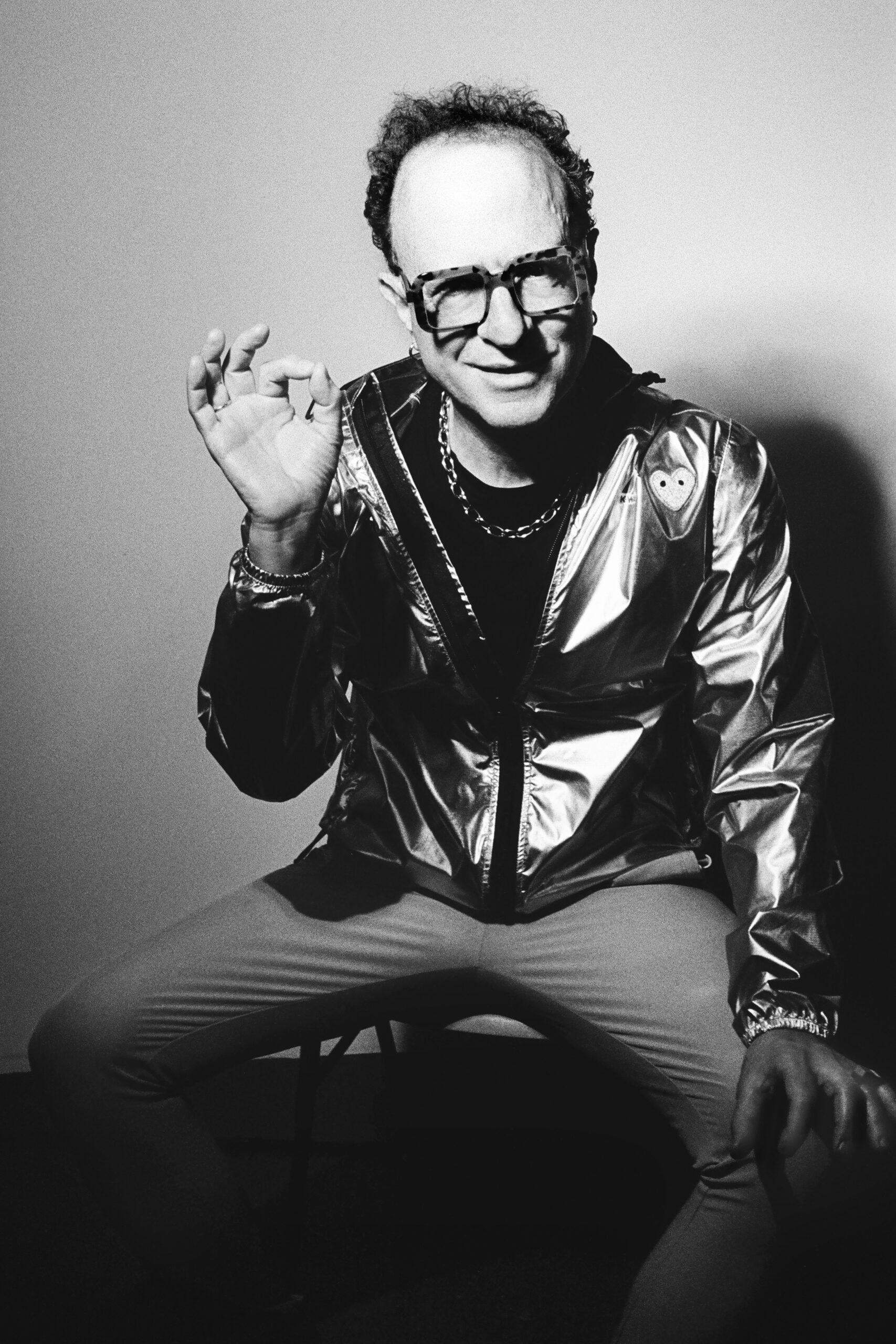
“Hey, want to be in my movie?!” a man with curly hair, thick glasses, and a fluorescent coat yelled, half chasing me down West 26th Street as I exited Visual AIDS’s annual “Postcards from the Edge” show in 2023.
I’d heard many stories that began with that very question and ended poorly, so I said maybe and took his card. That’s how I learned that the man was Wayne Koestenbaum, a leading figure in New York’s queer and literary scenes since the ’80s, synonymous with confessional prose, dissonant poetry, and genre-straddling criticism. His best-known book remains 1993’s The Queen’s Throat, which chronicles the timelessly homosexual obsession with opera.
This March, Koestenbaum re-enters the fictional fray with his first novel in almost two decades. And what a novel it is. My Lover, the Rabbi centers on an unnamed narrator’s psychosexual affair with an aging rabbi. Its 464 pages, like their author’s visual art practice, pull no punches in their depiction of sexual obsession. I knew I had to talk to Koestenbaum before the rest of the world dives in, so I called him up to talk intellectual filth, bad gays, and writing to embarrass. (Oh, and we made the movie, by the way.)
A key element of the book is the conflation of desire and repulsion. It feels like the protagonist hates the Rabbi, yet he’s so sexually infatuated with him.
My earliest gleams of homosexual feeling were necessarily twinned with disgust. It was the 1960s and 1970s, and there was no language or idealizations for what I was feeling. Gayness was a kind of filth location. That’s not unique to me, [but] many people don’t build an erotic home around the filth portion of eroticism. I did—and maybe that’s because I’m such a deeply internal person. The deeper you go into your own consciousness, the filthier it gets.
The Rabbi goes unnamed, but the fact that he is a rabbi comes up at least once a chapter. Does it feel accurate to say that the narrator could be seen as a self-hating Jew in addition to experiencing internalized homophobia?
Inevitably, yes. But my hope with this book is to experience those vibes rather than take them as received wisdom. We all know about the self-hating Jew and internalized homophobia, but the actual experience of those things may be rich with desire and erotic potentiality. Built into the narrator’s love for the Rabbi is the knowledge that the Rabbi always has and always will refuse him. His overwhelming desire for the Rabbi will never be met: It’s an asymptote.
And the narrator doesn’t even believe the Rabbi is a good rabbi.
But the “rabbi-ness” is crucial. A rabbi, like the Pope, is an earthly representative of the divine—an unfathomable pinnacle. So the Rabbi is somehow permanently above the narrator. It’s as if the Rabbi is saying, “You will never attain my tabernacle.” And the tabernacle in this case is his body.
Somewhat early in the book, the Rabbi goes to Warsaw where he is engaging with the Holocaust by doing vaguely “reparative” work. How does this proximity to the Holocaust impact the story?
The Holocaust is central, though subterranean, to the book. Its aftermath is like the water table underneath the book’s sense of melancholy and of permanent damage already having been done. The issues of speech and silence, guilt and alienation, perpetual mourning, and interpersonal unfathomability—these are all inheritances of the Holocaust. That sense of turgid, mutual unapproachability is part of the wreckage of the Holocaust.
The book isn’t exactly an “easy read.” Parts of it are ugly and kind of gross, and it feels like we’re trapped in this obsessive and winding mind. How do you think about legibility and opacity when you write?
I’ve always tried to write within the register of intellectual filth. Even in terms of fiction, my role models are Samuel Delany, Jean Genet, Hervé Guibert, Pierre Guyotat, and Dennis Cooper. I learned from them that you need to pay attention to the things that give you the creeps and that really turn you on—and maybe even at the exact same moment. I’m constantly telling my students that if you don’t wake up in the middle of the night terrified and embarrassed about what you’ve written, then you’re probably not doing the right thing. And obsessiveness is my style but in this book, I feel like for the first time I’ve really described what my mind and my nervous system and my libidinal system feel like from inside.
This book also has so much sex—with people who aren’t 21 and don’t have washboard abs. There’s this quote I’m obsessed with about “a body allowing itself to not go to seed but relax in its own unfenced fruitfulness of contour.” It’s about the gay male body that isn’t necessarily poorly taken care of, but isn’t at the gym every day.
I grew up in the clone era, and I did think clones were hot, but I thought they were hot because of their mustaches, not their muscles. The mustache as a signifier turned me on as much as the mustache itself… I’ve never been a good gay in terms of the way I look. I’ve never felt that I perfectly occupy a desired position like “nerd twink.” I’ve always felt very ill at ease in places like Fire Island, at least when I went in the ’80s. I basically often don’t feel like I belong. And as a writer of course I’m going to write about that experience of not belonging to gayness. You don’t ask that a rabbi or a poet look like an Abercrombie & Fitch model. I enjoyed celebrating non-normative bodies as desirable in this book.
Do you care about how the audience receives the book?
My life as a writer has mostly been avoiding the reality that somebody might one day read my book. This novel in particular happened in the deepest privacy. When I started writing it, I was sitting on a pink couch in my house in Germantown. It was a Friday night, and the first line of the book came to me. I am aware that it will fall somewhere, but I guess I don’t want to prognosticate lest anything I fear comes true.
And why a novel after 20 years away from the form?
I’ve always idealized the novel, without it necessarily being my first choice as a reader. A novel, at its best, is Gesamtkunstwerk that captures the flow of time and an entire body of real experience. When I’m writing my other books, I always pretend that they’re novels; I never wanted my non-fiction to be pedestrian. When I write anything, I have in mind this torrid tunnel of language, and I felt so inspired by this topic when I wrote the first sentence of My Lover, the Rabbi that I thought, I want to continue with this impulse until the end of time. I wrote it in this intense immersion, like staring at the sun.
My last question is about The Queen’s Throat, your mammoth book from 1993. Why do you think it has such an enduring legacy?
The writing of that book was a very powerful experience, very much like writing My Lover, the Rabbi, in that I had given myself permission to write about the thing I really cared about in the way I cared about it. When I wrote The Queen’s Throat, I positioned myself as somebody who can’t sing and who is unqualified for opera, even socioeconomically or chronologically unqualified for opera. My position writing the book was as this queer interloper.
In My Lover, the Rabbi, my relation to maleness and to the attainable erotic idol is also distanced and forbidden. There are huge obstacles between the narrator and the Rabbi, and between my desire and its fulfillment. In both books, the narrator is presenting himself as forever distant from the object of desire. That’s why you need to pile up so many heated words: to build up a monument that will be the bridge to that object.
More of our favorite stories from CULTURED
10 Collectors Share the Book That Changed How They Think About Art
Nobody Sings About Sex Like Peaches. With Her First New Album in a Decade, She Shows Us Why.
Stylist Jason Bolden Spotlights 3 Young Black Designers You’ll Soon Be Seeing a Lot More Of
The 14 Horniest Places in New York, According to Jordan Firstman, Francesca Scorsese, and More
Sign up for our newsletter here to get these stories direct to your inbox.





 in your life?