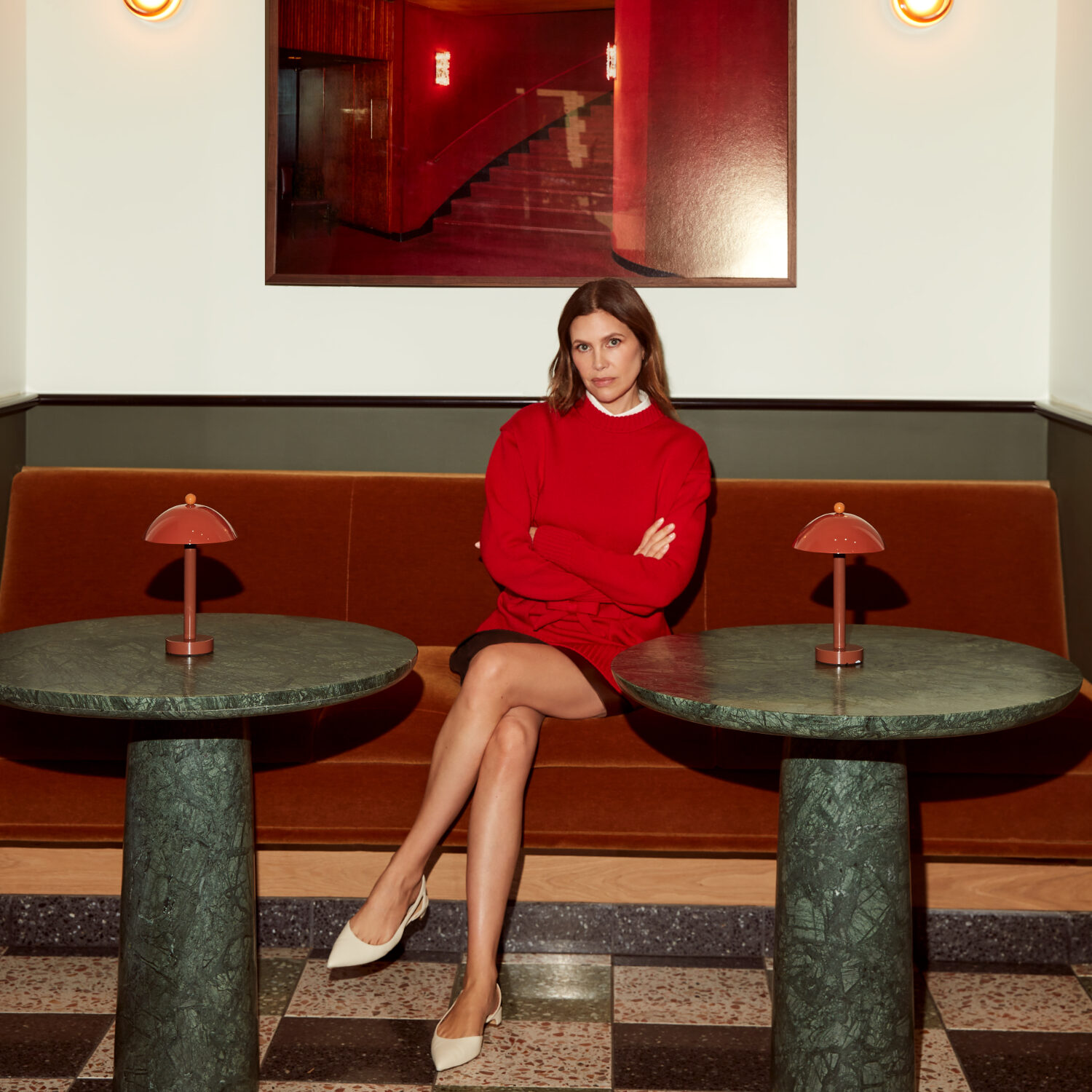
On a recent morning, Dasha Zhukova welcomes me into the lobby of Ray Harlem, a new residential property development on Fifth Avenue, just off 125th Street, where the National Black Theatre has been located for more than four decades. The lobby’s enormous windows look directly onto the street; inside, the room is layered in hues of dark green, mustard yellow, and pink. Opulence, a painting of a woman in a fur coat by the American artist Jurell Cayetano, hangs above the couch.
Zhukova—a former fashion designer, magazine publisher, and museum founder who is a Met Gala fixture and was twice-named to Vanity Fair’s Best Dressed List—is not your average real estate developer. But according to her, this new stage of her life makes complete sense. She first began work on her new company, Ray, in 2018. In 2021, it won a bid to replace the National Black Theatre (NBT)’s original building.
The original concept for the much-anticipated project was conceived by Barbara Ann Teer, who founded NBT in 1968, and carried forward by Sade Lythcott, Teer’s daughter and NBT’s chief executive officer. Developed in collaboration with Zhukova and others, the vision is innovative but simple: The 27,000-square-foot theater would remain the corner property’s centerpiece, while 21 floors of residential space would be built above it. With site-specific commissioned artwork, theater workshops, and event space, the building would be a place where culture, art, and community meet.
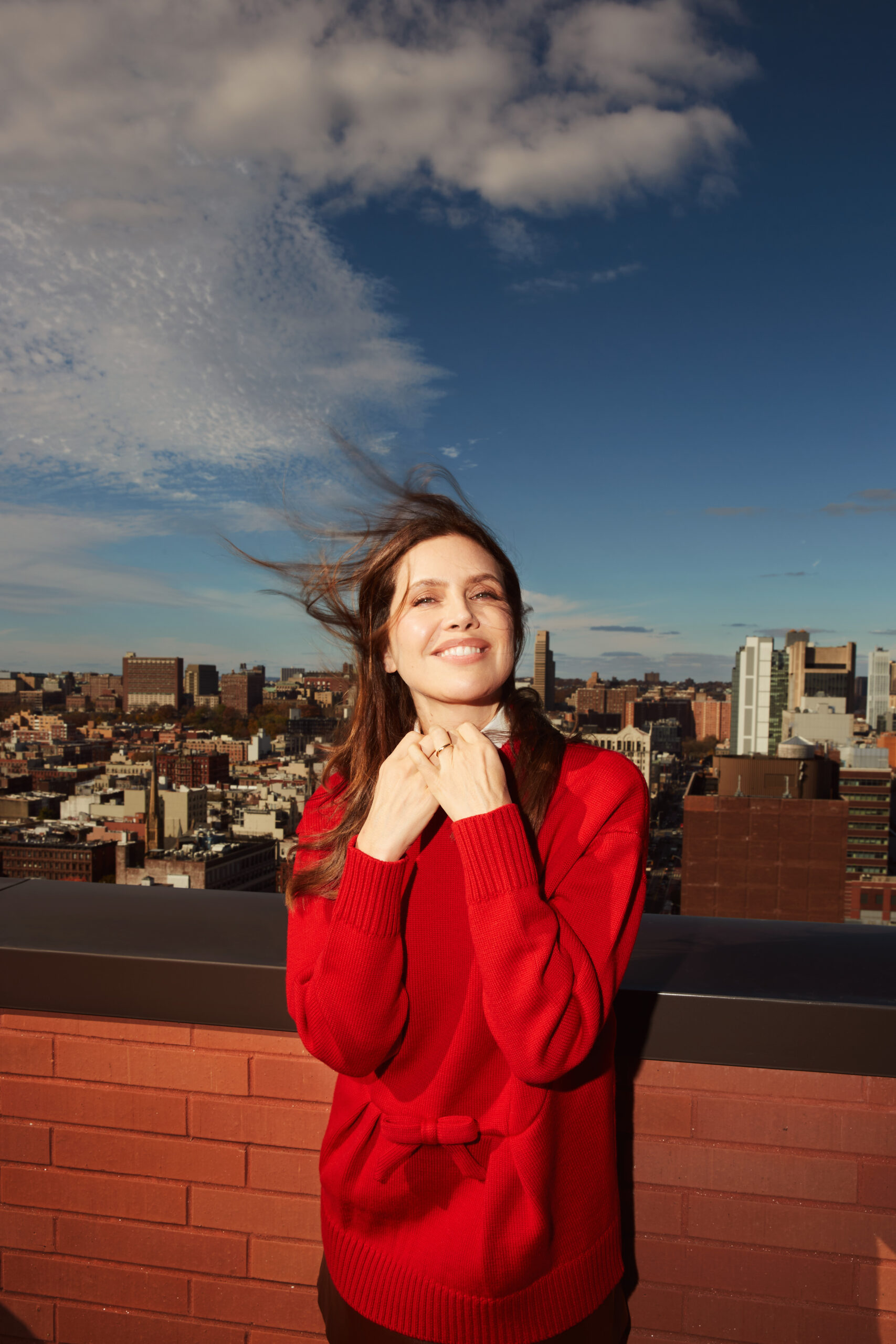
Zhukova gives me a tour of the building briskly. She is a mother of five—her youngest is 1, her oldest just turned 16—and time, she acknowledges, is often in short supply. But her demeanor is relaxed. Above the mailboxes hangs another painting, commissioned by Ray, by Dominican-born artist Freddy Carrasco. Upstairs, alongside a gym, is a library, a tea room, and artwork by emerging Black artists Nikko Washington and Ellon Gibbs. We step briefly out onto the roof terrace. All of Manhattan sprawls out before us, with the top of Central Park immediately below.
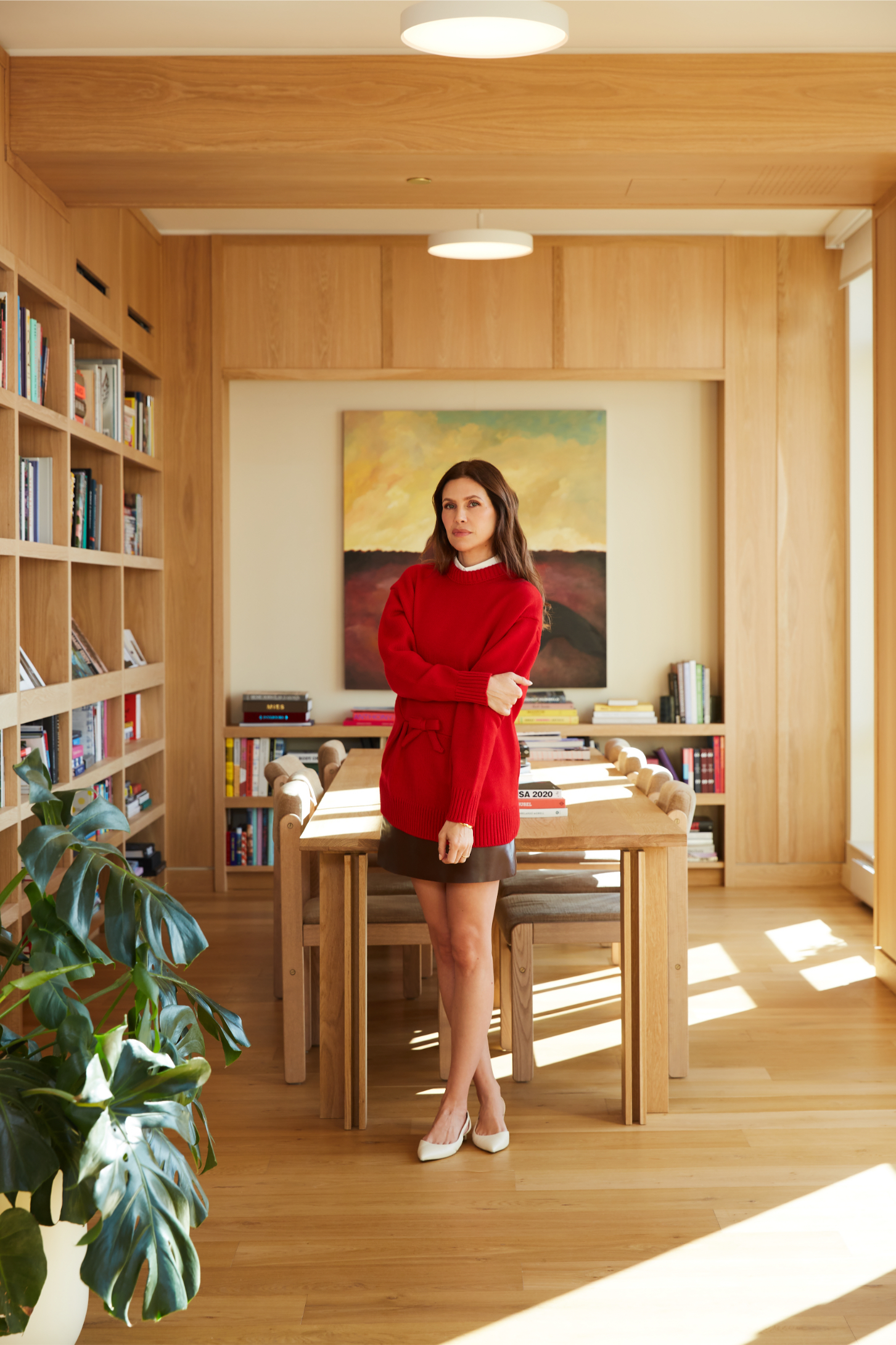
The red-brick building was designed by Frida Escobedo Studio with Handel Architects. Rents range from $3,000 for a studio to over $4,000 for a two-bedroom (a quarter of the 222 apartments were made available through a public affordable housing lottery last year; nearly all are now occupied). Small details like floating shelves of white oak add a soft but contemporary touch. A young man walks past us on the terrace as we settle onto a couch, his dog running ahead. All sorts of people live here, Zhukova tells me: doctors, lawyers, families, Columbia students.
The idea for Ray, she explains, came to her after observing how people gathered in the lobby of the Garage Museum for Contemporary Art in Moscow, a public art institution she established with her ex-husband, the Russian oligarch and art collector Roman Abramovich. Amy Winehouse performed at an early opening party in 2008. The Dutch architect Rem Koolhaas designed Garage’s permanent building, which opened in 2015, to be a premier destination for the art world. Zhukova and Abramovich liked to fly in art-world stars such as Hans Ulrich Obrist and Larry Gagosian to celebrate world-class shows for major artists like Yayoi Kusama, James Turrell, and Urs Fischer.
Over the years, Zhukova observed, Garage also became a place where Muscovites came together to just, well, hang out. The art may have been the draw, but the architecture created the container. “Building Garage allowed me to really fall in love with architecture, she tells me. “I understood how art and architecture and ideas, when in proximity to each other, can create something magical. And selfishly, I thought, How can I experience this every day?”
From afar, Zhukova strikes a glamorous profile. She is now married to Stavros Niarchos, one of the many heirs to the Niarchos Greek shipping fortune. In New York, where she lives between winter holidays in St. Moritz and summer jaunts on David Geffen’s yacht in the Mediterranean, she attends the U.S. Open and MoMA galas. She sits on the boards of major museums, including the Los Angeles County Museum of Art and the Metropolitan Museum of Art. During our interview, Zhukova’s phone rang, and as she reached to turn it face down, I saw Karlie Kloss’s name on the screen. Her mother, Elena Zhukova, became Rupert Murdoch’s fifth wife in 2024 (Zhukova remains friends with Wendi Deng, his third).
But she has also been scrutinized for her proximity to Abramovich, from whom she split in 2017 and who has been sanctioned by the European Union and the United Kingdom for his association with Putin’s government. After Russia invaded Ukraine in 2022, Garage halted its exhibition program “until the human and political tragedy ceased”; the building remains open for events and tours, but has not presented shows since 2022. A representative for Zhukova did not respond to a query about whether Garage plans to resume exhibitions after the war’s end.
I spent about a year working with Zhukova after Vice Media hired me as the editor-in-chief of her now-defunct Garage Magazine (an entity in which Vice had taken ownership after Zhukova met Shane Smith in LA). Her life was cosmopolitan, but she revealed herself—at least then—to be someone with taste, who was confident enough to surround herself with experts. She worked hard to be taken seriously in whatever realm she was in, whether art, fashion, or architecture. “I get a lot of my ideas from talking to smart people,” she tells me.
Despite her glittering life, though, she always struck me as a bit of a nerd. For example, Ray takes its name from a mathematical symbol, she explains. “It’s a point of origin that goes to infinity. I was dreaming big. I thought, We’re going to build these everywhere. I want to build as many Ray buildings as possible.” Today, in addition to Ray Harlem, there is Ray Philadelphia. Early this year, Ray Phoenix will open, and there are plans to open Ray Nashville in 2027.
Her first venture was a contemporary fashion line, Kova & T, which she launched in 2004. I wanted to know what accounted for her turn toward the unglamorous world of residential real estate. Perhaps being happily married, with a full house, has meant she doesn’t have time for the nonsense, and she is finally settling into what she really loves to do. She didn’t disagree. “I just enjoyed building something. I literally thought, I want to keep working with architects. How can I do that?”
Zhukova rarely gives interviews. Though she is a public figure, she has expressed discomfort in the spotlight. When I asked if she felt that the way she was represented in articles didn’t quite capture her, she nodded her head cautiously. “Everyone would say yes to this question, right? I can’t be objective to myself, but yes, of course, I feel that.”
A few days after we meet, Zhukova texts me, unprompted: “I was also thinking about the question you asked me about Stavros [and Zhukova’s turn to real estate] during our interview, and since I’ve never really spoken about him publicly, I wanted to elaborate a bit more (hopefully in a more eloquent way). Stavros and I share a love of architecture, art, design, film, and other arts, and that naturally finds its way into my work. We spend a lot of our free time around those interests—seeing art, exploring architecture, watching films, so I often discover new ideas and materials through the things we experience together. I have no idea why this question stayed with me.”
Zhukova seems to have entered a new phase of life, one that is a little more pragmatic and a little less glamorous, but that requires actual building and problem-solving. She told me her days start early with kids and school drop-off and pick-up—most nights, she says, she doesn’t go out, preferring to fall down rabbit holes on Instagram or TikTok at home. “My whole TikTok feed right now is Japanese 7-Eleven,” she tells me.
At the end of our tour of Ray Harlem, Zhukova takes me down to the second story, where the National Black Theatre will eventually reopen in 2027. (Ray, which is for-profit, will soon be neighbors with the NBT, a nonprofit, which remains running through partnerships and commissions as the building undergoes development.) Standing on the unfinished floors, Zhukova says, “I’m not sure if there’s a more modern term than feng shui, but I’m really sensitive to how something feels.” Looking around the still cavernous and raw space, it was already possible to imagine how the drama of live performance would change everything—how the hum of a living, breathing cultural institution will create a lasting sense of possibility.
More of our favorite stories from CULTURED
Tessa Thompson Took Two Years Out of the Spotlight. This Winter, She’s Back With a Vengeance.
On the Ground at Art Basel Qatar: 84 Booths, a Sprinkle of Sales, and One Place to Drink
How to Nail Your Wellness Routine, According to American Ballet Theater Dancers
10 of New York’s Best-Dressed Residents Offer the Ultimate Guide to Shopping Vintage in the City
Sign up for our newsletter here to get these stories direct to your inbox.


 in your life?