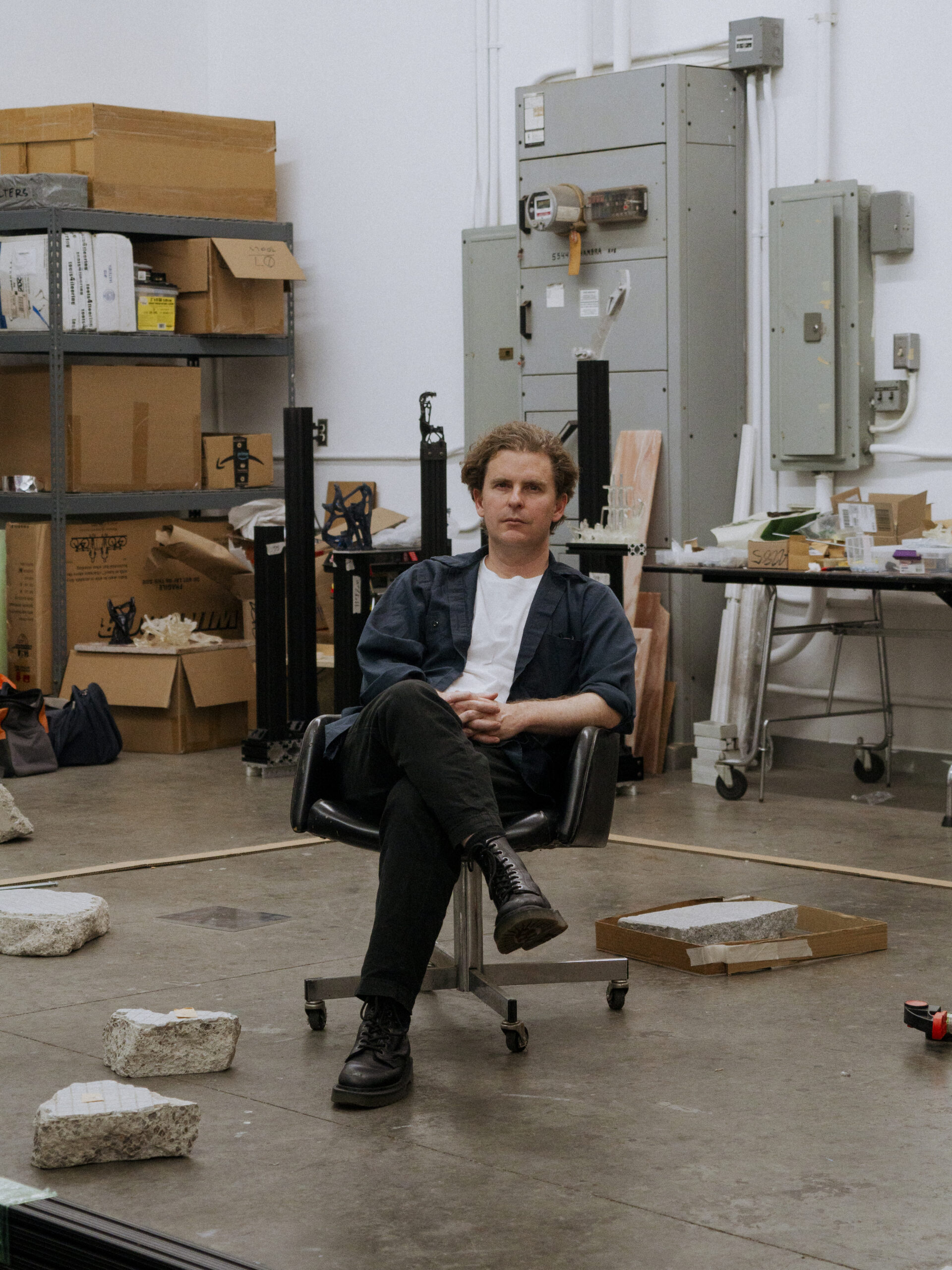
Many of Cayetano Ferrer’s projects begin in archives—an apt breeding ground for work that worries itself with time and how it is annotated, warped, and reinterpreted.
The 44-year-old artist was born in Honolulu; when he was around 14, his parents, originally from Argentina, moved the family to Las Vegas. It’s notable that one of Ferrer’s earliest pieces, a farrago of casino carpeting exhibited at the first “Made in L.A.” biennial in 2012, was inspired by the experience of pulling at the seam of one such specimen in Vegas, and revealing the cement underneath. (His first institutional solo show, at the Santa Barbara Museum of Art in 2015–16, paired a version of this work, Remnant Recomposition, with rarely exhibited artifacts and architectural remains dating from the 1st century C.E.)
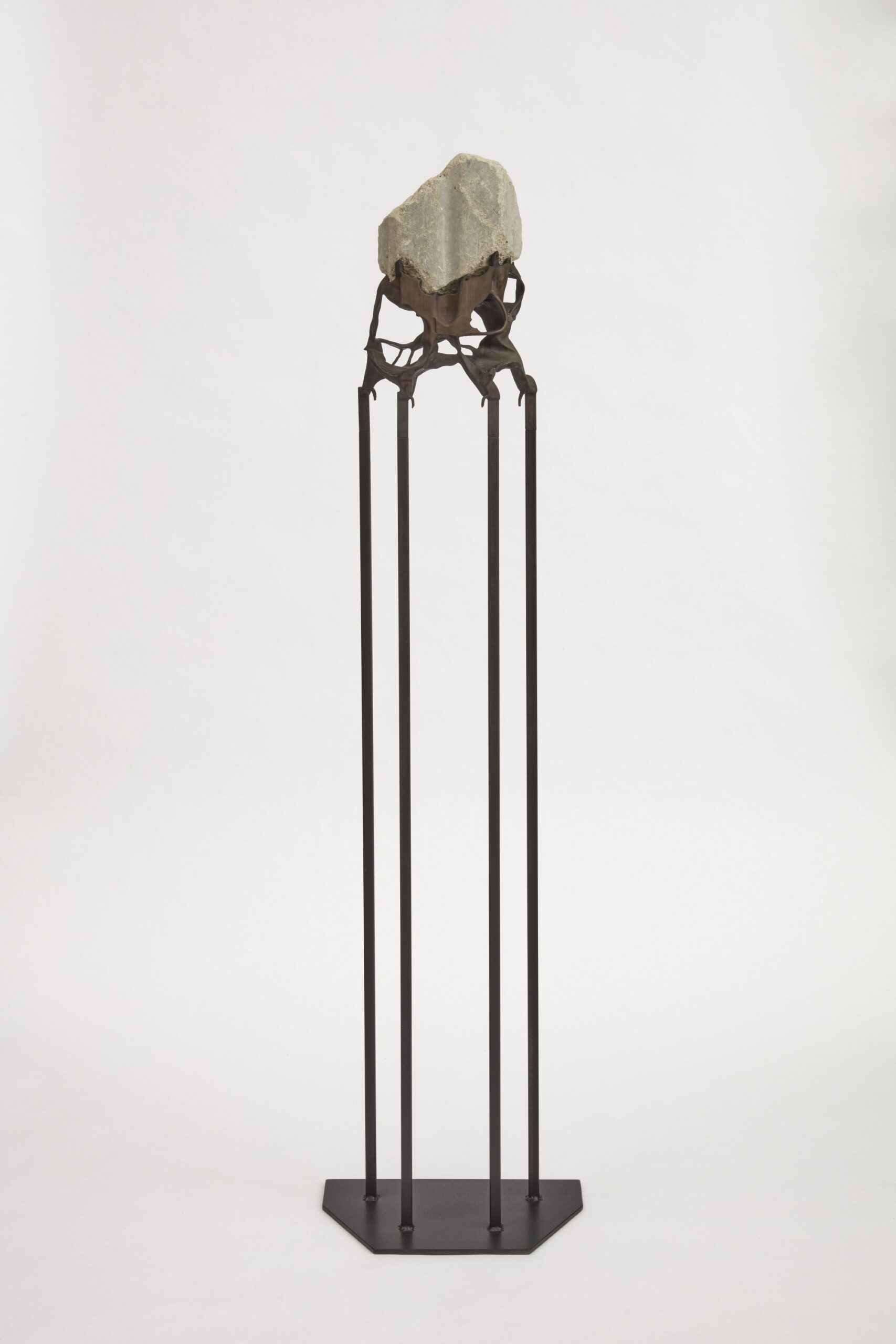
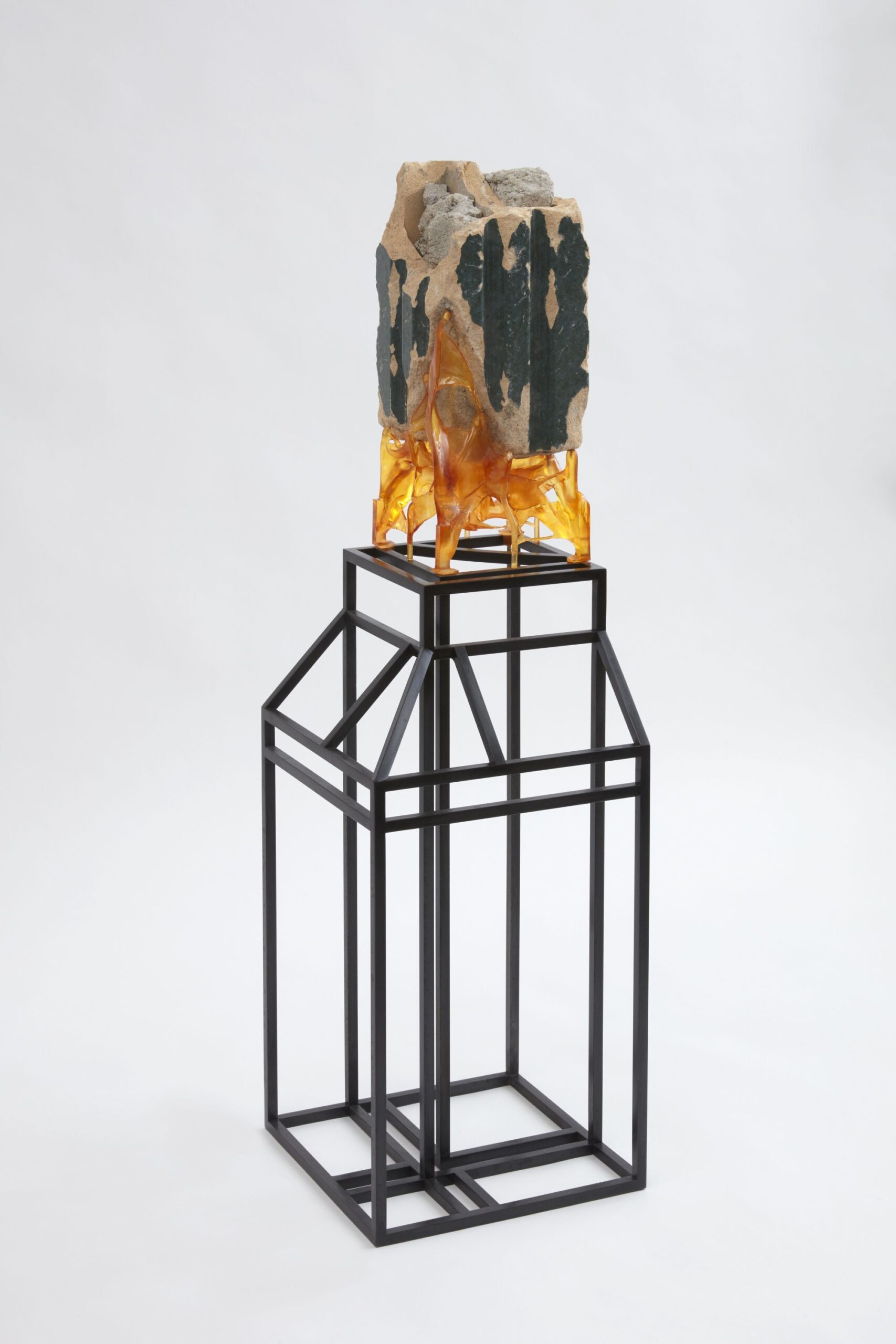
His inquiry into the life cycle of objects both ancient and contemporary continued when Ferrer salvaged fragments of the original William Pereira-designed LACMA buildings, repurposing them in a suite of different projects, including his latest show, “Object Prosthetics,” on view Jan. 31 through March 14 at Commonwealth and Council in Los Angeles.
Ahead of the opening, the artist, who is embarking on a PhD in Historic Preservation at Columbia University, gave CULTURED a studio visit.
What’s on your studio playlist?
Lately, I have Yasuaki Shimizu’s album Kiren on heavy rotation. It has a perfect balance of mechanical rhythm and tonal experimentation, equally perfect for generating ideas and physical labor.
If you could have a studio visit with one artist, dead or alive, who would it be?
The painters of the caves of Lascaux.
What’s the weirdest instrument you can’t live without?
The Kool Glide Pro. It’s a hot iron seaming machine that allows me to construct works from odd-shaped remnants in a way that wouldn’t be possible with a traditional iron. It’s basically a handheld microwave with a ’90s design that looks like it could be a prop from Star Trek.
Do you work with any assistants or do you work alone?
It tends to be project by project because the demands shift constantly. For my upcoming show Object Prosthetics, I had a lot of support from Max Cleary, who is a fantastic artist in his own right.
Have you ever destroyed a work to make something new?
In a way, yes, I work with a lot of fragments, and that includes components of prior works, but I don’t always think of it as destruction. There are always traces that travel with a fragment, so in a way, it’s more of a transformation.
When do you do your best work?
Walking through a new city for the first time or looking out of a train window.
On a scale of hoarder to Marie Kondo, where do you fall?
When I relocated to New York recently, any hoarder tendencies were mediated by necessity. I still never got rid of any books.
What book changed the way you think about art?
Caetano Veloso’s Tropical Truth is a powerful memoir of making art and music amid Brazil’s right-wing dictatorship. The concept that stuck with me is antropofagia, translated as “cultural cannibalism,” which describes a subversive strategy of ingesting and transforming dominant cultural forms.
What’s your studio uniform?
A blue-collar uniform shirt and a white T-shirt.
Tell us about the best studio visit you’ve ever had.
A memorable visit happened before I had a dedicated studio in Los Angeles. In 2011, I met with curators from the Hammer Museum at California Donuts on 3rd and Vermont. We had a great conversation about casino architecture that developed into a project at the first “Made in L.A.,” the following summer.
More of our favorite stories from CULTURED
13 Books Our Editors Can’t Wait to Read This Season
With Art Basel Qatar, Wael Shawky Is Betting on Artists Over Sales Logic
Jay Duplass Breaks Down the New Rules For Making Indie Movies in 2026
How Growing Up Inside Her Father’s Living Sculpture Trained This Collector’s Eye
It’s Officially Freezing Outside. Samah Dada Has a Few Recipes Guaranteed to Soothe the Cold.

 in your life?