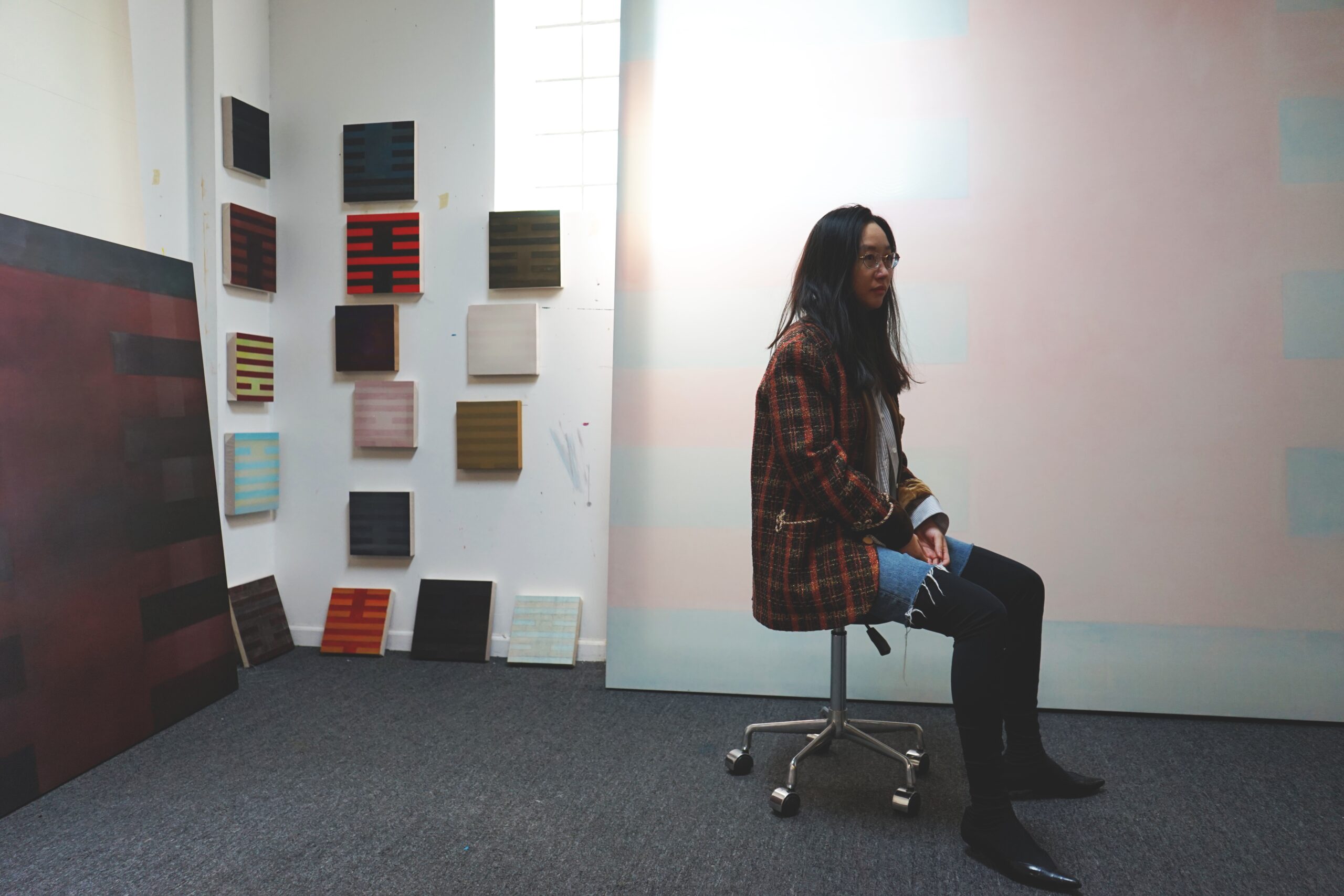
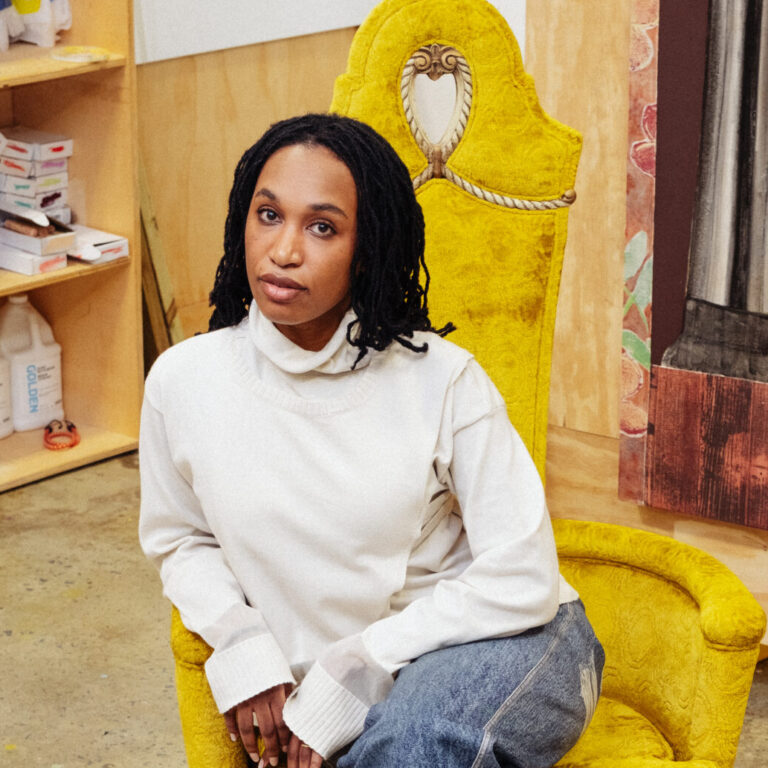
“The brush only becomes a brush when you are using it to paint,” Leah Ke Yi Zheng tells me across her computer screen, sitting, cigarette in hand, in her Chicago studio. “I think I’m only a ‘painter’ when I’m painting.”
The artist’s first encounters with paint came as a child growing up in Wuyishan, China, where she learned calligraphy and classical techniques from a traditional painter. But it was in Chicago, where Zheng enrolled in an MFA program at SAIC after leaving the prospect of law school behind, that she found her own path to it. Since graduating in 2019, she’s made a name for herself as an artist concerned with stretching the possibilities of her medium—and the meaning we glean from it. Zheng traded in canvases for Chinese silk, and rectilinear shapes for subtly (and sometimes jarringly) asymmetric forms. “I want to think about what makes a painting and go not from the starting point, which is zero,” she says, “but a step back—to the minus-one point—and think about how to construct that.” From this antechamber, three main motifs have surfaced and been reinterpreted over the years: machine gears, haunting, absent faces often obscured by color, and hexagrams rooted in the I Ching.
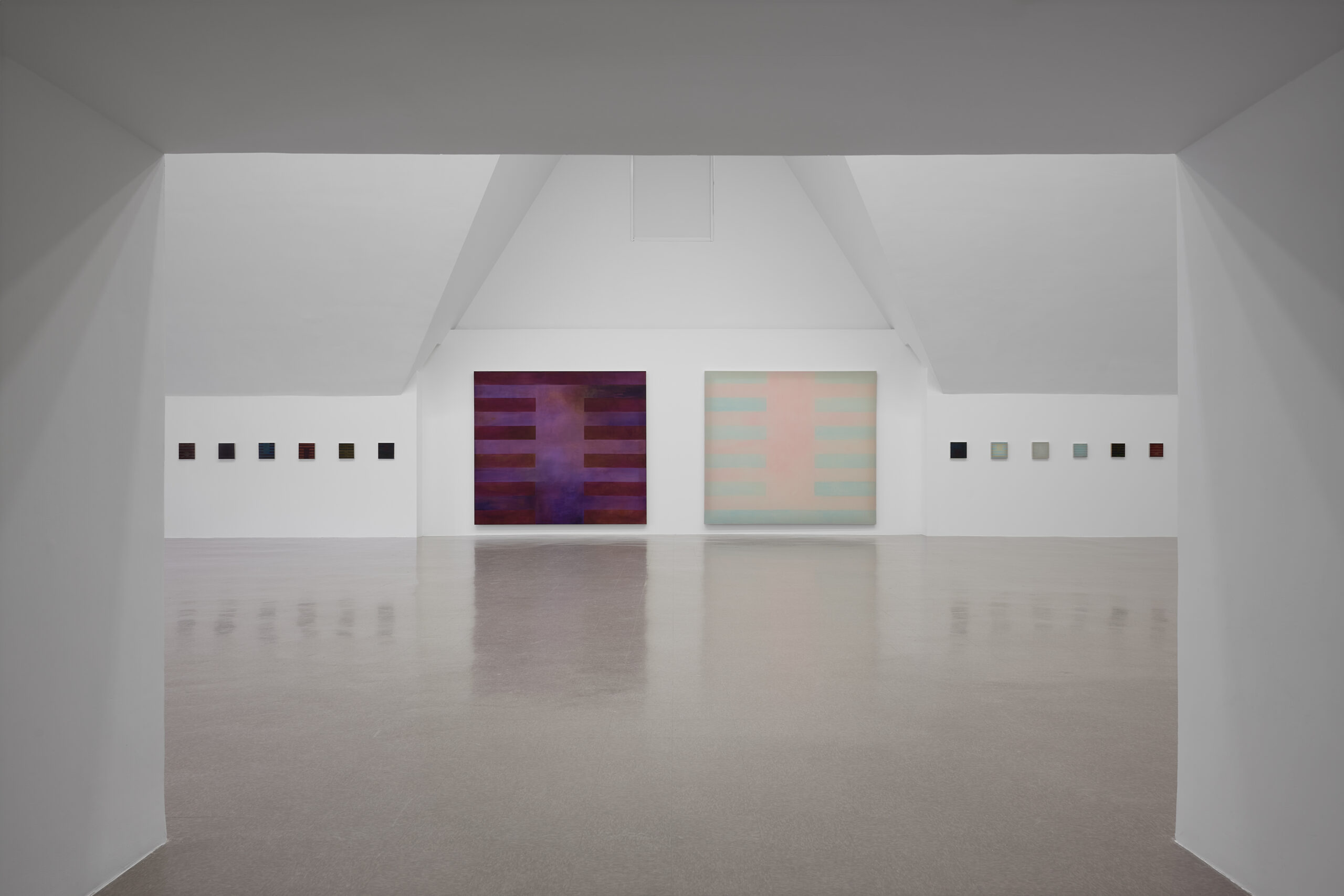
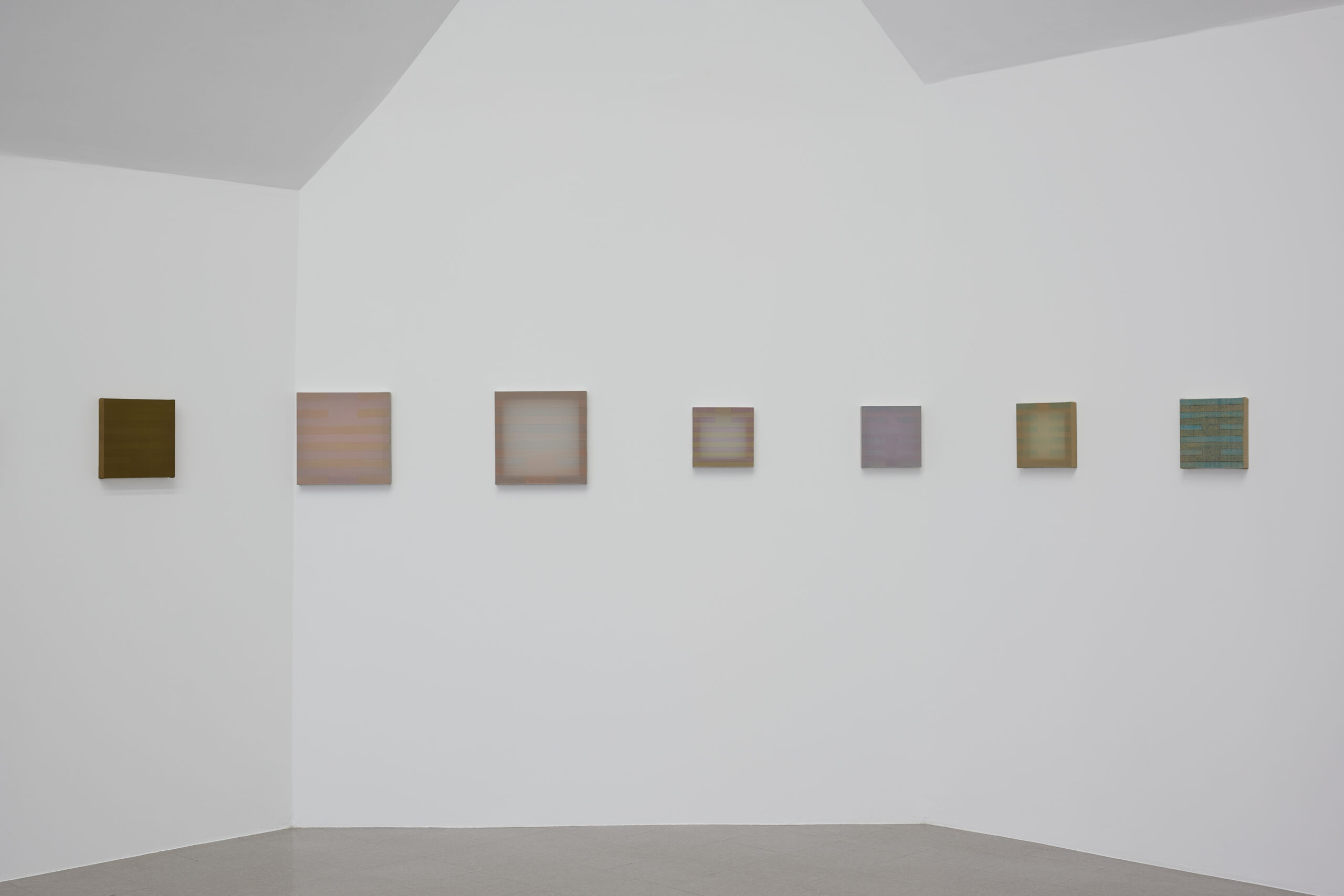
The ancient Chinese text laid the groundwork for the 64 paintings Zheng has on view at the Renaissance Society through April 12, which make up her first solo institutional showing. Inside, the artist has created a parcours in dialogue with daylight and the Renaissance Society’s existing architecture. (Certain windows have been concealed, and some walls’ proportions modified.) Like the featured pieces, which embody the “recursive, returning but not repeating” practice of configuring every possible arrangement of the “six, stacked, horizontal lines, solid or broken, which form a … hexagram,” any visit to the exhibition promises to be a (re)discovery. Below, I speak with Zheng about the studio practice that underpins this reflective body of work, her relationship to her analytical brain, and protecting her space.
CULTURED: This Renaissance Society show, your first institutional solo, is a big milestone for you. It’s also a hometown show of sorts. You moved to Chicago to get your MFA at SAIC, and you’ve been based there ever since. What’s kept you in Chicago? And what has its art ecosystem afforded you in terms of what you’ve been able to create?
Leah Ke Yi Zheng: I graduated in 2019. Chicago is kind of a quiet place. It’s really offered me time and space. I could find a studio with high ceilings and enough room to make large paintings. In terms of time, the commute is relatively easy. My son, who is 10, goes to school here, which limits the desire to move elsewhere. It’s quiet in terms of mental space too. I live a relatively reclusive life. There’s not too many openings; there is an art scene, but it’s not as active as in some other cities. My work deals with different histories, both Asian and Western painting histories. Having this kind of time and space here makes it easier to move among them.
Quieter means not [having] an immediate response. When you have a response, you need a response back, where[as] this gives an idea more time to grow. It becomes bolder and more ambitious.
CULTURED: You’ve made this monumental work for the Renaissance Society, a series of 64 paintings. Where did the I Ching paintings start, and did the progression surprise you?
Zheng: I have been making I Ching paintings since 2021. The I Ching is an almost 3000 year old book that is at the core of Chinese philosophy—a way of living, a way of understanding and being in the world. My initial desire was wanting to know about the world, and I Ching is a book of world’s phenomena. The idea of the show came very quickly; it’s quite an intuitive response to the architecture of the Ren. I [wanted] to work with the architecture, but the work itself forms another space. Together they form a new experience. The paintings are not strictly site-responsive, but they are considering the site…
Another challenge was the idea of light. In this project, the paintings embody the light. There are some that are really opaque, some that are really transparent. The two oppositions form this recursivity that keeps on generating newness or life. With this large quantity, for the first time, I could really vary the nuances or differences within the group of work for one exhibition.
CULTURED: I’m interested in what you’re saying about this dance between opacity and transparency. It makes me think of a review by the poet John Yau about your work from a few years ago, where he speaks about this dance between legibility and illegibility. There’s something a little disconcerting about that in your work; your eye isn’t exactly sure where to land on the painting. That brings to mind the idea of refusal as something that opens something up rather than shutting something down. You’ve also spoken about aliveness in your work, and refusal can be a way to keep something alive. I see that tug of war very much at play, at least formally, in your paintings.
Zheng: It’s definitely there; it’s relating to this recursive way of thinking. When I started to make shaped canvases, it was a very straightforward rejection. I didn’t want to start my painting just accepting the regular 90-degree corners. I want to deviate from it. I want to think about what makes a painting and go not from the starting point, which is zero, but a step back—to the minus-one point—and think about how to construct that. That was at the beginning of the practice. Now it’s not a conscious rejection. If there is one, maybe it’s [a rejection of] a blind belief in rationality.
CULTURED: The motif of the machine comes up a lot in your work. The machine is something that can be seen as very rational, versus a text like the I Ching that feels rooted in going beyond rationality. Where do the machines come in?
Zheng: They exist in multitudes together, where one almost offers a metaphor for the other. The idea of a machine in industrial times was really [one of] linear reproduction. Now, with artificial intelligence or a robot as a house helper, that’s a different context. It’s more embedded in embracing different modes of repetition and production. It’s also a recursive way of coding and producing that allows contingency.
When I made each of these 64 paintings, it was a huge challenge but also a huge enjoyment. Imagine you have all the possibilities of size, which decides the painting’s presence. I decide on the shape and the structure, then I kind of need to slow myself down with a slow-beating heart and allow all the contingency that could happen. Each time I start a new painting it could be anything. If you think of other large painting projects like Richter’s “48 Portraits” or Warhol’s “Shadow” paintings, the system already decides it all. What made this project a challenge, and eventually rewarding, is that I made each painting as an individual work. Then it becomes a recursive spiral. That’s why the I Ching is like a philosophical companion. I’m not a master of it; I’m still learning it. Just like the show, one cannot comprehend the entire work at once. The only way is by walking [around] it.
CULTURED: Are you reluctant to have spiritual meaning assigned to your work? Spiritual can be such a vague word.
Zheng: It’s like when we say “surreal.” I think it is spiritual, it is mystic. I’m not reluctant, but I think it’s less of what I say, and more of how one experiences it. The feeling I have myself … is a sense of epiphany.
CULTURED: I know that you went to law school. Is there anything about that experience that still percolates into your work today, that lawyer brain?
Zheng: I think just that moment of not being able to quite commit to saying spirituality—that is the analytic brain thinking, Is that 100% true? But I also can’t reject that. That’s why making art is really great.
CULTURED: Art doesn’t have to exist in the realm of fact. It’s about the experience first and interpretation second.
Zheng: And open to different experiences. And different explanations. The idea of translate-ability is really one of the best things we can have. I imagine how the painting is translating that unsayable thing to the viewer in a similar way as how when we are in nature, the whole of it—the temperature, the light, the breeze, what we see—becomes part of our biology, and part of us for a moment.
CULTURED: In an interview about the I Ching paintings you showed at Mendes Wood, you mentioned they were in a way an attempt to paint the idea of time. What’s your relationship to time like in the studio? Do you lose track of time? Is there a time of day where you like to work best?
Zheng: I feel it’s quite like an athlete—how they’re kind of in the flow, or in the zone. Now I know when I’m in that zone or not; I will only paint when I am. I stop when I’m out of energy or lose my focus. It’s a really focused zone, where time is not relevant.
You’re really just absorbed in the color, in the texture; it’s a world of feeling and emotions, no thoughts. If my son is around, I’ll put on noise-canceling headphones. Once, I knocked into him and it scared me, and he was like, “Now I know why sometimes you’re so late, because it takes you a long time to paint a small area.”
CULTURED: What is your relationship to showing work to people and to that sort of porosity? Is that when your analytical brain kicks in?
Zheng: I share a studio with my partner, so he sees it. But I protect my space. With my son, I tell him, “Until I finish these, until I know what it is, let’s not talk about it.”
CULTURED: Does he respect that?
Zheng: He grew up in the studio.
CULTURED: What’s the first thing you do when you enter the studio? Is there anything that structures your entry into that zone?
Zheng: I know when I will paint, because there’s a lot of preparation. To stretch a large canvas takes two days. Painting starts the night before really. I already know I have this new surface. I start to paint it in my head. The next day, I make tea, then I sit and look at [the canvas]. I put on headphones and don’t listen to anything a lot of the time; it just creates that space with the painting. And if I’m in the process of painting then I don’t quite leave it; I go home and the painting will still be on my mind. When you’re really in it, you don’t leave it until it’s done.
CULTURED: What’s your relationship to getting rid of work? Do you turn it into something new? Do you hide it?
Zheng: Rejects and the anomalies I keep in the studio for myself … Each painting you make, you absorb it: It becomes part of your feeling and your language. The [rejects from this series] will remind me of the whole process. But this is a special case. In the past, with individual paintings, it’s been very intuitive. I recently learned this idea of what is intuitive. Intuition is this accumulated knowledge, where you just know immediately. It does not come from nothing; this quick response comes from tons of experience and knowledge. So I know when I finish a painting.
CULTURED: For me, intuition is instinct that’s been practiced over time.
Zheng: But then what you practice with changes because you have more of it.
CULTURED: What’s next after the Ren show? Is there anything you haven’t done that you’re excited to delve into?
Zheng: I really want to make an animation with Bach’s method of composition composing the music to it. But that sounds very time-consuming, and it’s the wrong idea because I’m attracted to the form and not a real idea. So I’ll wait until something really clicks and it can grow naturally.
I think I have a seed for the next project around my fictional portraits, the figure paintings that I do. I’ve made them sporadically, but I feel like that’s a place where I can have some fun and challenge myself to have a succinct and precise presentation.

 in your life?