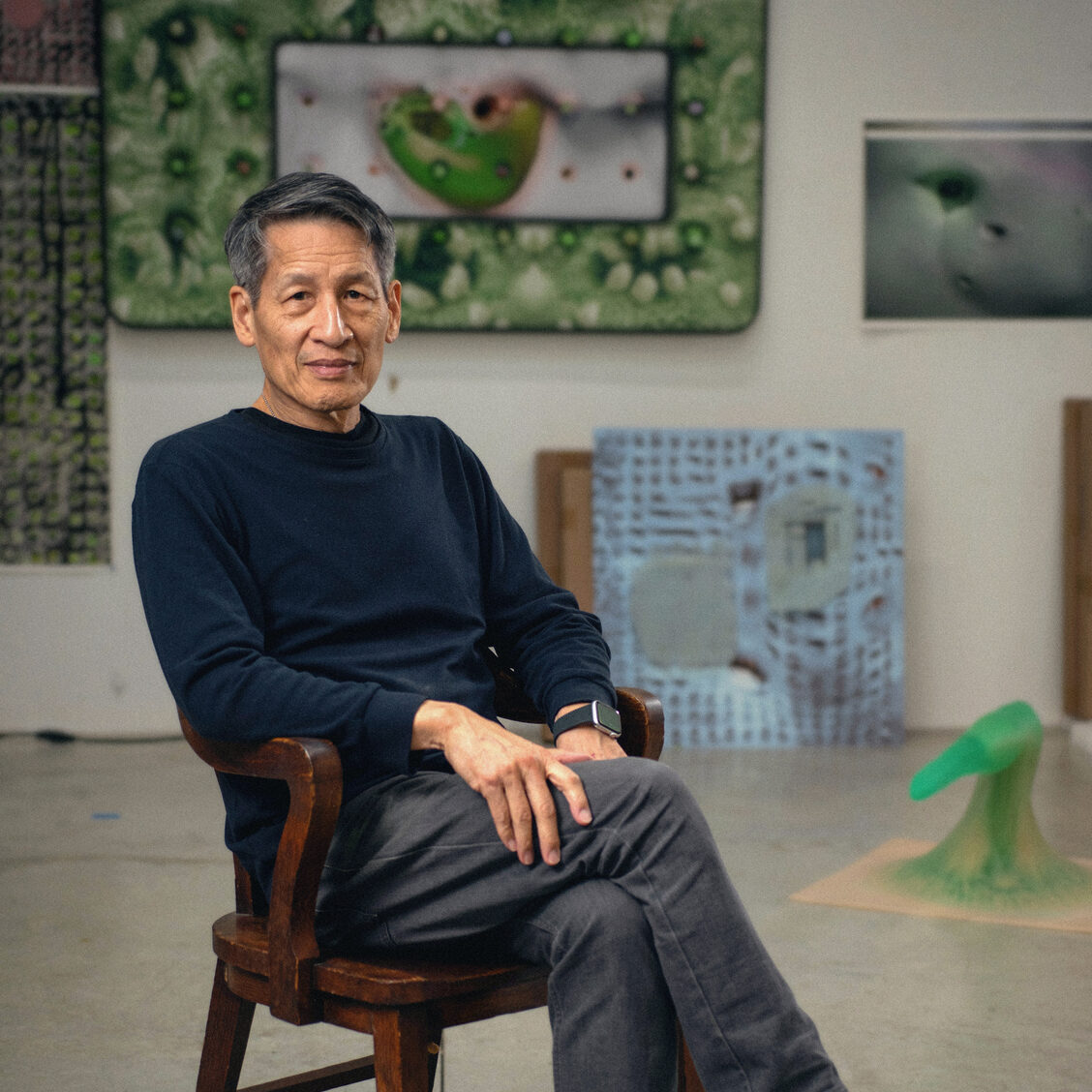
It’s growing ever more difficult to tell where the virtual ends and our skin begins. The artist Tishan Hsu has sought to give form to that creeping sensation for the past 40 years through sculptures and prints that mutate between hallucinogenic pixelscapes and fleshly figures. His interest in this nebulous territory dates back to the mid-1980s, when he worked as a word processor at a Wall Street law firm. Even then, he says, “I felt a paradox between the presence of my body and the virtual distance of the emerging landscape I was immersed in.”
Hsu, now 74, is speaking from his warehouse studio in Williamsburg, Brooklyn. He is surrounded by the tools of his trade: plastic compounds and dyes, a piano-sized printer, a computer in a corner cubicle that recalls those early word processor days. As much as the world has changed since his Wall Street era, the fundamentals of Hsu’s practice have not. “I feel the struggle has been to identify and express a feeling, or an emergence,” the Boston-born artist explains, “that I do not yet understand.”
Hsu’s use of the word “emergence” nods to his fall show of the same name at Lisson Gallery in New York (through Jan. 24). The exhibition features new biomorphic UV prints affixed with silicone appendages that, in several cases, resemble the digits of a hand penetrating a computer screen. As much as this image evokes Cronenbergian body horror, Hsu maintains his art isn’t speculative or futuristic. “I was never that interested in sci-fi because I never saw what I was doing as sci-fi,” he notes. “I was trying to take what was in front of me and propose that there’s something very unknown here.”
That Hsu has touched a cultural nerve is evidenced by the recent superbloom of interest in his practice. “Emergence” caps a six-year run of high-profile shows at venues including the Museum of Contemporary Art, Toronto; New York’s High Line; the 59th Venice Biennale; and the 58th Carnegie International.
But even as the world began catching up with Hsu’s art, he was still in the process of getting there himself. The aha moment came with “Liquid Circuit,” his first survey, which opened at the Hammer Museum in Los Angeles in January 2020. It was a cruel twist of irony that the exhibition coincided with the pandemic, but nevertheless, it enabled him to see, for the first time, four decades’ worth of creations in a single space. “I suddenly understood what it was trying to do,” he says.
When asked what that was, Hsu resists answering directly, insisting that he works through intuition, not intent. There is something ominous in his work—something that says, “This is not good.” But Hsu is not editorializing, just paying attention. “When people have said that there’s a sense of foreboding in it, I just say, ‘Look at the world we’re in.”

 in your life?