Alex Katz
Gladstone Gallery | 530 West 21st Street
Through December 20, 2025
I have a vivid memory of seeing Alex Katz somewhere downtown in the late ’80s. This was when I was first writing about art, and going out in the art world, and I happened to be writing a piece about him at the time. The weather was inclement. The painter was wearing extremely short shorts and a rather puffy windbreaker—his running outfit. Clearly, he was someone very involved in his physical upkeep. I was in my mid-20s; Katz, born in 1927, was 61 or 62.
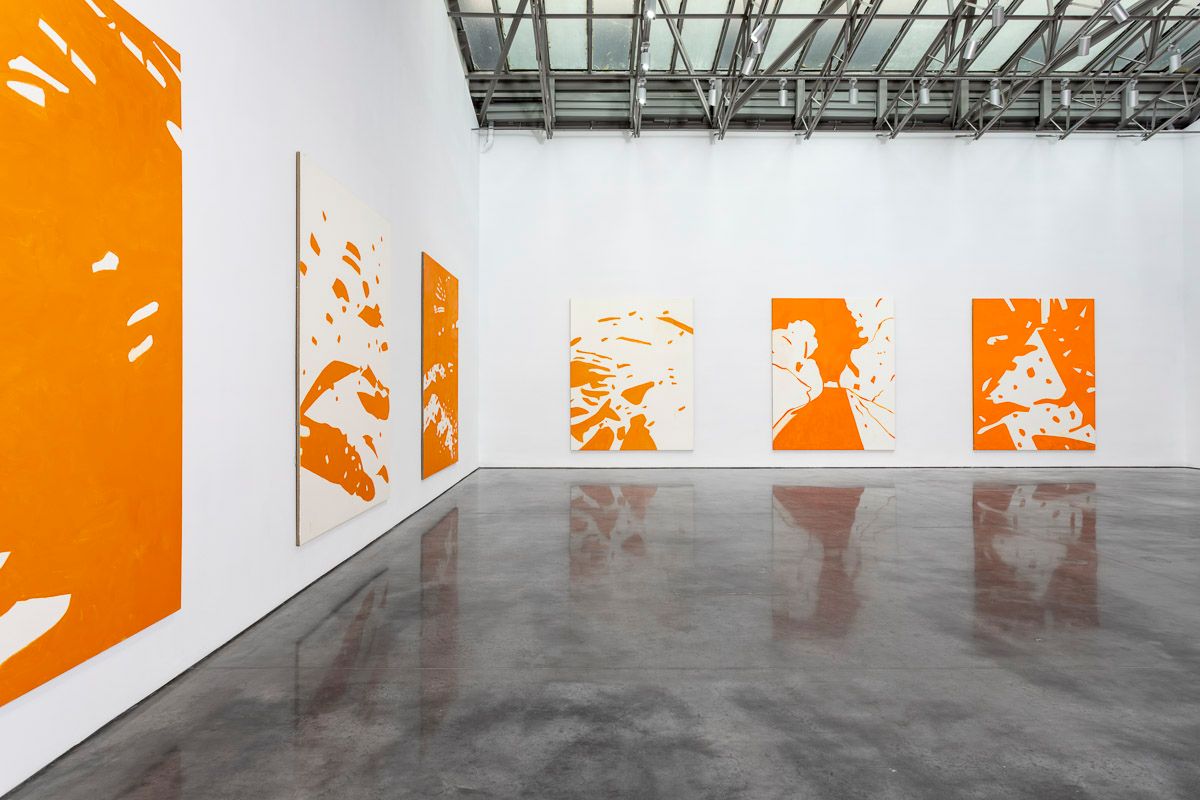
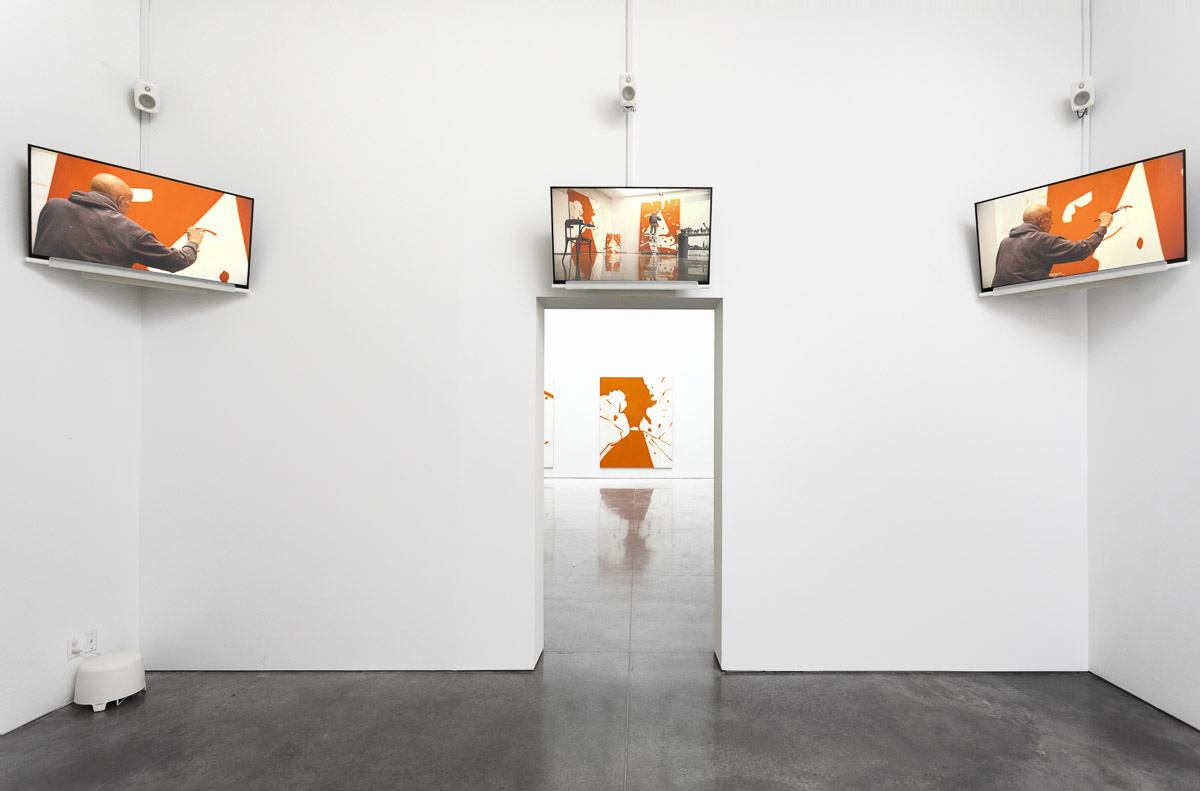
He is 98 now, and was 96 when Matthew Barney captured him at work in the three-channel video work DRAWING RESTRAINT 28, installed at Gladstone Gallery, just outside the room where 11 of Katz’s new orange-and-white canvases hang. (This show comes very near a clean year after a similar one, which likewise paired Katz’s orange paintings—fewer of them—with Barney’s work in a one-month, pop-up iteration of Jamian Juliano-Villani’s outsider/insider outrage gallery, O’Flaherty’s.) Barney shows Katz up on a ladder. Up and down he goes—I felt kinda sick just watching him; ladders always scare me. “Et in Arcadia ego” is one thing; Katz as Jack LaLanne Methuselah, quite a radical other. The video’s soundtrack incorporates Foley effects, the scraping and the laying on of paint becoming like an Einstürzende Neubauten piece; Katz’s performance, in Barney’s treatment of it, emphasizes not belle peinture but something else—maybe “mythic,” but readily open to ridicule as well as stargazing.
In Invented Symbols, 2012—Katz’s “art autobiography” which is really quite interesting, though if you want the barest outline of Katz’s first date with Ada Del Moro then you’re better off hitting Wikipedia—he returns to the idols of youth that are the competition: Katz is hyperbolically alpha-male, ever-striving, but one appreciates his very often blandly sound estimations. I wouldn’t say I agree on all matters of taste, but to a remarkable degree I do agree with his judgments, tendered in a style at once conversationally casual and emphatic. “I didn’t like the way the Matisses aged, and I didn’t like the way the Mondrians aged. They had an idea of a painting being immediate and left as an open surface. I thought a Van Eyck surface looked newer.” Nevertheless, it’s Matisse who recurs many times as the major competition for Katz. So, his asseveration that the shimmeringly intimidating, very big orange paintings here, the ensemble he claims was inspired by Matisse’s The Red Studio, 1911, is quickly comprehended as another instance of fair praise and potential—indeed desperately wished for—parricide.
“He’s optical, very optical,” Katz observes of Matisse in the press release. “He’s held down by the literal, and my paintings are not literal. I started out doing literal paintings, but I moved away,” he explains. “I guess I miss the sentiment of objective painting, but I don’t want to do it anymore; I want to do something else.” Approaching his centennial, Katz polemically disavows the settled styles and masters, and I believe him: he’s never been satisfied—why should he settle? But, The Red Studio feels too tidily overweening as a Modernist precursor. That Katz is inspired by it is almost a given, the way that Analytical and Synthetic Cubism are datum.
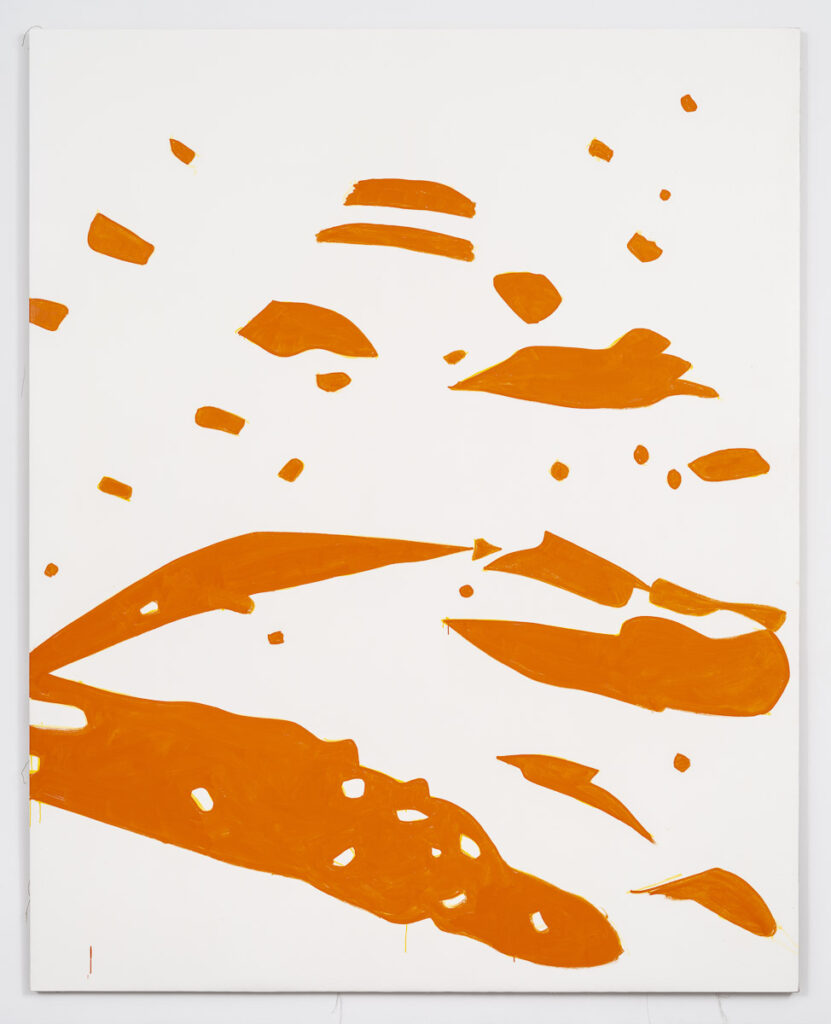
He has been going to the same spot in Maine for 70 years, and the road to his house is the sole subject of these canvases. Susurations of Jack Kerouac aside, this road is very modest, very local. Yet the phenomenological experience that Katz aims to pull off in these paintings isn’t untouched by Beat America and a spirit that is searching, wayward, rebellious, and youthful. The singular importance Katz gives to the 1950s in his development might be enough to admit the conjecture. He remembers the purportedly most conventional and “gray” decade in American culture as one that—in the right circles of New York at least—was brimming with invention, radicalism, experimentation, transformation.
The paintings are a gigantomachy of bucolic vignettes, rendered in a serene, quasi-imperial style that makes me think of Virgil’s Eclogues. “Nunc scio quid sit amor.” Now I know what love is. Lines can form abstracted skeletons of road, house, leaves, branches. Road 24, 2024, seems to pull dramatically away from the incidents of the passage, through the trees, to a more distant landscape, a comparatively parsimonious, interrupted line cutting the picture plane into two unequal parts. Two other paintings explode what’s left of the path through the forest: in one, a hail of orange fragments, in the other, white leaves crushed and unrecognizable. The feeling is rather epic. Rather sublime in the high Romantic sense: an experience of Nature that devolves upon Terror.


 in your life?