His assemblage paintings speak unconventional combinations into being, allowing for the intertwining of personal and collective histories.

DATE

SHARE

Twitter
LinkedIn
Facebook
Email


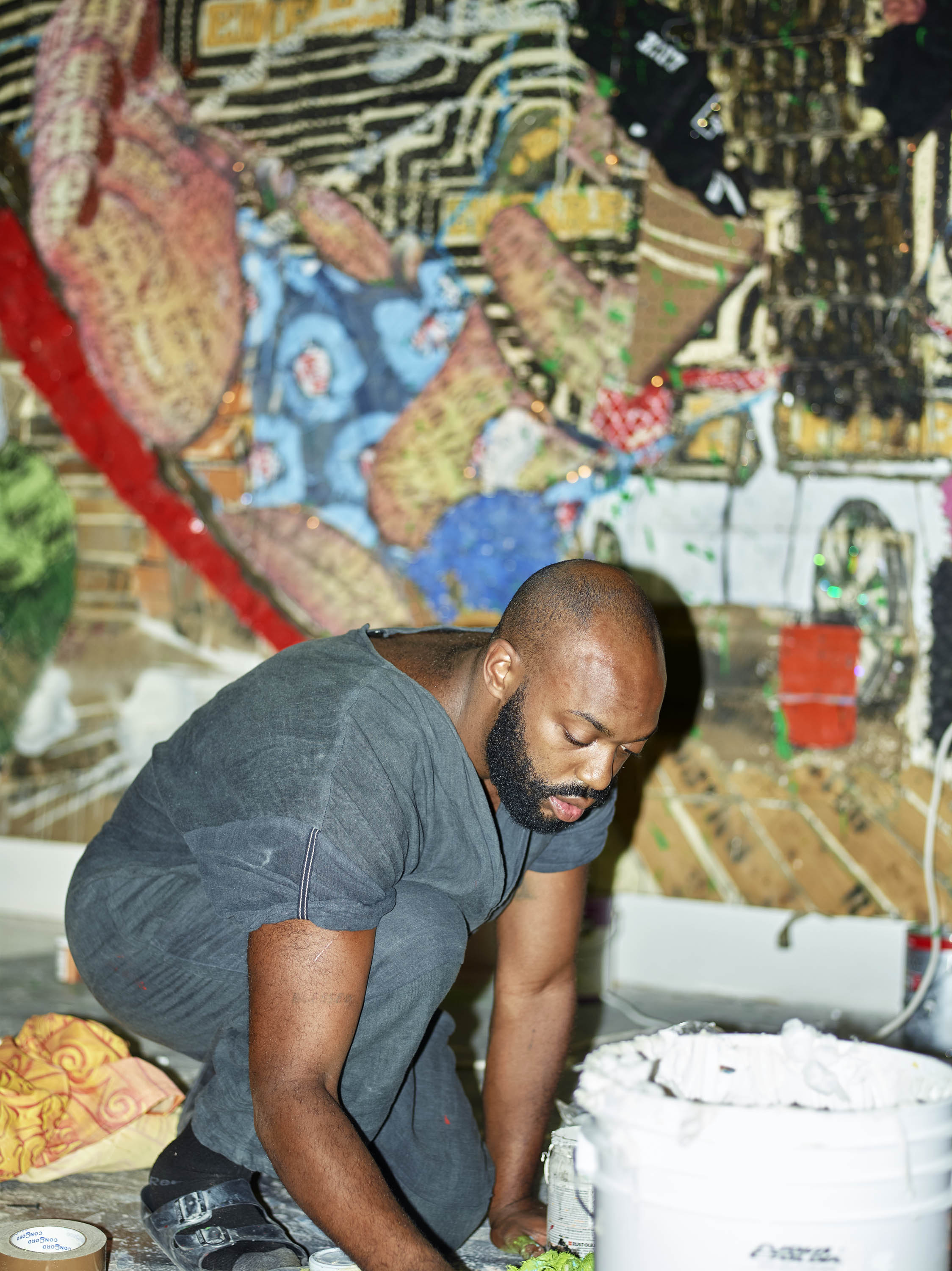
Aaron Fowler photographed in his Los Angeles studio, 2018.

“These objects become manifestations,” Aaron Fowler says of his work. His assemblage paintings speak unconventional combinations into being, allowing for the intertwining of personal and collective histories. Latent ideas that have not yet found material form emerge from Fowler’s juxtapositions and create a forum for expanding and enriching our individual stories. Central to this questioning of narrative is Fowler’s interest in art history, as evinced by his engagement with the legacy of history painting. His work becomes a tool for questioning the establishment of histories altogether, for he shows that any established narrative is inherently an assemblage of paradoxical and competing elements.

It follows that a central component of Fowler’s work is a generous relationship with the audience, which encourages a sustained reflection into questions of identity—how the collage of life itself is built, maintained and deconstructed. “We as people have so much knowledge and so many different perspectives,” he says. “There is so much to learn and so much to relate to. I always gravitate toward worlds that are not my own history, so I can learn something new. I am constantly trying to put worlds together. You have to make it relatable.” In Fowler’s painted assemblages, there is always something that grabs our attention, what Roland Barthes called the punctum. For Barthes, and perhaps for Fowler, the punctum is a site that is forever only yours, even as it offers the language necessary to connect empathetically with others.

We’ve Waited All Year For This…

Our 10th annual Young Artist list is here, comprised of 27 names you need to know ahead of 2026.

You’ve almost hit your limit.

You’re approaching your limit of complimentary articles. For expanded access, become a digital subscriber for less than $2 a week.
You’re approaching your limit of complementary articles. For expanded access, become a digital subscriber for less than $2 a week.

Already a Subscriber? Sign in Here

You’re approaching your limit of complementary articles. For expanded access, become a digital subscriber for less than $2 a week.

GET ACCESS

Already a Subscriber? Sign in Here

Want more in your life?

For less than the price of a cocktail, you can help independent journalism thrive.

Pop-Up-1_c
Already a Subscriber? Sign in Here
Pop-Up-1_c

Already a Subscriber? Sign in Here

Want more in your life?

For less than the price of a cocktail, you can help independent journalism thrive.

Pop-Up-1_c
Already a Subscriber? Sign in Here
Pop-Up-1_c

Already a Subscriber? Sign in Here

You’ve almost hit your limit.

You’re approaching your limit of complimentary articles. For expanded access, become a digital subscriber for less than $2 a week.

You’re approaching your limit of complementary articles. For expanded access, become a digital subscriber for less than $2 a week.
Already a Subscriber? Sign in Here
You’re approaching your limit of complementary articles. For expanded access, become a digital subscriber for less than $2 a week.

Already a Subscriber? Sign in Here

This is a Critics' Table subscriber exclusive.

Subscribe to keep reading and support independent art criticism.

Already a Subscriber? Sign in Here

Want more in your life?

For less than the price of a cocktail, you can help independent journalism thrive.

Pop-Up-1_c

Already a Subscriber? Sign in Here

Pop-Up-1_c

Already a Subscriber? Sign in Here

You’ve reached your limit.

Sign up for a digital subscription, starting at less than $2 a week.

Already a Subscriber? Sign in Here

Want a seat at the table? To continue reading this article, sign up today.

Support independent criticism for $10/month (or just $110/year).

Already a subscriber? Log in.