

The phrase “exit through the gift shop” has come to signify the growing commercialization of our museum spaces. Retail pop-ups now cluster near the exits of major exhibitions. Museums face pressure to compete with other forms of entertainment and to find additional income streams beyond donors and admissions. Meanwhile, some galleries are working to turn themselves into leisure or community destinations, complete with restaurants, listening rooms, and libraries.
Amid these increasingly blurry goals to be omnichannel (something for everyone), the architectural studio Peterson Rich Office (PRO) has emerged as a key force in determining what the spaces where art and commerce collide actually look and feel like.
PRO was founded by husband-and-wife team Miriam Peterson and Nathan Rich in 2014. (They discussed what starting a studio practice together would look like on their very first date as students at the Yale School of Architecture.) Since then, they have designed Perrotin’s 25,000-square-foot Lower East Side gallery and numerous artist studios. Three recent and ongoing projects—one in Detroit and two in New York—showcase their welcoming and expansive approach to designing cultural spaces.

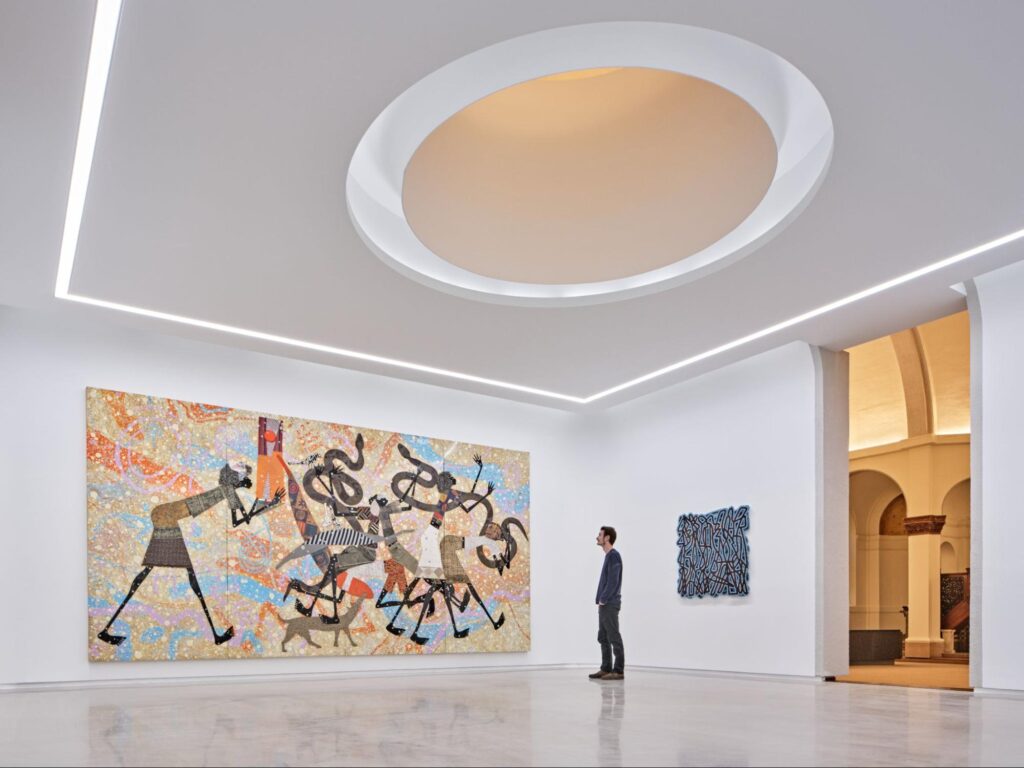
In East Detroit, gallery owners JJ and Anthony Curis’s Library Street Collective is transforming several buildings into a cultural campus for a neighborhood lacking in investment and attention to infrastructure. PRO took on a core role in converting a Romanesque church into the Shepherd, a space for public exhibitions, a community library, and performances.
Peterson says the firm loves working in Detroit because it’s a “community that is willing to take risks, and the city provides an accessible feedback loop for helping to make things happen.” While PRO’s interior interventions are rightly praised, their exterior improvements equally stand out. In collaboration with the landscape architect OSD, the firm removed the Shepherd’s black iron fencing, installed new lighting, and landscaped the grounds into a sculpture garden—announcing the area as a creative oasis to passersby.

PRO faced a different challenge in the SoHo neighborhood of New York, where foot traffic often bypassed the MoMA Design Store at Spring and Crosby Streets. The 19th-century cast-iron building is part of a retail empire with a staff team rivaling any mid-size museum. PRO’s task: draw in more visitors and serve as a satellite gateway to MoMA, the Midtown institution welcoming three million annually.
PRO stripped away old decals, window displays, and drop ceilings, bringing in more light and creating a loft-like space. They reconfigured two corner entrances into one on Spring Street, aligned with the main axis. Peterson aimed to enliven the space and more explicitly link the store to contemporary artists.
“Foundational to the store’s concept was an idea for a mural at the back wall that would tie the store inextricably to the museum and be visible as a focal point from the street,” Peterson says. MoMA’s decision to commission the artist Nina Chanel Abney for the inaugural mural “was a special coincidence because we’ve been working with her on a few projects and she has become a friend,” she continues.
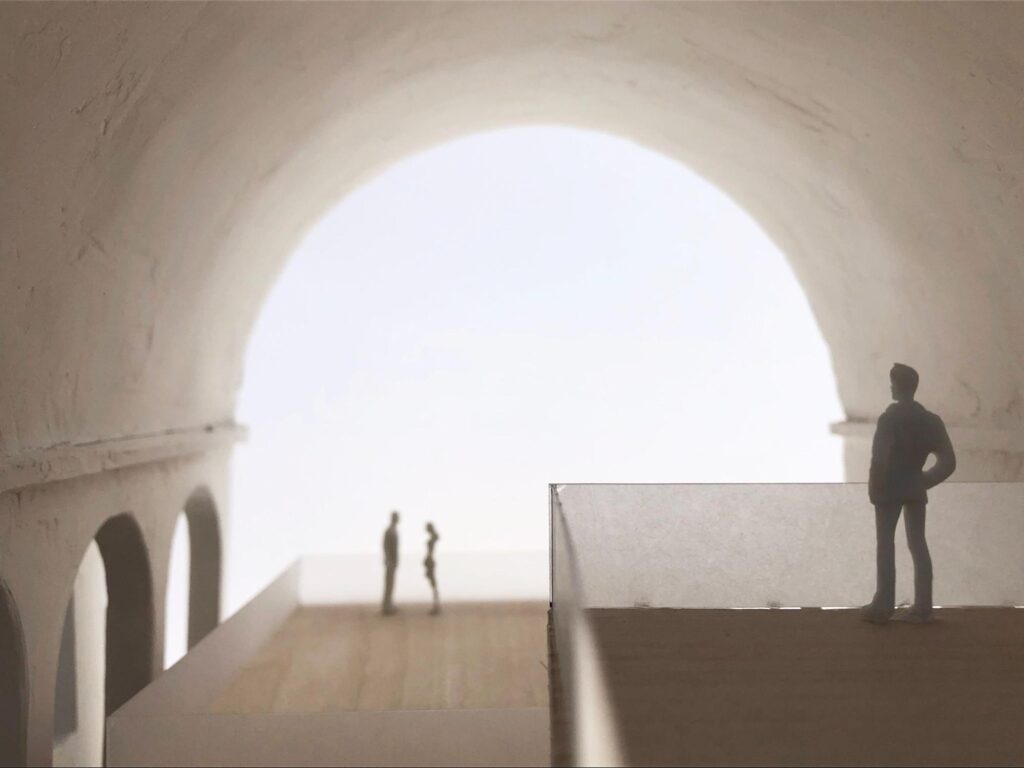
The fluid co-mingling of galleries, retail, and dining, is what drives PRO’s most ambitious and high-profile commission yet for the Metropolitan Museum of Art. The scope of the forthcoming project includes a special exhibition gallery, dining and retail spaces, and a new entrance at 83rd Street. “The project forges new connections across eight different eras of Met construction and engages just about every stakeholder group in the museum,” Peterson explains. “We are juggling multiple stakeholders and agendas, weaving it all together into a new museum experience that will hopefully feel effortless and timeless.”
To develop its plan, PRO envisioned the Met as a city in miniature, composed of 21 interlocking buildings that house 800 galleries, and mapped out the visitor circulation—which can surge to more than 30,000 a day during holidays—as streets with storefronts. Their new 83rd Street entrance will accommodate the extensive crowds that currently gather on the Met’s front steps and offer a bold, fully accessible gateway to the museum.
With increasingly large-stakes projects, a significant ground-up cultural or civic commission likely isn’t too far off. For her part, Peterson doesn’t mind being called “buzzy”—just “as long as it also means our work will stand the test of time.”
IN HER OWN WORDS: Miriam Peterson
What was your favorite toy growing up?
To be honest, I have no memory of playing with toys. But I had somewhat of an unusual childhood because I was a very serious ballet dancer. I was cast in my first professional production at 6 years old. And then I was a student at the School of American Ballet here in New York. At that time, it was the 10-year anniversary of George Balanchine’s death and they were reviving several of his ballets, many of which involved children’s roles and Peter Martins was choreographing new ballets that also involved children. So I spent a lot of time at Lincoln Center. Now that I think about it, we played a lot of jacks backstage when we weren’t performing. I wonder if the kids at SAB still play with jacks today—it was pretty old school and analog even back then.
Whose house would you live in (real or fictional) and why?
My own house, but renovated, and it would probably have to be designed by someone else because Nathan [Rich] and I are terrible at making design decisions when we are the architect and the client.
What is your go-to uniform when you’re powering through a project?
Black Gap jeans, a James Perse T-shirt, Bensimon sneaks, and, if it’s cold, a blazer. I wear that most days.
Are there any analog materials you return to in spite of the prevalence of new technologies?
Daylight. The oldest, best, and most enduring material!
Who chooses the playlist in your studio?
Nathan [Rich]!
What’s a trend in architecture you wish would die out?
Biomimetic design.
What is one detail of a structure that most people wouldn’t notice, but that you always look to for insight?
Seams in materials—where the limit of a material’s size, its manageable scale or practical weight, requires a seam, and how that’s articulated or subverted, which is not the same thing as a transition between materials. We were in Versailles last spring. I’d never been there before. There is this incredible stone stair, the Escalier des Princes, built in 1672. At the seams in the balustrade, there are metal butterfly-shaped inlays that hold the two pieces of stone together. I’d never seen anything like it before. I think the technical term is an agrafe.
What is the most progressive architectural city you’ve visited?
Detroit. Compared to New York, where there is so much red tape and the cost of doing something out of the box is prohibitively high to most people, Detroiters welcome progressive architectural ideas and it doesn’t need to cost more to achieve them. I love Detroit.
What is your last source of inspiration that surprised you?
The Escalier des Princes, in Versailles.









 in your life?