
Nicole Eisenman
52 Walker | 52 Walker Street
Through January 10, 2026
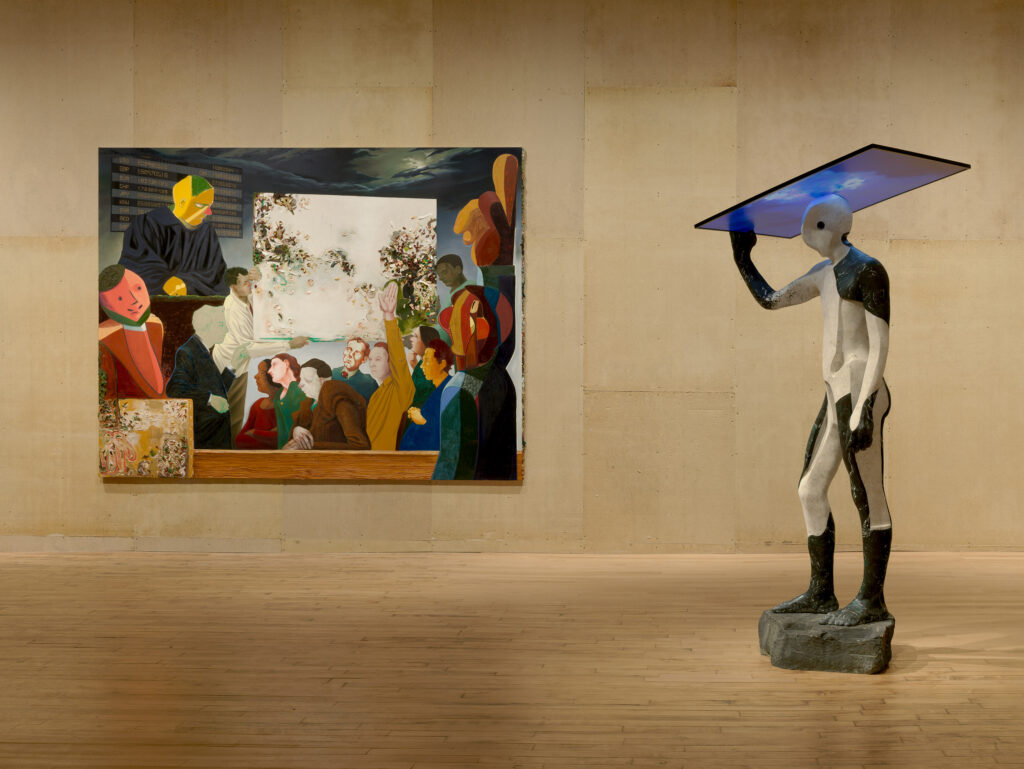
A man in a brown shirt, in the center of Nicole Eisenman‘s painting The Auction, 2025, raises his hand to place a bid. Or maybe he is Sieg Heiling. Under scrutiny, the picture dissolves into multiple or layered scenarios. The auctioneer seems to be wearing the robe of a judge, the electronic chart above him displays currency exchange rates, and where the ceiling should be is a moody moonlit night sky instead. The painting on offer in the middle of the scene is a milky white expanse pocked with impasto blobs in earth tones, arranged in clusters like Hannah Wilke’s bite-sized gum sculptures. (A similar, smaller painting waits in the wings at left.) The assembled characters in the surrounding crowd are rendered in a variety of styles, from the realism of the possible-Nazi to the post-Cubist, post-Guston caricature in the foreground on the right who’s also attempting to win the lot. The Auction could be the composite, collaborative work of half a dozen different painters, but in its ambition and tightly managed balance of coherence and ambiguity, it can only be the work of Nicole Eisenman.
As I considered this picture, I moved to examine a scrap of paper pinned to the wall 10 feet or so to the right, where I found—as if anticipating my train of thought—a color printout of Martin Kippenberger’s 1984 geometric abstraction For the Life of Me, I Can’t See Any Swastikas. In the German artist’s composition of layered rectangles, Eisenman—whose family fled Nazi persecution in the 1930s—seems to find precedent for her own reflection on modernism’s fascist haunting as well as the aesthetics of its contemporary resurgence.
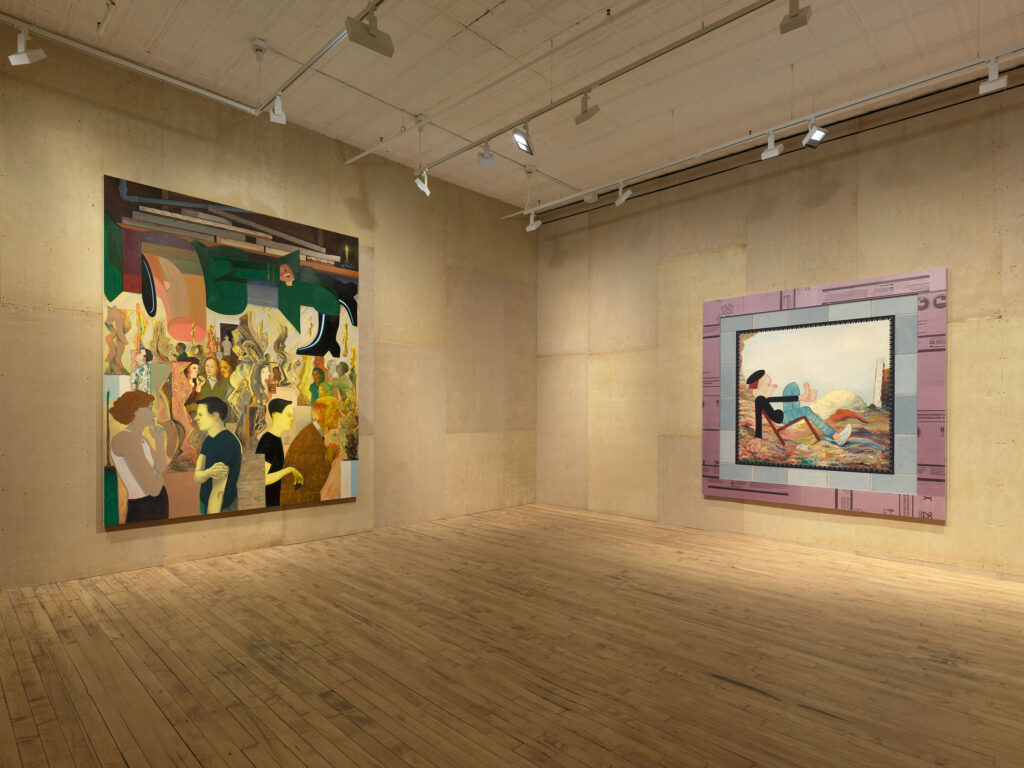
“STY” is the New York-based artist’s first hometown solo exhibition following her three-decade spanning institutional survey that originated in Munich, before traveling to the Whitechapel Gallery in London and concluding at the Museum of Contemporary Art Chicago in 2024. For this show, 52 Walker has been transformed into a single room, divided off from the entryway and front desks, and lined with Homasote board, which is commonly used in art studios to facilitate the ease of installation and deinstallation of artworks. Curator Ebony L. Haynes gets the scale potently right here, providing both a concentrated show, as well as a hint of insight into the artist’s working process by creating an atmosphere that seems to welcome the viewer into the private space of the artist, an effect emphasized by the inclusion of reference ephemera (such as the Kippenberger) sourced from Eisenman’s Brooklyn studio.
Despite its title, “STY” conjures a tidy intimacy. But there is a pig present. In a second crowd-scene painting, Archangel (The Visitors), 2024, a swine-headed cartoon soldier floats above a lively group gathered for an art opening. They converse among modernist, abstract sculptures on plinths. In an attic space above, stacks of canvas are stored, their surfaces otherwise out of view. In the foreground at right, a self-portrait of the artist appears to pick the pocket of a balding man in a tweed suit who is distractedly engrossed in sculptural details. The compositional setting collapses historical moments, mashing together the present with the First International Dada Fair, held in Berlin in 1920, where a pig-faced papier-mâché effigy of a German soldier was hung from the ceiling causing a scandal.
Eisenman’s entire show is like an interactive stage set for contemplating the possibilities and limitations of art’s ability to address the crisis of the present. It dares to juxtapose our contemporary moment with prior historical eras, when authoritarianism, censorship, and fascism were on the rise. It implicates the whole art-world apparatus: the exchange of great sums of money in the auction house, as well as the gallery system of which 52 Walker is part. Eisenman parodies herself, not as a singular genius within that system, but instead—echoing Jean Genet—as a petty thief. (This isn’t entirely new for the artist: For her first appearance in the Whitney Biennial, in 1995, she painted a mural of the museum, depicting it after an explosion, with herself at the center of the ruins.) The theater of it all—and her work is an entertaining performance—distracts from the fact that the artist has taken real risks with her political stances, particularly for calling for a ceasefire in Gaza, which prompted backlash from collectors.
The most significant artists are often ones that make audiences and fellow artists say some version of “I didn’t know you could do that?” And, with the best artists, this reaction often corresponds to both technical proficiency and their approach to subject-matter and composition. Eisenman accompanies the five oil paintings and two works on paper (in addition to the reference images culled from the studio) with a set of three statues made from scagliola, a plaster material dating back to ancient Rome, which was revived in 16th-century Italy, especially in the decorative flourishes favored by the Medici family. The sculptures—collectively titled There I Was, 2025—are mounted on rock bases. Each holds a large flatscreen monitor that plays a video work: a virtuosic mashup of ancient technique and bleeding-edge tech. They form a lyrical send-up of the contemporary notion of screen time.
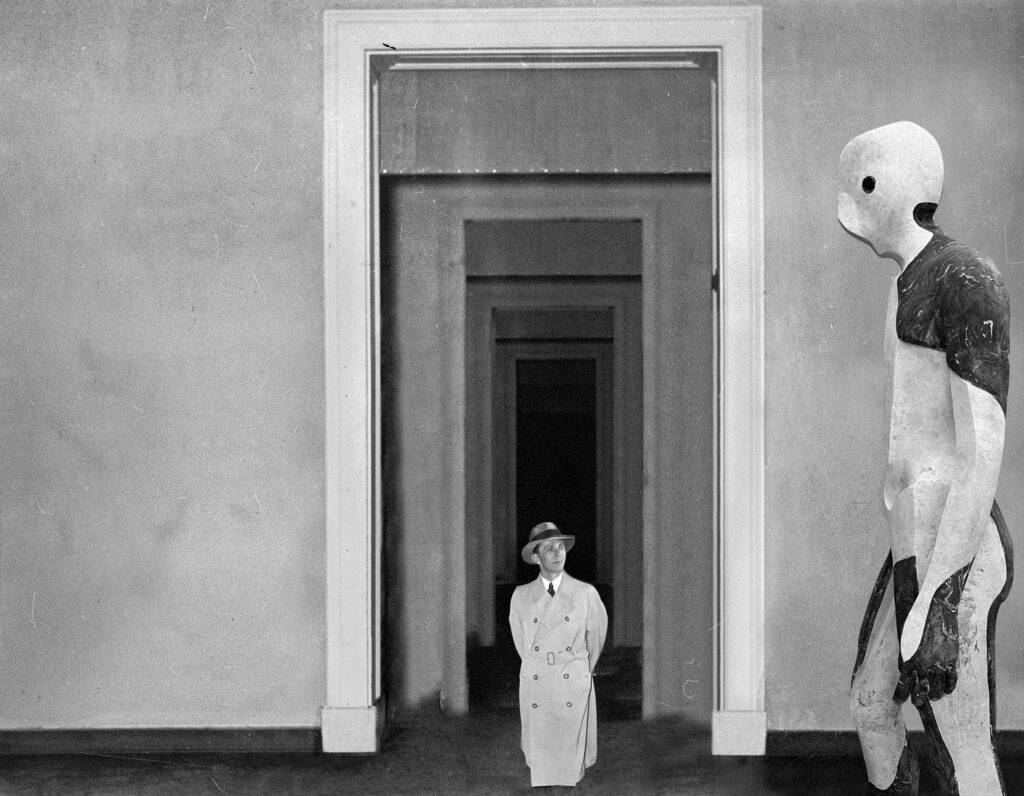
The promotional image for the show appears to graft a black-and-white picture of one of Eisenman’s sculptures onto an edited and pared-down archival photo of Nazi propagandist Joseph Goebbels entering the Degenerate Art Exhibition, staged in Munich in 1937. While noting Eisenman’s healthy willingness to parody the role of the artist, in sum, the force of “STY” sides with artistic freedom in the face of state repression, and is animated by a nuanced yet forceful antifascism.
But Eisenman herself might remind us that many trace the origin of the Roman salute (later adopted by the German Nazi Party) not to ancient Rome, but to the painter Jacques Louis David. His 1784 scene of young men taking up arms in The Oath of the Horatii was completed a decade before he would be jailed for participating in the French Revolution—and two decades before he would paint the Coronation of Napoleon and Josephine, 1804, on his way to become the Emperor’s great propagandist. It’s as if Eisenman cautions: Consider the enduring, ever-mutating symbolic content of art, as well as the stakes of the present moment—sure. But never fully trust a painter.




 in your life?