Women’s History Museum through February 15
Amant | 315 Maujer Street, Brooklyn
“I was able to start a high-fashion shop,” said the once-upon-a-time, 20th-century grisette, the founder of the House of Chanel, “because two gentlemen were outbidding each other over my hot little body.” Coco, once Gabrielle, worked men and made hats, blackening her milliner’s dress with gris. Ka-ching! Grisettes—working-class women of 17th-century France, who were both laborers and exemplars of style—left their mark on fashion history with their traditions of craftswomanship and independence. It’s this history that Mattie Barringer and Amanda McGowan of Women’s History Museum rifle through for their exhibition “Grisette à l’enfer” at Amant, the privately owned arts organization in Greenpoint, Brooklyn.
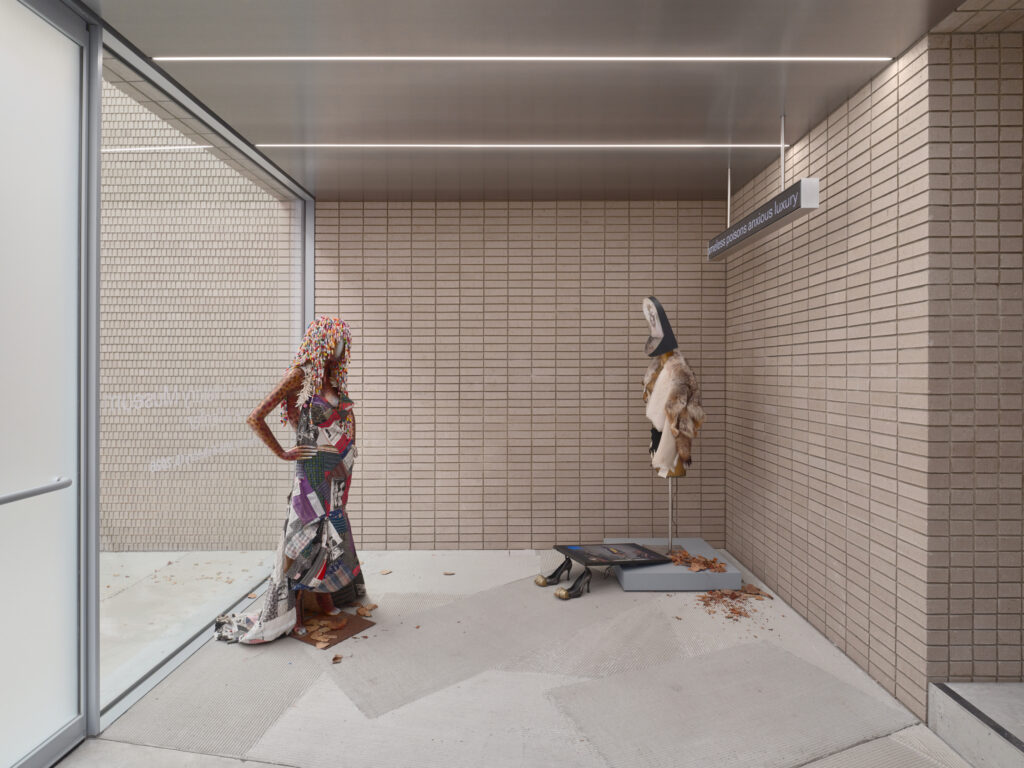
The show‚ the duo’s first institutional solo presentation in the U.S., drops our heroine in hell. Part retrospective, past video, fashion, and sculpture appear with new work inside a re-creation of a shopping experience. Shop owners as well as artists and fashion designers, Barringer and McGowan stretch and extend the fleeting thrill of finding the right dress in the rubble of your life. Hanging over the space like a shop sign, For a Moment I Have No Pain, 2025, is a soft, jewelry-box-flocked message of relief. The velvet, a rich, mourner’s black, promises to absorb suffering.
Femininity and its price tag fan the flames of desire and, for the artists, a past life: they met at the site of the 1911 Triangle Shirtwaist Factory Fire, which claimed the lives of 123 garment workers, locked in to prevent unsanctioned breaks. (It became part of the NYU campus where Barringer and McGowan met a century later, in 2011.). All this could serve as an easy metaphor for today’s manufactured disasters, haunted by historic injustice, but Hell is a recurring stage for them, a plane of acceptance and repudiation for the hardships of their industry. A video of last year’s fall show, titled Enfer, plays in the ruins of their Théâtre de la Mode homage. A bare-chested mannequin on loan from the Metropolitan Museum of Art wears a collection of matchbooks around her neck, waiting to be lit with promise. Shopping bags around her feet read “Shattered Dreams” and “New York Grief.”
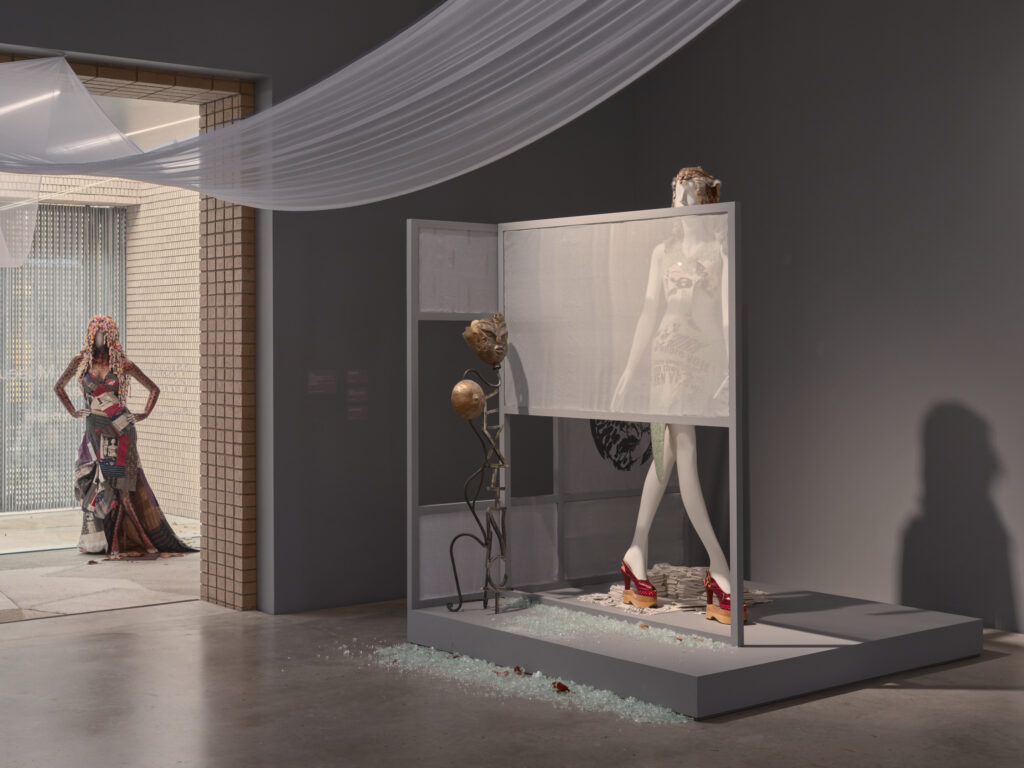
Precarity carries its own small privileges; when the world looks away, you can see it more clearly. Outside, fashion week has just ended—the worst ever, I hear. Fashion, too obsessed with its own principles, forgets that it’s supposed to be a product of everything around it. I think of this standing before Lit Reliquaire de Mary Magdalene, 2025, a sex-shop mannequin writhing in a wooden and glass apothecary case. “It’s a self-portrait,” the curator and publicist say, and I nod. I am here, unbeknownst to my employer, anxious to check my e-mail. I feel that this Mary is a portrait of me too, though I don’t know how to tell these strangers, and the words crumble in my throat.
I try to reach Barringer and McGowan, but do not hear from them all week. They have been busy at their shop on Canal Street (the mannequin’s case reads, “Manufactured 1850–1899 by the Manhattan Showcase Company, Canal Street, NY”). They reply when it is too late; I am already late to file. McGowan posts on her Instagram story, giving voice to my disintegrated thoughts:
“In all seriousness I feel like the collective ugliness of people’s interior selves (ideologically etc.) is being reflected sartorially in the world around us. Everything is related. I wish things were more beautiful in more ways than one.”




 in your life?