For his Critics’ Table debut, the artist and author Gregg Bordowitz writes about Jennie C. Jones’s profound use of an abstract language across disciplines. While the commanding—and inviting—rooftop installation at the Met anchors the artist’s commission, in a sense, it’s just the start: Bordowitz also writes about the power of Jones’s accompanying collaborative projects and programming.
Jennie C. Jones through October 19
Metropolitan Museum of Art
1000 5th Avenue
Many viewers arrive at Jennie C. Jones’s Roof Garden Commission at the Metropolitan Museum of Art with expectations that it will extend her formally rigorous, experimental, multifactorial methods, further developing her deep interests in Black avant-garde modes of composition and improvisation. And it does: The work succeeds in all ways, amplifying mysteries at the core of the artist-scholar’s incisive formal decisions.
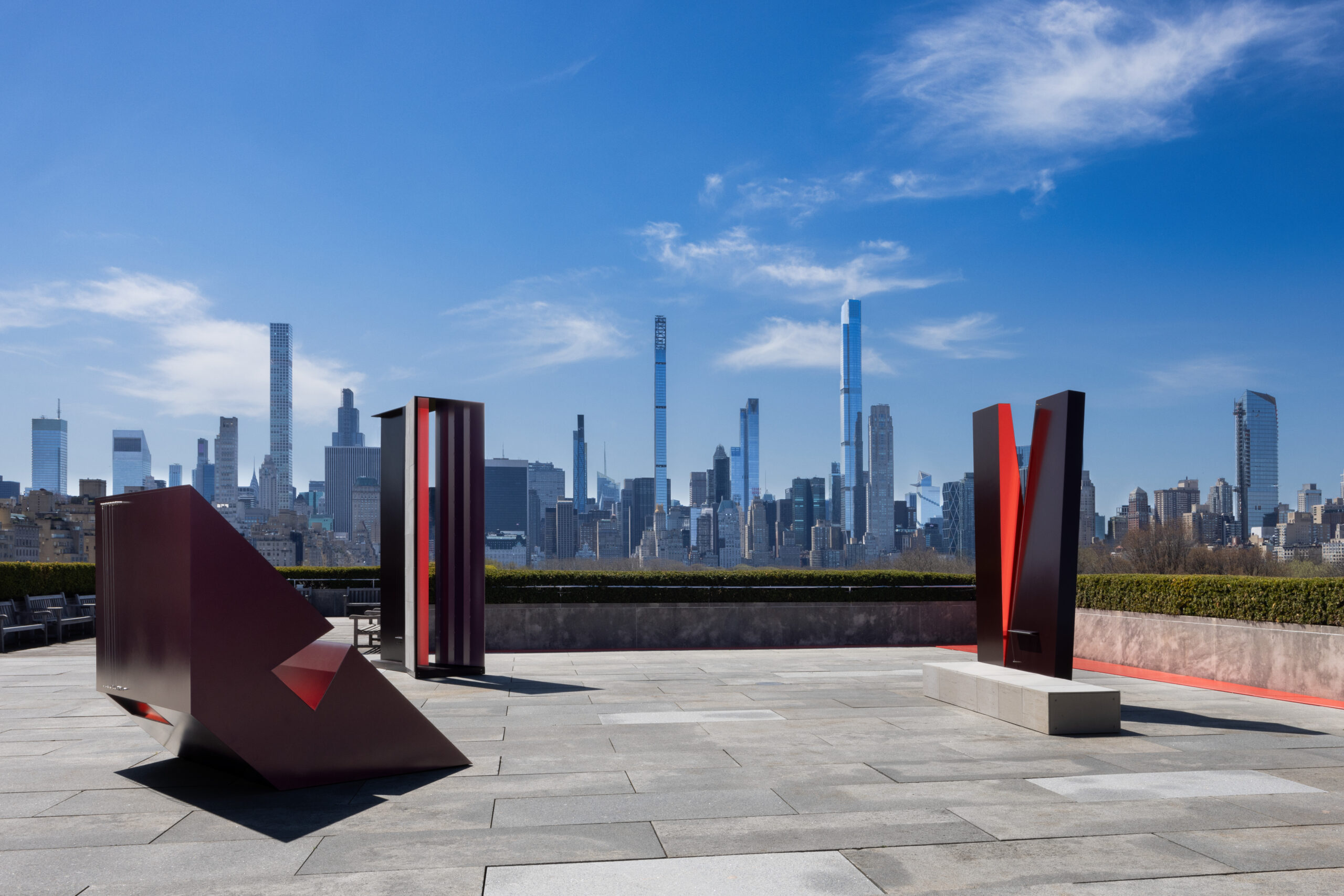
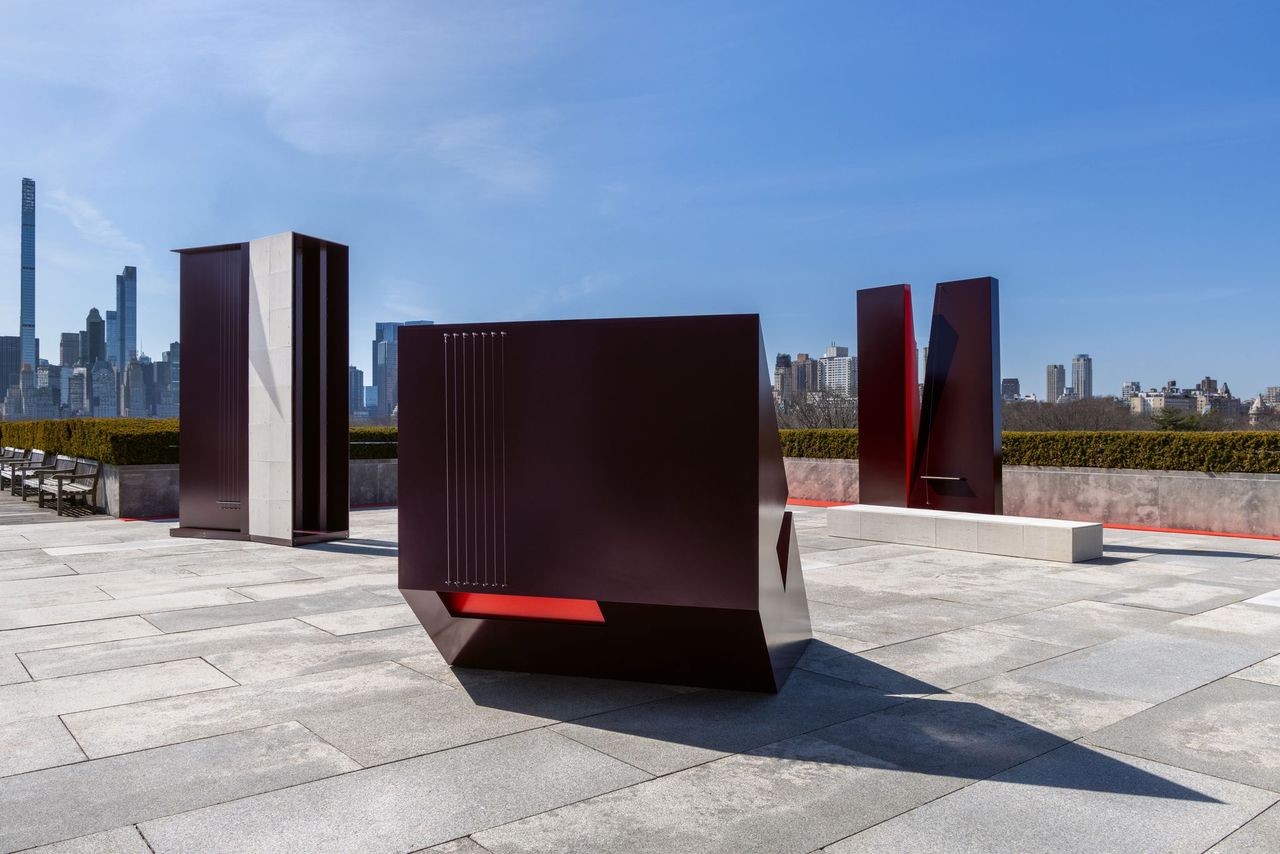
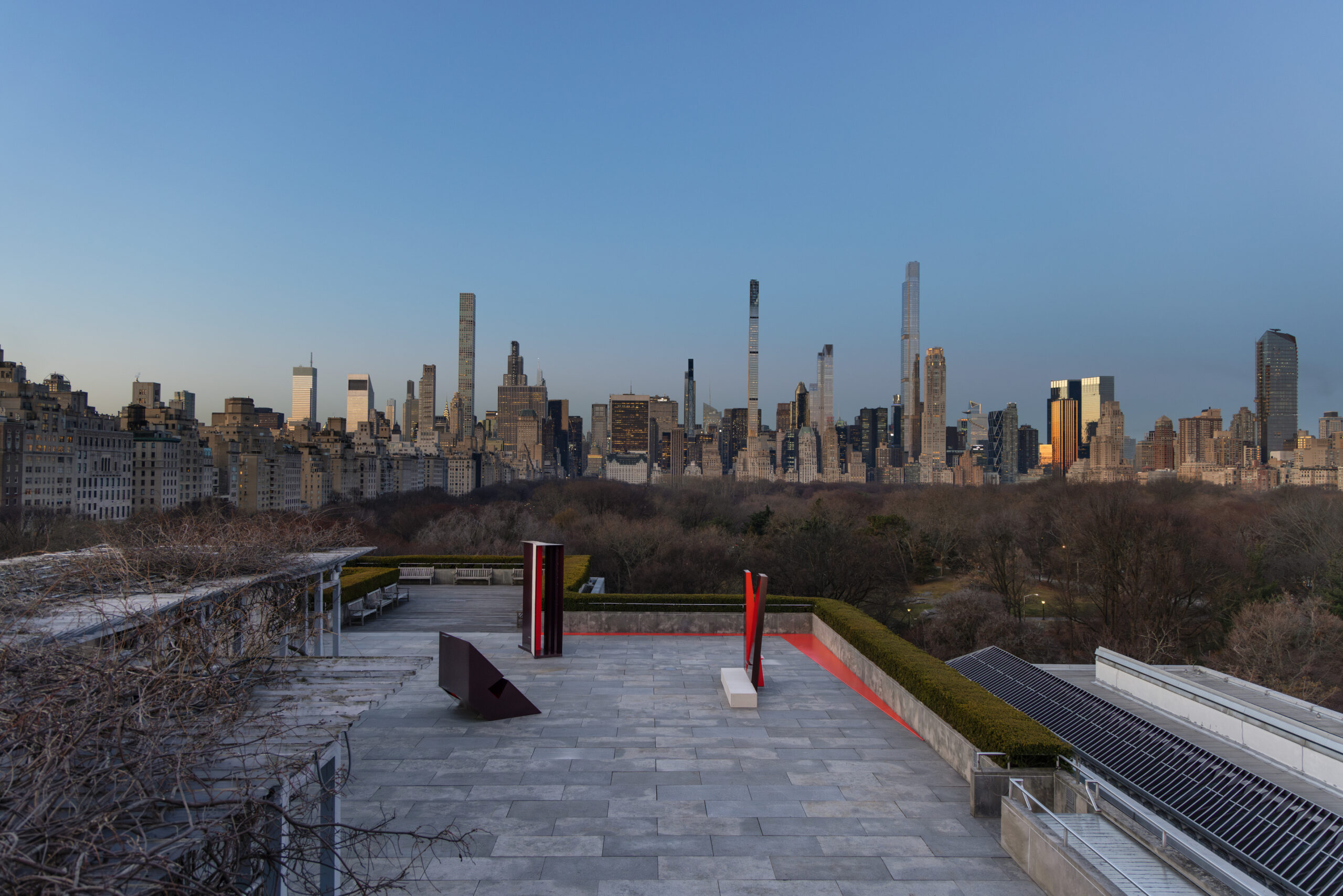
Ensemble, as the installation is titled, features three upright sculptures. Made from concrete travertine and powder-coated steel, their angular forms are drawn from musical instruments—a zither, an Aeolian harp, and a one string. This last instrument is doubled and leaning, conceived of as a twin tribute to 20th-century improvisers Moses Williams and Louis Dotson—an example of how Jones has developed her Minimalist formal vocabulary via references to an extensive catalogue of musicians and music. A fourth work, red and flat upon the ground, runs alongside and spreads out from the roof’s perimeter line, like a partial border; in the wall text, it’s referred to as a “conductor.”
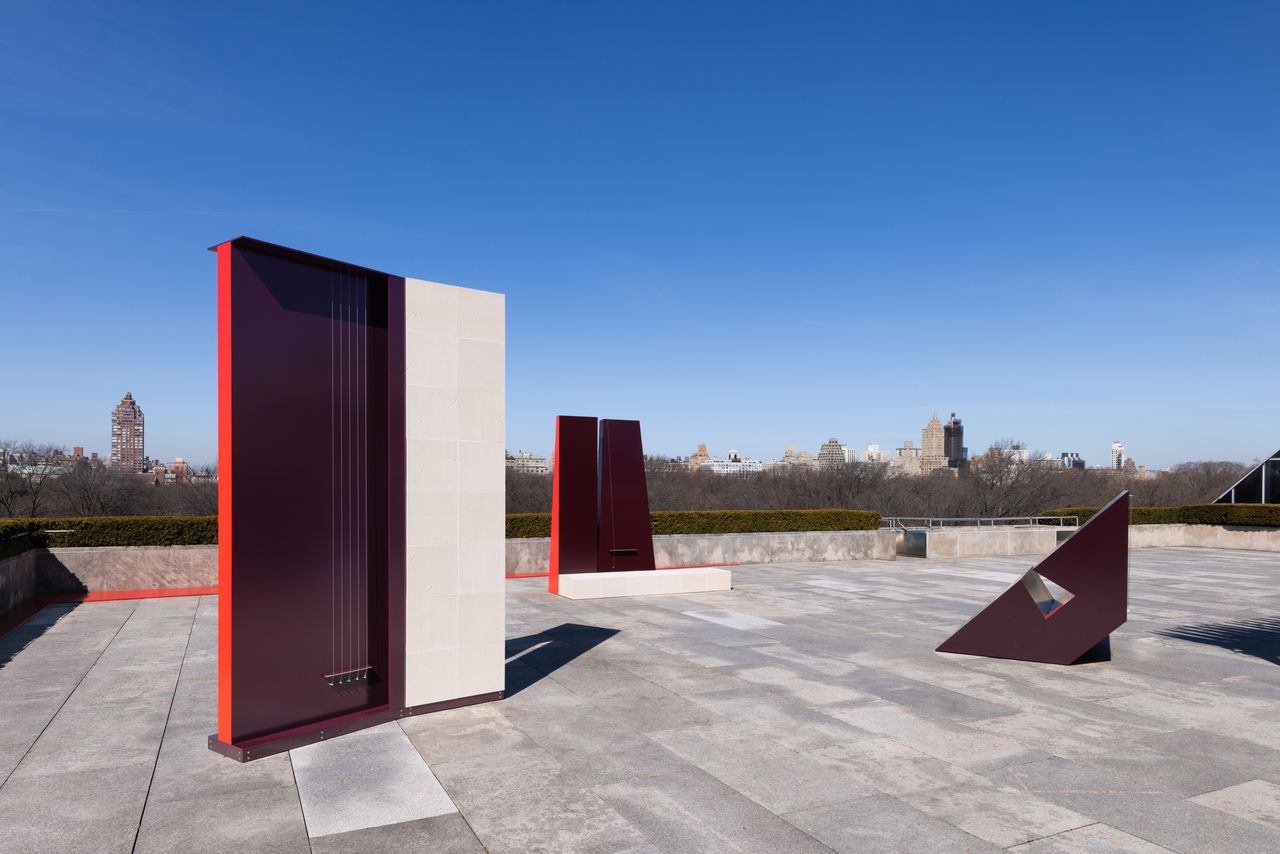
The artworks are larger than the viewers, but not monumentally scaled. With their palette of rich burgundy, accented by flashes of bright red, they stand out, viewed and viewing, against the cityscape backdrop of towering buildings, beyond the museum’s Central Park environs. Significantly, they’re approachable, offering themselves as instruments to be played. Each is equipped with frets and pegs that hold vertical metal strings taut, waiting to be plucked. The strings of the instruments vibrate and hum, stimulated by the wind. The trio is alert to the conductor’s prompt—the red floor-sculpture grounds the circulating energy.
The hot, bright sun is an active collaborator, lengthening and widening the sculptures’ shadows as it moves across the sky. While the wall text emphasizes the sonic character of Ensemble, every angle, groove, and aperture of the instruments receives the glaring light, each one acting as a sundial. The starkly contrasting light and shadows are measured by the gravity of the floor elevated—weighing—above the park’s trees. Such visual equations calculated by the eye translate into a floating feeling, almost dizzying, as the viewer is at once on the roof, smaller than the sculptures, and suspended above the surrounding green.
The roof is packed on the afternoon of my visit. We, the viewers, circulate, bending ears to listen, squinting eyes, admiring the ways that the volumes’ outlines relate to one another. Our bodies turn toward and away, interacting individually or combining in various groupings, as couples, trios, and so on. We are a shifting composition, an ensemble of our own. As in a concert setting, where the attendees are elements of the music, our solid bodies together are an acoustic factor, collectively making an atmosphere. This choreography of visitors is another well-planned element of the artist’s design.
As with many contemporary art exhibitions that employ all available platforms, the roof-garden installation is co-extensive with didactic materials, performance activations, and programmed events, including an excellent, affordable publication with contributions by Associate Curator Lauren Rosati and artist Glenn Ligon. On the museum website, there are video recordings of musicians Tomeka Reid and Luke Stewart improvising as they pluck, bow, and work the strings of the sculptures. And a wide-ranging playlist compiled by the artist is available for streaming, featuring cuts by Moses Williams, Zeena Parkins, JJJJJerome Ellis, and Laraaji, among others.
On a Sunday afternoon in early October, the museum’s Grace Rainey Rogers Auditorium was full to hear Jones in conversation with composer, musician, theorist, and historian George Lewis. Here, the meeting of visual art and musical composition was addressed directly, as Lewis detailed the qualities of improvisation— spontaneity, judgement, agency, choice, and chance—in explaining the ways musicians translate a visual source as a musical score. A significant aspect of the conversation addressed the ways that official histories of avant-garde music often segregate and exclude the contributions of Black musicians (a topic that Lewis has addressed in depth in his scholarship).
Jones discussed how she composed, drew, and collaged the scores that the International Contemporary Ensemble played after her conversation with Lewis. It was thrilling to hear the musicians play each score as its image was projected on stage for us to see. From the audience, I could observe each musician reading the same score off of a tablet placed on their music stand. Jones’s scores are realized using the same Minimalist vocabulary as the sculptures—geometric shapes, lines, and patterns place sonic events in the foreground or background, and indicate repetition. The resulting music is angular, textural. One of the violinists felt moved to bow the side of their instrument percussively.
Minimalist sculpture is understood to be as much about the surrounding space as it is about the shape and volume of its material forms. Extending this premise, I understand Ensemble to be about social formations, including the crowd on the roof-deck and the full museum auditorium, as well as the audiences streaming content online. Jennie C. Jones works at the center of all this orchestrated activity, her combined efforts unfolding over the months-long commission, loosening the givens of established disciplines (music and art), and stimulating often-siloed sense organs (eyes and ears) to create new categories of experience.
Gregg Bordowitz is an artist and writer living and working in New York.

 in your life?