
WORDS

DATE

SHARE

Twitter
LinkedIn
Facebook
Email

Matranga's <em>Storm Quin</em>, 2018.” width=”4906″ height=”3773″><figcaption>Matranga’s <em>Storm Quin</em>, 2018.</figcaption></figure></p></p><p>I first encountered Quintessa Matranga work at <a href=Freddy, Joshua Abelow’s upstate gallery. Her small furious paintings of toilets lining the refurbished barn called to mind the dirty cartoons of my childhood like Ren and Stimpy and Rugrats, where part of the joke was the speed and imperfection of the line. While their subject matter and language were simple, one could observe Matranga’s desire to push the ordinary into another dimension—maybe even the sublime.

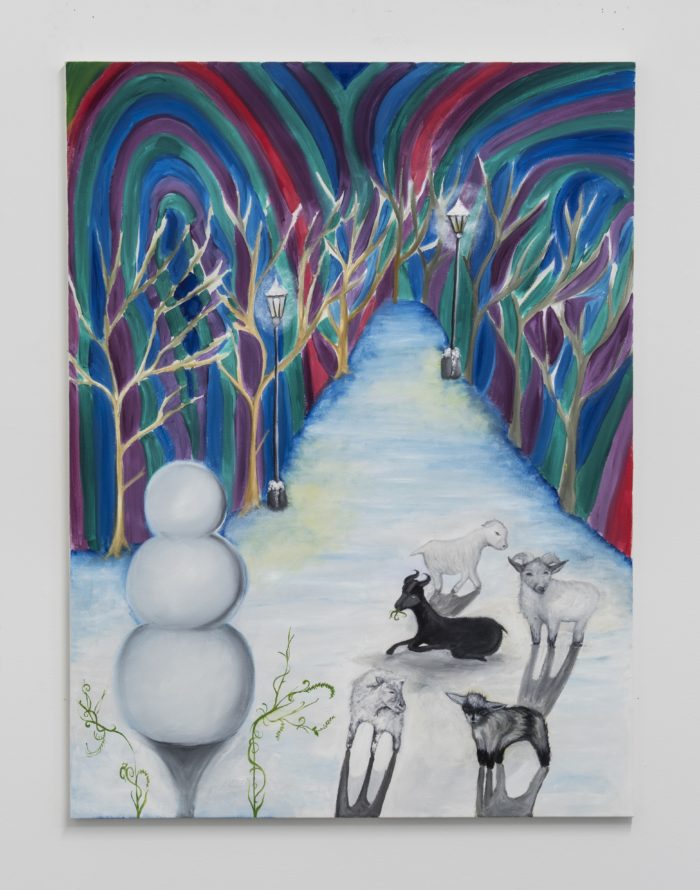
Curiosity piqued, I visited Matranga on her home turf, a Brooklyn studio connected to her apartment. She was at work on a new series, her Winter paintings. In part inspired by New York’s prolonged cold front, the images teased out all kinds of seasonal cliches from swirling cups of Starbucks to gingerbread houses. Now on view at The Loon gallery in Toronto, her new paintings served as an entrypoint for a conversation around her her intuitive practice.
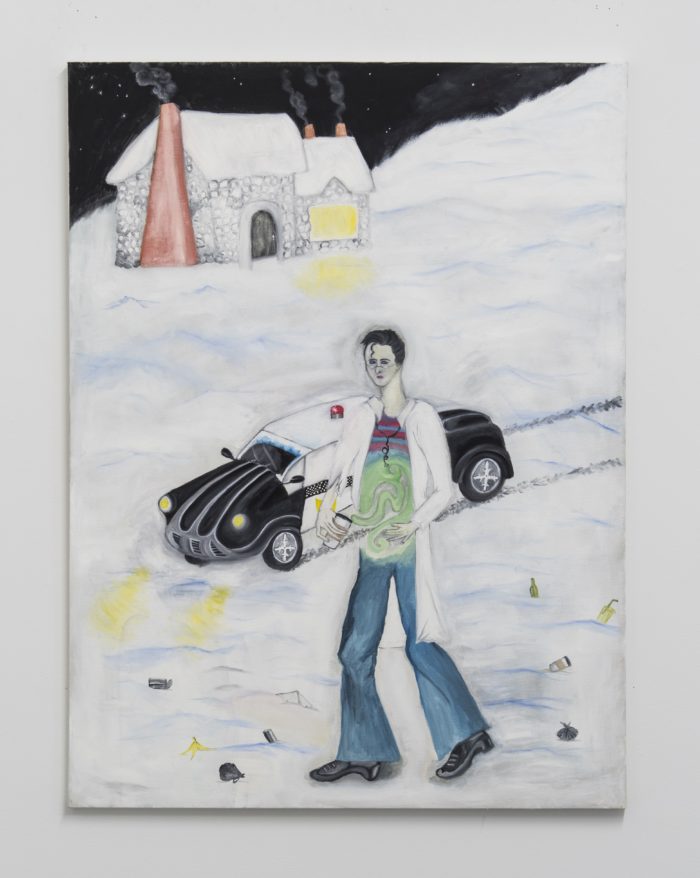
Garbage Doctor, 2018.

When you paint different characters like in your Winter series, you are painting from memory rather than images. How do you think this ultimately affects your subject matter? I use drawings to work out ideas quickly. I might also reference photos or memories and personal experiences and extrapolate from there. There’s a painting in this series about driving through a blizzard in a rental car looking for a Mennonite AirBnB in Pennsylvania. There’s also a painting called “Ciao!” The female character in it was originally based off of the character Lady Mary from Downton Abbey but ended up reminding me of a movie called “Mrs. Santa Claus” from 1996.
What first attracted you to painting as a medium? My father worked as a journalist for TV and music magazines in the 80’s and 90’s. He made great, humorous drawings of his interviewees that he shared with us at home.

Welcome To Our Pygmy Goats, 2018.

Do you see your compositions as narrative? If so how would you describe their genre? Yes, I think of them as narrative. My friend, Tim Gentles, once called them a form of domestic surrealism.

What role does comedy play in your work? Is it something you associate with relief or critique? Dan Graham recently told me, the secret of all great art is humor.


How do series like the toilets or winter function in your practice? When do you know a series is complete? By restricting my focus to one or two key elements per suite of works I can more easily go deep into creating that world than if my focus was less specific.
Finding the initial subject is the most difficult part of this process for me, but working in this way has been very generative. I usually end the series when I run out of new ideas for it. Then I know it’s ran it’s course.

We’ve Waited All Year For This…

Our 10th annual Young Artist list is here, comprised of 27 names you need to know ahead of 2026.

You’ve almost hit your limit.

You’re approaching your limit of complimentary articles. For expanded access, become a digital subscriber for less than $2 a week.
You’re approaching your limit of complementary articles. For expanded access, become a digital subscriber for less than $2 a week.

Already a Subscriber? Sign in Here

You’re approaching your limit of complementary articles. For expanded access, become a digital subscriber for less than $2 a week.

GET ACCESS

Already a Subscriber? Sign in Here

Want more in your life?

For less than the price of a cocktail, you can help independent journalism thrive.

Pop-Up-1_c
Already a Subscriber? Sign in Here
Pop-Up-1_c

Already a Subscriber? Sign in Here

Want more in your life?

For less than the price of a cocktail, you can help independent journalism thrive.

Pop-Up-1_c
Already a Subscriber? Sign in Here
Pop-Up-1_c

Already a Subscriber? Sign in Here

You’ve almost hit your limit.

You’re approaching your limit of complimentary articles. For expanded access, become a digital subscriber for less than $2 a week.

You’re approaching your limit of complementary articles. For expanded access, become a digital subscriber for less than $2 a week.
Already a Subscriber? Sign in Here
You’re approaching your limit of complementary articles. For expanded access, become a digital subscriber for less than $2 a week.

Already a Subscriber? Sign in Here

This is a Critics' Table subscriber exclusive.

Subscribe to keep reading and support independent art criticism.

Already a Subscriber? Sign in Here

Want more in your life?

For less than the price of a cocktail, you can help independent journalism thrive.

Pop-Up-1_c

Already a Subscriber? Sign in Here

Pop-Up-1_c

Already a Subscriber? Sign in Here

You’ve reached your limit.

Sign up for a digital subscription, starting at less than $2 a week.

Already a Subscriber? Sign in Here

Want a seat at the table? To continue reading this article, sign up today.

Support independent criticism for $10/month (or just $110/year).

Already a subscriber? Log in.